
Google Pomelli and AI Advisors Reshape Campaign Automation for Agencies
See what Google Pomelli and AI advisor tools mean for brands and AI marketing agencies running automated campaign workflows at enterprise scale.
16 December 2025Team COEY
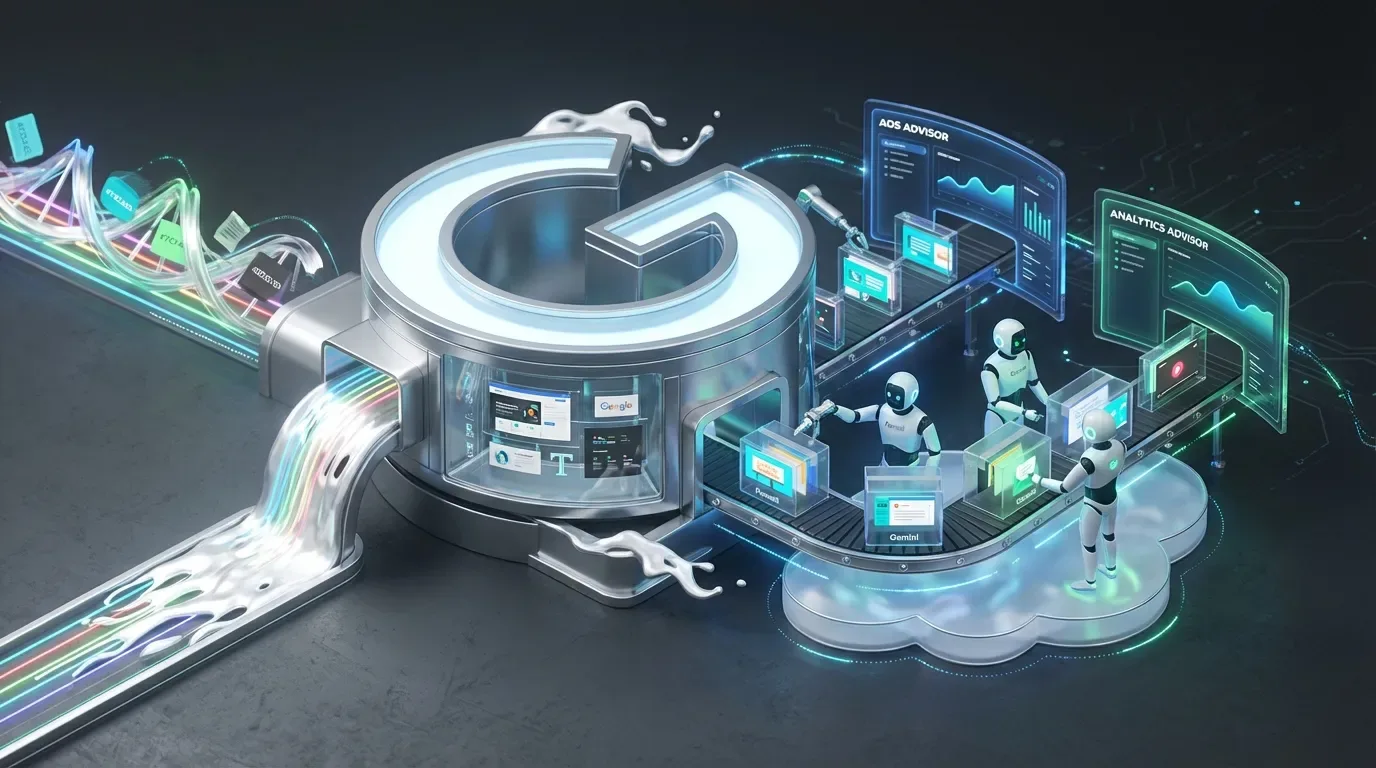
Google is making a clear bet: the next era of marketing isn’t “AI helps you brainstorm,” it’s AI manufactures on-brand campaigns and then helps run them. Two announcements show that direction from different angles: Pomelli, a Google Labs experiment that generates marketing assets straight from your website, and the new in-product AI assistants for Ads and Analytics, Ads Advisor and Analytics Advisor, which aim to compress the optimize-measure-iterate loop inside Google’s platforms.
COEY take: This isn’t “one more AI tool.” It’s Google trying to make your website the seed crystal for a repeatable, multi-format campaign factory, then pairing it with in-platform advisors that reduce the manual work of optimization and analysis. The missing piece (for now) is the one automation people actually want: clean APIs and push-to-channel execution.
Pomelli is an experimental marketing tool built by Google Labs in collaboration with Google DeepMind. The headline feature is “Business DNA”: you give Pomelli your website URL, and it extracts brand elements like tone, style, colors, fonts, and context directly from the site. From there, you can prompt it with something simple,“Create a Black Friday campaign”,and it generates editable assets for marketing use.
What happened: Pomelli turns your website into a campaign starter kit
What Pomelli actually produces
Pomelli is positioned as multi-channel collateral generation, with outputs designed to be edited before export. The key point isn’t that it generates copy (everyone does). The point is that it tries to generate consistent brand assets without requiring you to upload a brand kit.
| Capability | What it means in plain English | Automation readiness |
|---|---|---|
| Website-to-brand extraction (“Business DNA”) | Your site becomes the input brand guide: visuals + voice | High for speed; depends on how well your site reflects your true brand system |
| Prompted campaign generation | Ask for a theme or moment; get a set of assets back | Medium: you can scale variants, but still need human selection |
| Editable assets | Adjust text/visuals without redoing everything | High for real teams; “fix and ship” beats “prompt roulette” |
| Multi-format output (social/web/ads) | One brief, multiple placements | Medium: output exists, but distribution is still manual |
Automation lens: can Pomelli be plugged into a real workflow today?
Partially. Pomelli is a Google Labs product (currently in public beta in select countries and English), and its biggest current limitation is exactly what ops-minded teams care about: there is no announced public API for Pomelli and no direct “publish to platform” automation path.
What you can automate today (even without Pomelli APIs)
If you’re a creator, marketer, or exec trying to scale output, Pomelli can still fit into a broader automation system, but it’s a human-in-the-loop node for now.
Structured briefing: Use your existing systems (CMS, Notion, Airtable, etc.) to standardize campaign prompts and inputs, then generate in Pomelli.
Asset intake + routing: Export assets and route them into your DAM, shared drives, or review tools where approvals and versioning already live.
Variant testing workflow: Generate multiple variations, then move only the best ones into paid social testing and measurement.
What’s still locked (and what would need to happen)
To make Pomelli truly automation-grade, Google would need to expose at least three things:
A generation API: Submit URL + prompt + output spec → return assets programmatically.
Event hooks/webhooks: Let workflows react to “asset ready,” “render failed,” or “needs review.”
Publishing connectors: Direct push to Google Ads assets, YouTube, email platforms, and/or social schedulers.
Translation: Pomelli looks like a campaign factory, but today it’s more like a campaign workbench . You can move fast, but your hands are still on the wheel.
Multi-format relevance: Pomelli’s real promise is cross-media consistency
Most “AI marketing tools” are secretly text tools wearing a Canva hoodie. Pomelli’s “Business DNA” idea matters because it’s trying to unify:
Text: Voice inferred from site copy (useful, but risky if your site copy is outdated or inconsistent).
Photo/design: Visual cues from existing brand presence (better than blank-slate generation, but can inherit bad design decisions).
Video: The bigger Google ecosystem has serious generative video capability via Veo. Veo is available to developers via the Gemini API in paid preview (e.g., Veo 3.1 + Gemini API ), but Pomelli’s direct, programmable linkage to Veo is not the same as “you can run this headless.”
Audio: Not a primary Pomelli story yet, which means the “full-stack creative output” dream still needs separate voice/music tooling. (Separately: Veo 3.1 itself includes native audio generation , but that’s a Veo capability, not necessarily a Pomelli feature.)
Google Ads adds Advisors: optimization and measurement get an AI layer
Alongside Pomelli, Google is rolling out two in-product assistants: Ads Advisor inside Google Ads, and Analytics Advisor inside Google Analytics. These are built on Gemini models and aim to help with recommendations, reporting, insights, and troubleshooting. Per Google, they’re rolling out broadly to English-language Google Ads and Google Analytics accounts.
Ads Advisor: closer to “agentic” campaign management (with approvals)
Ads Advisor is designed to surface recommendations based on your current campaigns, performance, and business context, like suggesting improvements and helping troubleshoot issues (including policy-related questions). Importantly, the framing is “help you do and decide,” not “fully run campaigns without oversight.” That’s the right posture for teams that care about budget and risk.
Analytics Advisor: faster insight extraction without spreadsheet marathons
Analytics Advisor brings conversational analysis and automated insight generation into Google Analytics: summaries, visualizations, trend/anomaly detection, and “why did this spike?”-style investigation.
| Assistant | Best at | What it replaces | Automation gap |
|---|---|---|---|
| Ads Advisor | Suggestions, troubleshooting, asset/keyword ideation | Manual audits + “what should we do next?” meetings | No public “Advisor API” to run this as a background automation |
| Analytics Advisor | Explaining trends, summarizing performance, generating insights | Manual report building and interpretation | Not yet a programmable analyst you can call from your stack |
Automation lens (again): what about APIs and integrations?
Here’s the practical reality: Google already has robust “classic” automation surfaces, like the Google Ads API, which supports programmatic campaign management and reporting. That is production-grade automation.
But the new Advisors themselves are not the same thing as the Ads API. The Ads API lets you build and manage campaigns. The Advisors are an AI layer inside Google’s UI that helps humans decide faster.
What you can do today
Use Advisors for human acceleration: faster audits, faster insight summaries, fewer “blank page” moments.
Use Google Ads API for real automation: automate reporting, budget adjustments, large-scale campaign updates, custom dashboards.
What you can’t do yet (but teams will ask for)
Run Ads Advisor headlessly as a scheduled “weekly optimization agent” that executes across accounts.
Trigger Analytics Advisor from your BI stack (e.g., “Explain anomaly and post to Slack”) as a first-class integration.
Exec-level translation: Google’s AI help is getting better inside Google. But if you want it to plug into your stack (Slack, your dashboards, your automation tools), you still mostly need the traditional APIs, or you wait for the “Advisor layer” to become programmable.
What this means for creators, marketers, and media builders
For creators and small teams: speed without a full ops rebuild
Pomelli is attractive because it reduces the “brand kit admin tax.” If your website is up-to-date and reflects your real design system, Pomelli can accelerate asset creation quickly. But expect manual export and manual publishing for now.
For marketing leaders: the new differentiator is throughput with governance
The competitive edge isn’t “we used AI.” It’s:
How fast you can create on-brand variants
How safely you can publish them
How quickly you can learn and iterate
Pomelli supports the first part. Ads/Analytics Advisors compress the learning loop. The missing piece is still the same: end-to-end automation with guardrails and audit trails.
For automation-first orgs: watch for convergence
Google is building toward a world where:
Your website seeds brand identity (“Business DNA”).
Campaign assets are generated and adapted across formats.
Optimization and measurement are assisted by in-platform AI.
The moment this becomes a true workflow platform is the moment Google exposes more of it via APIs and integrations, especially if Pomelli can write assets directly into Ads, and if Advisor insights can be triggered programmatically.
The COEY bottom line
Pomelli is a smart signal: Google wants brand-consistent campaign creation to start from the web presence you already maintain, not from yet another folder of “final_FINAL_brandguide_v7.pdf.” Ads Advisor and Analytics Advisor signal the next layer: AI-mediated optimization and faster insight extraction where spend decisions actually happen.
Still: don’t confuse “AI in the UI” with “automation-ready infrastructure.” Today, Pomelli is promising but mostly manual. The Advisors are powerful but in-platform. The real automation backbone remains the classic Google Ads API, and the next unlock will be making these new AI layers programmable, so they can plug into the workflows that actually scale.
COEY Builds This
We help brands and agencies automate content creation and marketing operations by connecting the right AI tools into workflows that actually work. From n8n pipelines to Claude Cowork setups, our AI automation team handles the wiring. Request a proposal.