GPT Image 1.5 Makes Image Ops 4x Faster
GPT Image 1.5 makes image ops 4x faster on the API. What it unlocks for AI marketing automation and high throughput ad creative generation at scale.
17 December 2025Team COEY
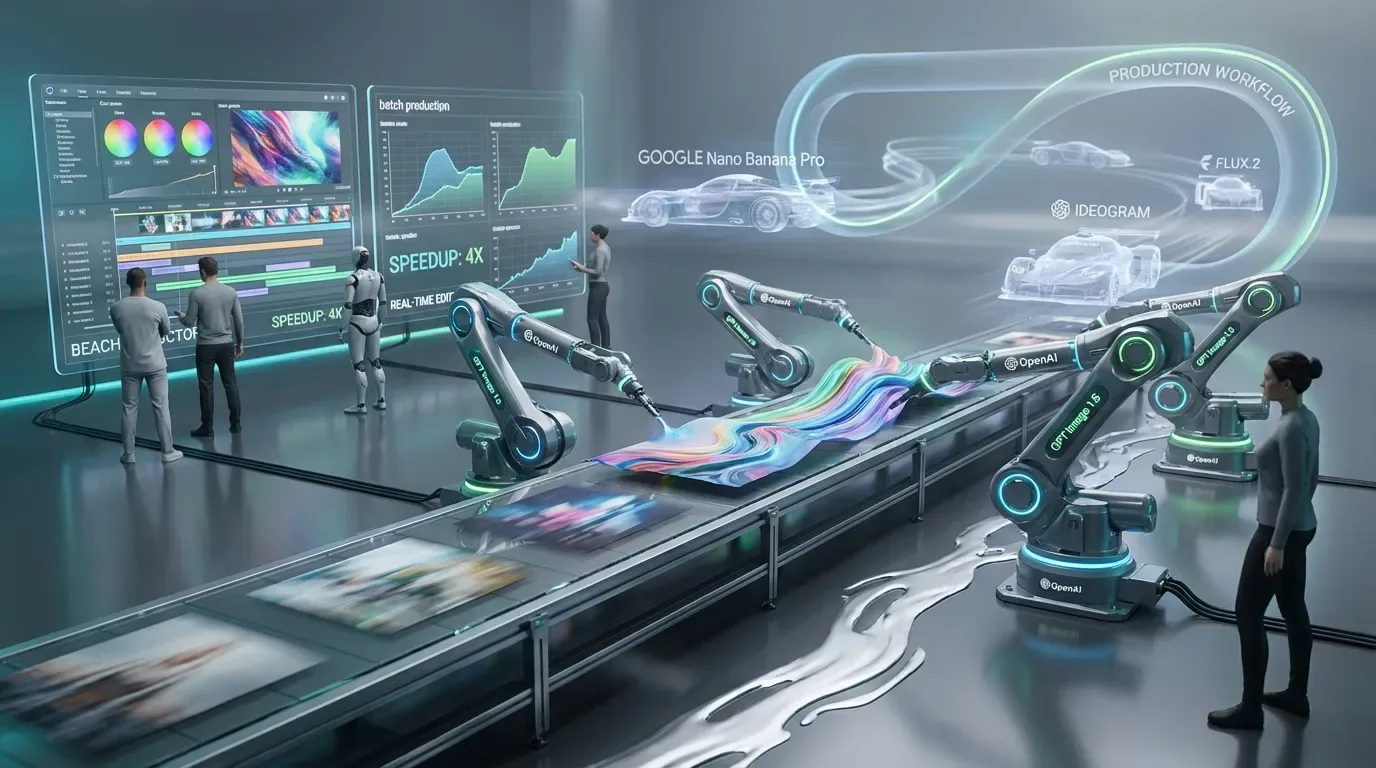
OpenAI just shipped an updated image generation stack for ChatGPT and developers, with the headline feature that actually matters in real teams: it’s up to 4x faster at generating images. Not “slightly snappier.” Not “feels faster.” A real throughput upgrade that turns image generation from “creative side quest” into something you can run inside an automation lane.
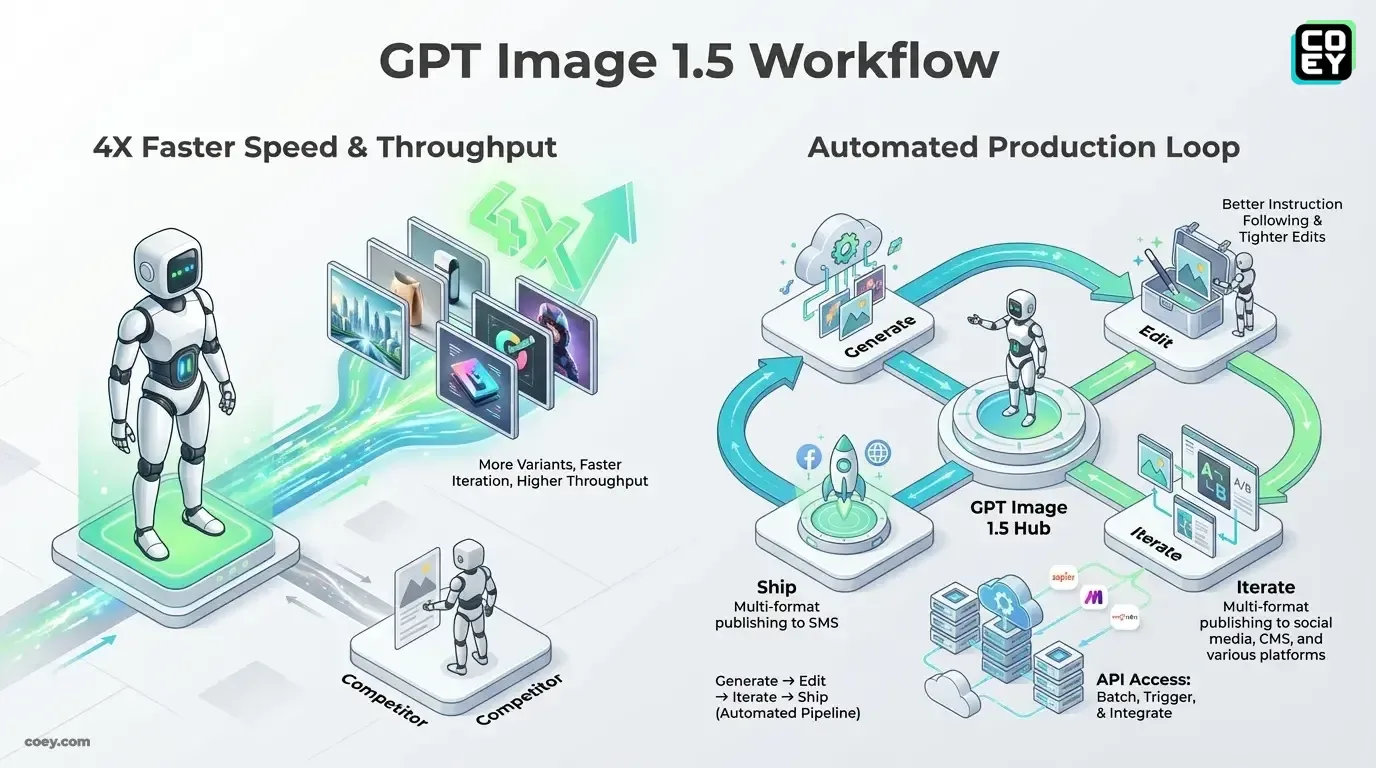
And yes, our internal testing still gives the edge to Google’s Nano Banana Pro on photorealism and text in image. But OpenAI’s move is less about beating one rival screenshot for screenshot and more about winning the production loop: generate, edit, iterate, ship. Speed changes behavior. Behavior changes operations. Operations change who scales.
What actually shipped
GPT Image 1.5 lands as an upgrade to OpenAI’s image stack inside ChatGPT, and it’s also available to developers via the API. OpenAI is pitching it as an improved “Images” experience: faster generation, better instruction following, and a smoother edit loop that’s increasingly “creative studio” vibes instead of “paste prompt, pray.”
Coverage has emphasized that the upgrade isn’t just raw rendering speed. It’s also about keeping details stable across edits and improving text rendering (still hard, still imperfect, but noticeably less cursed than older generations). TechCrunch’s write-up framed it as part of OpenAI’s “code red” push against Google’s recent image momentum, which tracks with what the market’s been feeling: image models are now shipping like weekly SaaS features, not annual research events.
The real headline: image generation is becoming latency sensitive infrastructure. Once it’s “near instant,” you stop treating it like a special request and start treating it like a button your systems can press.
What’s new for teams who ship
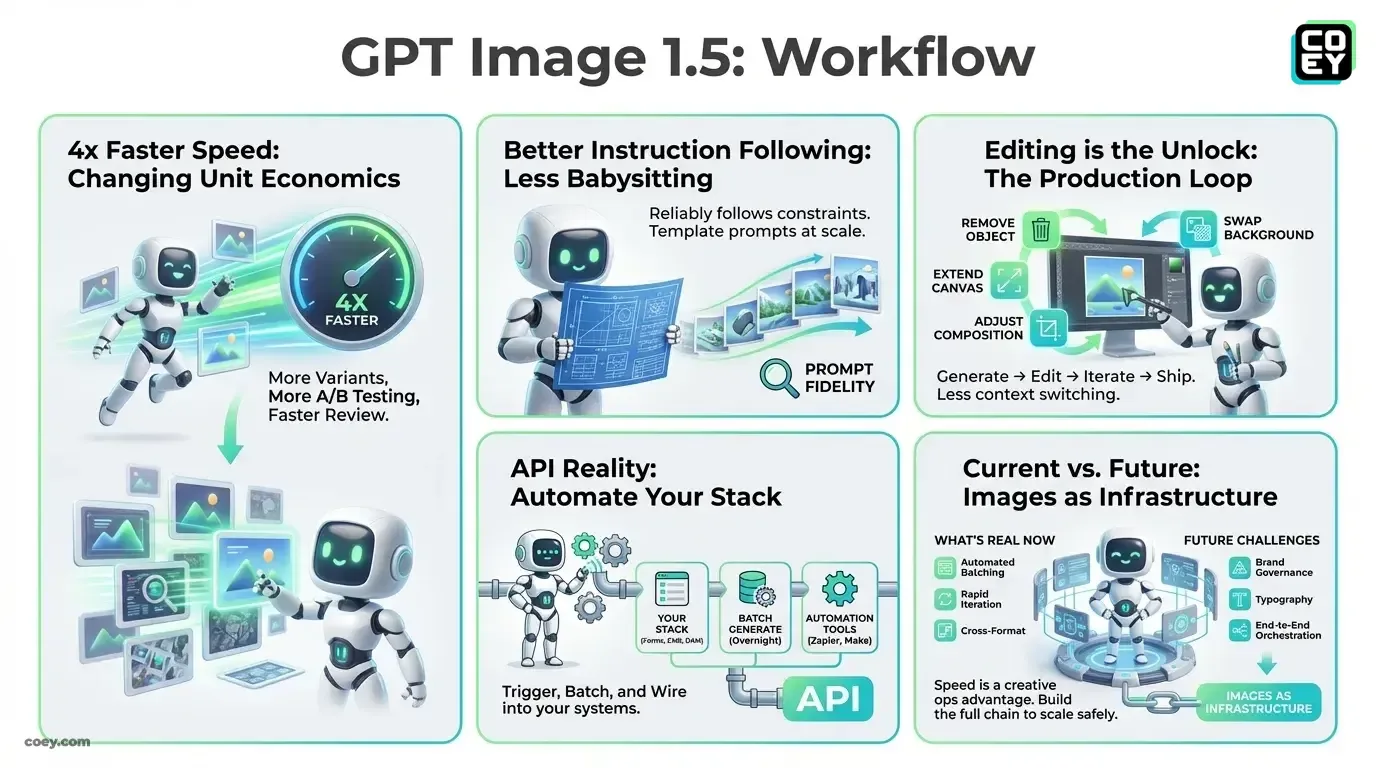
1) Speed changes the unit economics
“Up to 4x faster” sounds like a spec sheet flex until you map it to actual production behavior:
More variants per brief without blowing timelines
More A/B creative testing because iteration isn’t painful
More human in the loop review because humans can review 30 options in the time it used to take to generate 8
Fast generation doesn’t magically make outputs better. It makes your selection process better because you get more shots at a good answer.
2) Better instruction following equals less prompt babysitting
OpenAI is leaning hard into “prompt fidelity,” which is a quiet but important operational shift. The more reliably a model follows constraints (layout, style cues, subject requirements), the more you can template prompts and run them at scale.
That’s the difference between:
Inspiration tool: great when a designer is driving
Production tool: viable when a workflow engine is driving
3) Editing is the unlock, not generation
In the real world, brands don’t just need “new images.” They need: remove object, swap background, extend canvas, fix the one weird thing legal noticed, localize text, adjust composition for a new placement. GPT Image 1.5 continues OpenAI’s push toward a tighter editing loop inside ChatGPT. Less context switching, more iteration in one place.
This matters because automation isn’t only “make image.” Automation is “make image, then make 20 versions without rebuilding from scratch.”
API reality: can this be automated?
Yes. GPT Image 1.5 is not just a UI toy. OpenAI provides image generation via its API stack, and the current model documentation centers on gpt-image-1. (OpenAI’s public API docs and examples still reference gpt-image-1 as the model name; product marketing may describe the ChatGPT upgrade as GPT Image 1.5.)
For non technical teams, translate “API access” as:
You can trigger it from your stack (forms, spreadsheets, CMS, product feeds, DAM)
You can batch it (generate 200 thumbnails overnight, not one at a time in a browser)
You can wire it into automation tools (Zapier, Make, n8n via HTTP modules, webhooks, or custom connectors)
| Workflow step | Is it automatable today? | What’s still human work |
|---|---|---|
| Generate image variants | Yes (API plus batch) | Selecting winners (unless you add scoring or QA) |
| Edit existing assets | Mostly (API supports edits; UI is smoother) | Mask precision and art direction still benefit from humans |
| Publish to channels | Depends (your CMS, DAM, ad platform APIs) | Approvals, legal, final brand sign off |
How it stacks up vs late 2025 rivals
This is the part where people want a single winner. Sorry. The winner depends on what you’re optimizing for: speed, realism, typography, or controllable edits.
OpenAI GPT Image 1.5 vs Google Nano Banana Pro
Our internal tests still align with the market chatter: Nano Banana Pro looks better more often especially on photoreal humans and text clarity. Google has positioned Nano Banana Pro as its latest image generation and editing model across Gemini surfaces, with access via the Gemini app and developer tooling (including Google AI Studio and Gemini APIs, depending on account and region).
But OpenAI’s edge is the workflow feel: fast generation, tight ChatGPT integration, and an increasingly “just do the edit” experience. If your team ships a lot of creative and your bottleneck is iteration speed, that matters.
OpenAI GPT Image 1.5 vs FLUX.2
Black Forest Labs’ FLUX.2 is the other major signal in the last couple months: image generation framed explicitly as programmable infrastructure, with strong control features and hosted API options. If your org’s priority is repeatability (brand consistency, multi reference control, automation grade parameters), FLUX.2 is a serious consideration especially for teams building their own pipelines rather than living fully inside ChatGPT.
If you want the deeper breakdown, COEY already covered this angle in FLUX.2 Makes Image Generation Finally Automatable.
What about Ideogram?
Ideogram continues to be the “text in image specialist” brand in many creator circles, and their own product pages still center that differentiation. Their platform has pushed hard on design-y outputs, typography control, and poster or logo style workflows (which is exactly why it remains sticky for brand graphics use cases). Official product framing: Ideogram 2.0 overview.
Current vs. future: what you can do today
What’s real right now
Automated creative batching: generate image sets for social, blog headers, thumbnails, and ad variants from structured inputs
Rapid iteration loops: faster creative review cycles because waiting time drops
Cross format support work: images become inputs to video (thumbnails, storyboards) and audio packaging (cover art, promo graphics) pipelines
What’s still not “set it and forget it”
Brand governance isn’t shipped by default: you still need your own rules for logos, forbidden claims, sensitive categories, and accessibility checks
Text in image is better, not solved: “usable” is rising, “pixel perfect typography” is still a specialized lane
End to end orchestration is on you: OpenAI gives you generation plus editing. Your stack still needs routing, QA, approvals, storage, and publishing connectors.
Automation isn’t a feature. It’s a chain. GPT Image 1.5 strengthens the “generate and iterate” links but you still need the rest of the chain to scale safely.
Multi format implications: images are the hub
Even though this is an “image model” release, it affects the whole content engine:
Text to Image: use LLM written structured briefs to mass produce on brand visuals (blog headers, offer tiles, carousel panels)
Image to Video: generate key visuals and thumbnails, then hand them to video tools for motion (or use them as storyboard frames)
Image to Audio packaging: consistent cover art and promo cards remove friction for podcasts, webinars, and audio first drops
The meta trend: when images become fast and API addressable, they stop being “design time” and start being “compute time.” That’s how human creativity scales. Humans set intent and taste, machines handle the grind and the variants.
Bottom line
GPT Image 1.5 is OpenAI making a clear bet: speed is a creative ops advantage. Not because faster images are inherently better, but because faster iteration makes teams more experimental, more test heavy, and more likely to build real automation around visual production.
If your priority is photoreal fidelity and rock solid text rendering, Nano Banana Pro still looks like the stronger “finals” model in many scenarios. If your priority is throughput, tight editing loops, and getting image generation into repeatable workflows, GPT Image 1.5 is a meaningful step toward treating visuals like infrastructure.
Modernize Your Marketing With AI Agents
COEY deploys coordinated AI agent teams using n8n, Claude Cowork, and OpenClaw that compress marketing timelines from weeks to hours. See how our agentic automation works across every marketing channel, or request a proposal.