
ChatGPT Apps Directory Makes Chat a Work OS
ChatGPT Apps Directory makes chat a work OS. What the new surface unlocks for AI marketing automation, distribution, and assistant native product ops.
18 December 2025Team COEY
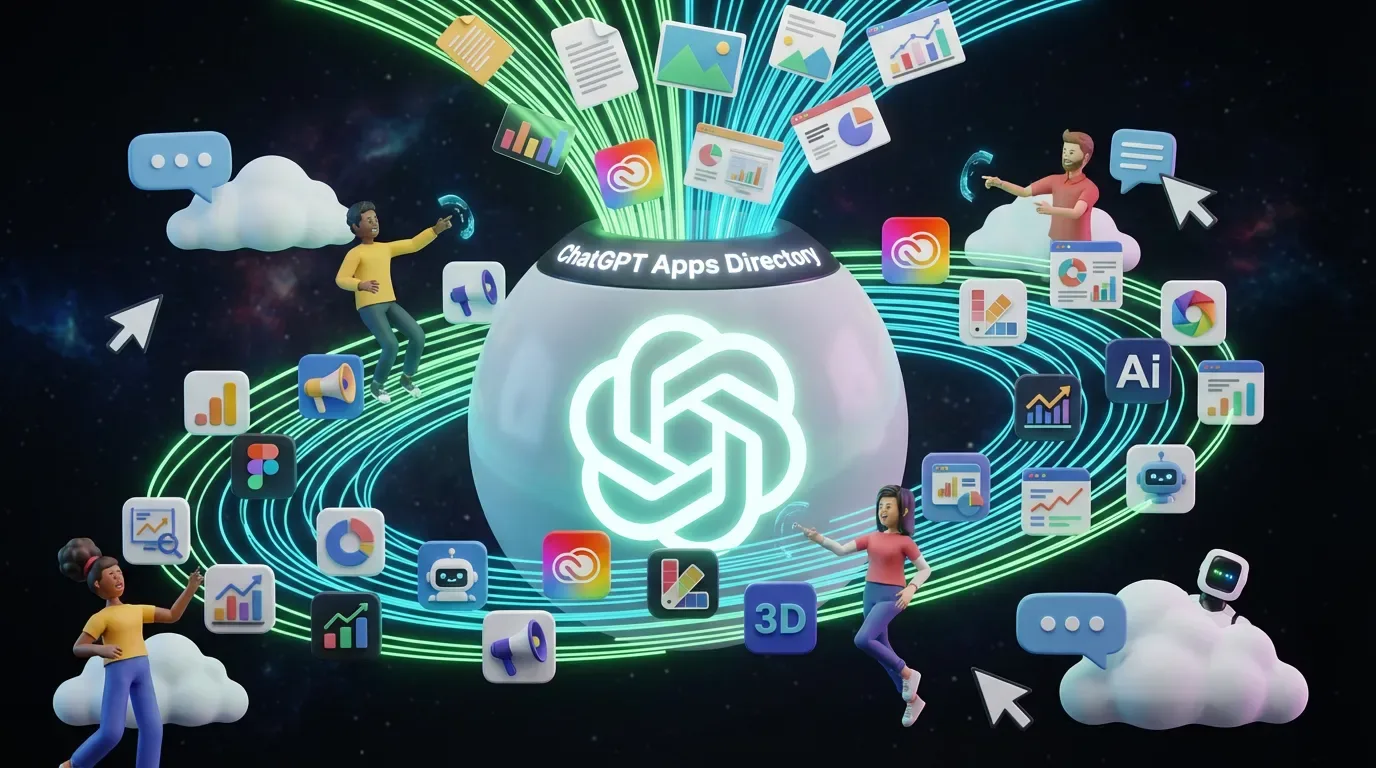
In its latest push to make ChatGPT less “smart autocomplete” and more “do the work,” OpenAI has launched an in product Apps Directory for ChatGPT, a built in place to discover and connect third party apps that run directly inside your conversations. Think: the app store energy, but optimized for getting marketing, content, and ops tasks done without the tab hopping cardio.
The headline isn’t “new marketplace.” The real news is that ChatGPT is becoming an interaction layer for your tool stack, where you ideate, execute, and ship. If you’ve ever thought “why am I writing the strategy in ChatGPT, then copying it into five other tools like it’s 2013,” this is OpenAI trying to close that loop.
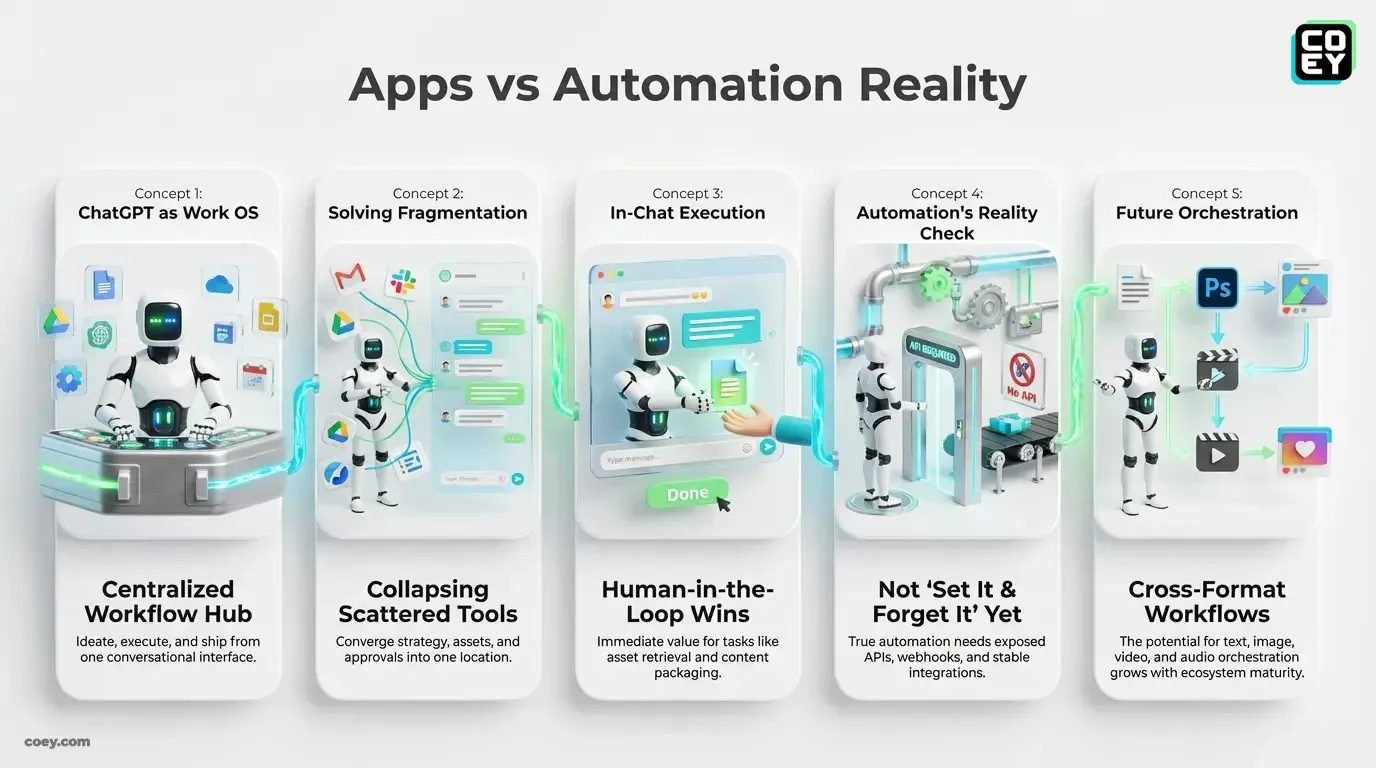
The practical shift: ChatGPT is positioning itself as the front door to your workflows, less of a destination, more of an operating system for creative output.
What the Apps Directory actually is
The Apps Directory is accessible inside ChatGPT and also lives at chatgpt.com/apps. Users can browse apps by category, connect them, and then invoke them inside a chat using an @ mention style interaction (or selecting from the tools menu), so actions happen in the same conversational thread where the request was made. OpenAI’s help docs outline how apps work, what permissions they request, and how to manage them (Apps in ChatGPT).
This matters because “apps inside the chat” is a different promise than “ChatGPT can suggest what you should do.” It’s closer to: “ChatGPT can do it, in the system where it needs to be done.”
From plugins to GPTs to apps (and why this is different)
If you remember the plugin era: limited inventory, clunky selection, and often a “click out to finish the job” vibe. Apps move in the opposite direction, more embedded, more discoverable, and more likely to feel like part of the product rather than an awkward bolt on.
OpenAI is also explicitly opening the door to developer submissions, with guidelines and review requirements that look a lot like “we’re building a platform now” (Developers can now submit apps to ChatGPT).
Why marketers should care (beyond “cool”)
Most marketing teams don’t have an AI problem. They have a workflow fragmentation problem. Strategy lives in docs, assets live in drives, approvals live in email or Slack, performance lives in dashboards, publishing lives in yet another tool. The Apps Directory is OpenAI’s attempt to make ChatGPT the place where those threads converge.
Here’s the real world implication: the more your stack is connectable, the more your creative throughput can be automated without turning your team into full time integrators.
Where this hits first: the boring but expensive tasks
This isn’t about replacing creative direction. It’s about collapsing the time between intent and execution:
Asset retrieval: “Pull the latest product shots” stops being a scavenger hunt.
Content packaging: One prompt can generate variants, attach assets, and prep handoffs.
Reporting: Summaries and slides move closer to real time instead of Friday night rituals.
Approval loops: Less copy and paste, more “here’s the thing in context, approve or revise.”
In other words: less time doing “marketing operations cosplay,” more time doing actual marketing.
Automation lens: can this plug into your stack?
Yes, sometimes. But with a big asterisk: apps inside ChatGPT aren’t automatically automation ready in the way Zapier, Make, or n8n users mean it. There are two different automation layers here:
1) In chat execution (available now)
This is the immediate win: actions triggered in the conversation. If your team already works in ChatGPT, apps reduce friction and keep context intact. The “automation” is human in the loop: a marketer prompts, ChatGPT performs actions through the connected app.
This is operationally valuable today for teams that:
already live in ChatGPT for drafting, planning, or analysis
need fewer handoffs between ideation and execution
want a single place to orchestrate assets plus instructions plus output
2) System automation (partially available, not universal)
This is what everyone really wants: triggers, webhooks, scheduled runs, and pipeline behavior. Content moves from brief to draft to design to publish to report without a human summoning it each time.
Apps can support this if the underlying services expose APIs, webhooks, or stable integrations. But ChatGPT apps themselves don’t magically grant automation if:
the third party tool doesn’t offer an API
auth scopes are limited to interactive use
actions require UI only confirmations
outputs aren’t structured for downstream systems
In short: ChatGPT is becoming the cockpit, but your stack still needs an engine.
Reality check table: what’s automatable?
| Workflow area | What you can do today | What’s still blocked |
|---|---|---|
| Campaign planning | Draft briefs, calendars, variants in chat with connected context | Auto pushing plans into PM tools without manual confirmation (depends on app plus API) |
| Asset operations | Pull and store files via connected services inside ChatGPT | Full DAM style governance, metadata standards, bulk lifecycle automation (often outside ChatGPT) |
| Creative production | Generate copy, concepts, outlines, scripts, then route into tools | End to end generate to render to publish without human review (brand plus platform risk) |
| Reporting | Summarize performance, build narratives, draft stakeholder updates | Reliable always on dashboards inside ChatGPT without analytics APIs plus clean schemas |
Multi format impact: text, images, video, audio
The Apps Directory is most obviously a text workflow accelerant, but the bigger play is cross format orchestration.
Text: briefs, scripts, variants at scale
If your bottleneck is “we need 40 variants for 6 audiences across 3 channels,” ChatGPT plus connected apps turns that into a packaging problem instead of a writing problem. The human role shifts upmarket: taste, judgment, approvals, and performance learning.
Images: creation and revision get closer to the prompt
One of the clearest signals that this is heading beyond text: Adobe has integrated Photoshop, Adobe Express, and Acrobat into ChatGPT, per Reuters (Adobe plugs Photoshop, Acrobat tools into ChatGPT). This integration was announced as being available across desktop, web, and iOS, with Android support fully available for Adobe Express and additional Adobe tool support expected to roll out to Android.
Video: the handoff tax starts shrinking
Video is where automation usually dies, because editing, versioning, and review workflows are messy. Apps won’t solve that overnight, but they can reduce the friction around:
shot lists and scripting
captioning and packaging
thumbnail and title variant generation
publishing checklists and QA
Audio: voice workflows become more operational
For pods, ads, and voice content: “summarize,” “clip,” “title,” “write show notes,” and “generate promo copy” can become routine, with assets and approvals staying inside a single thread, assuming the connected tools support file access and export.
What teams can do now vs. what’s still future
Current: ChatGPT becomes the workflow hub
Right now, the win is centralization: using ChatGPT as the place where decisions, drafts, and actions live together. That alone removes a ton of creative drag, especially for lean teams.
If you want immediate readiness, aim for:
repeatable prompts (brief templates, variant generators, reporting formats)
permission hygiene (who can connect what apps, and for which clients)
structured outputs (tables, JSON like formatting, consistent naming) so downstream tools can use it
Future: true orchestration depends on APIs plus standards
To get to “set it and forget it” automation, a few things need to mature:
More apps with real APIs and webhook support (not just interactive inside chat)
Stronger admin and governance controls for enterprise teams (auditing, policy, client separation)
Better structured data exchange so outputs don’t die as unstructured text blobs
This is where hype tends to creep in. “Apps Directory” doesn’t automatically mean “autopilot.” It means the interface is ready. The ecosystem has to catch up.
The bottom line for brands and creators
OpenAI’s Apps Directory is a platform move dressed up as a convenience feature. For creators and marketers, it’s a step toward the thing everyone wants: a single place where creative intent turns into shipped work across text, design, files, and reporting.
But the automation upside is only as real as your integrations. If your tools expose APIs and your workflows are standardized, ChatGPT apps can meaningfully compress cycle times. If your stack is still a bunch of closed SaaS islands, you’ll get smoother interactions, just not full automation.
Either way, the direction is clear: the conversation is no longer just where ideas happen. It’s increasingly where production happens.
Turn AI News Into Marketing Advantage
COEY turns the latest AI developments into real marketing firepower. We deploy n8n workflows, Claude Cowork agents, and OpenClaw pipelines that keep your channels running and your team focused on strategy. See our automation approach or request a proposal.