
Salesforce Agentforce Sales Lands Inside ChatGPT
Salesforce Agentforce Sales lands inside ChatGPT. What that shift means for AI marketing automation, pipeline, and assistant native sales workflows.
19 December 2025Team COEY
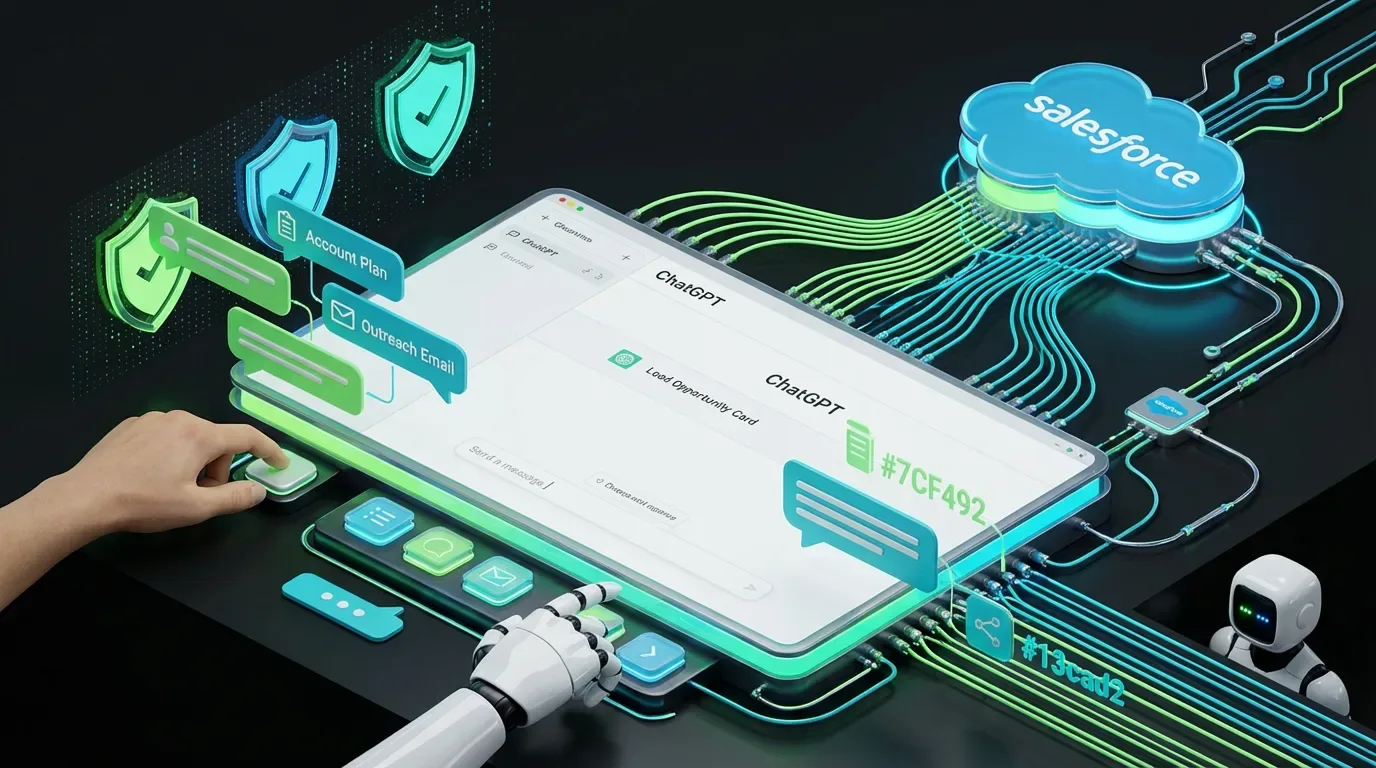
Salesforce just made the “CRM tab” optional. Salesforce announced Agentforce Sales for ChatGPT, an app that lets revenue teams query and update Salesforce from inside ChatGPT, without paying the daily toggle tax between tools. Coverage hit quickly, including MarTech’s report on what’s live and why it matters.
This is not another “AI writes your email” feature. It’s Salesforce pushing CRM actions into the same interface where teams already brainstorm, draft, analyze, and plan. If ChatGPT is becoming a work OS, Agentforce Sales is Salesforce’s attempt to be the database of record and the action layer, right where humans and machines collaborate.
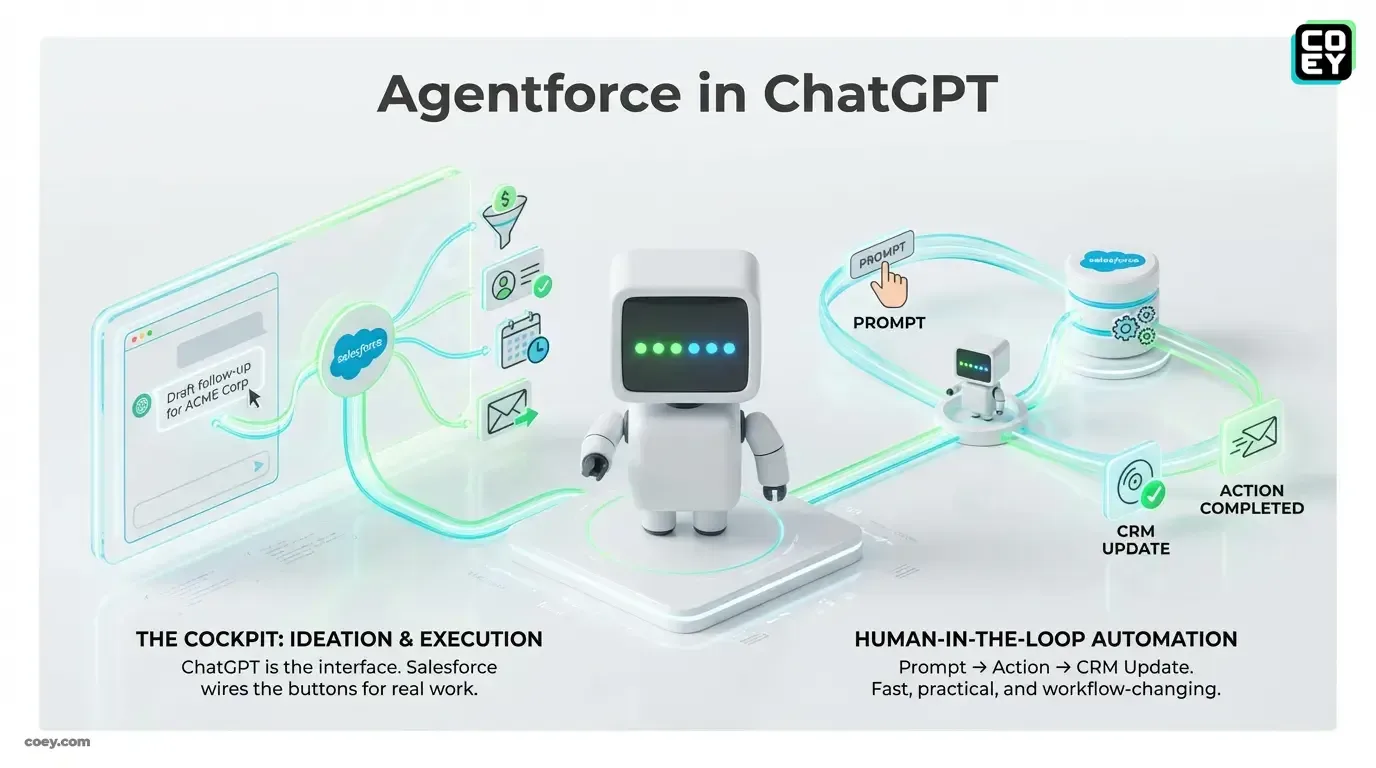
Translation: ChatGPT is the cockpit. Salesforce is wiring the buttons.
What launched (and why now)
Agentforce Sales for ChatGPT appears as an official app in ChatGPT’s app directory. After authentication, users can pull live CRM context (leads, opportunities, account activity) and run Salesforce actions from a conversational prompt. That’s the headline: ideation plus execution in the same thread.
Salesforce has been telegraphing this direction since its broader Agentforce push, agents that do not just suggest, but do. The timing is perfect: sellers and marketers increasingly start work in chat (plans, messaging, research) and then lose 30 minutes turning it into “real work” inside CRM. Salesforce wants those 30 minutes back.
How it works in practice
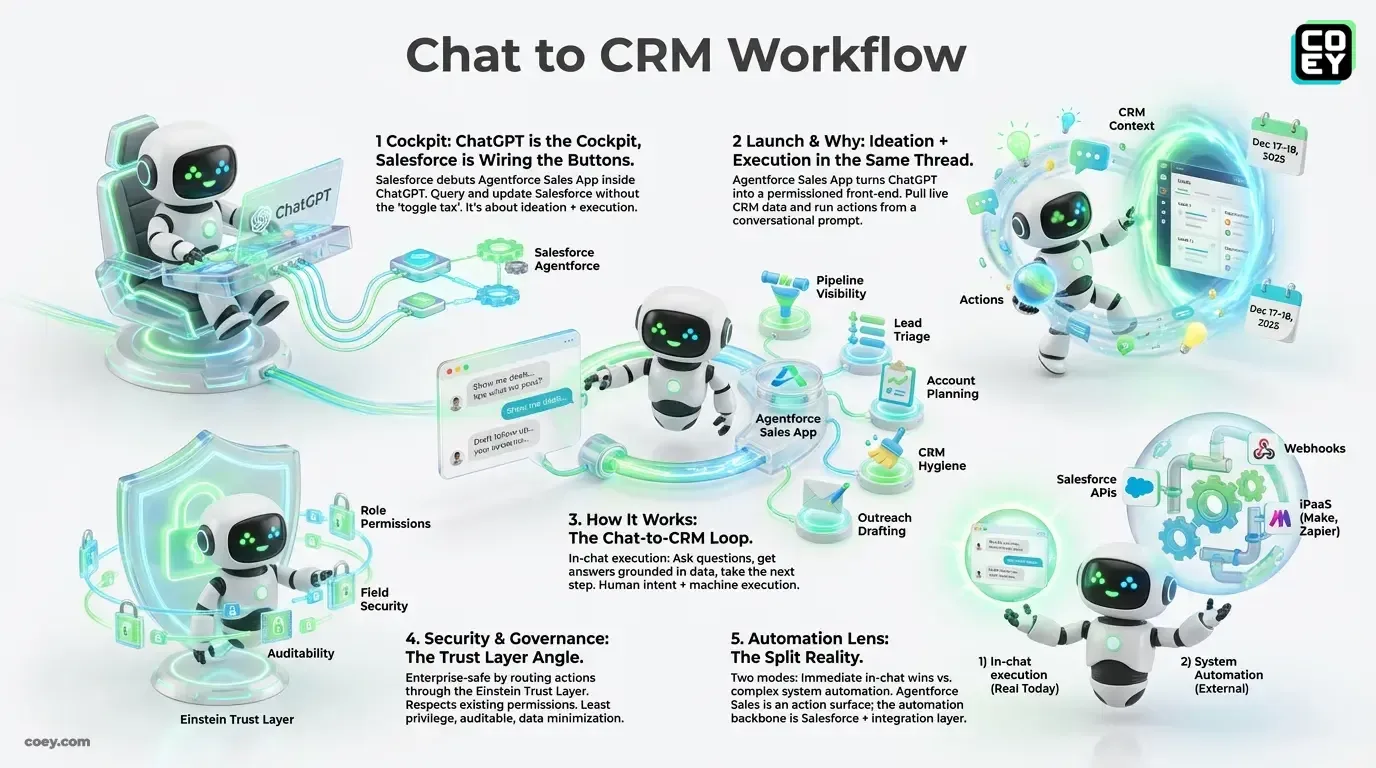
Functionally, Agentforce Sales turns ChatGPT into a permissioned front end for Salesforce. Ask questions, get answers grounded in your org data, then take the next step: update a field, create an activity, generate an account plan, draft outreach using actual deal context.
Typical actions teams will use first
Pipeline visibility: “Show me deals over $50K stuck in negotiation.”
Lead and work queue triage: “List uncontacted leads from last week’s webinar.”
Account planning: “Build an account plan for ABC Corp with risks plus next steps.”
CRM hygiene: “Update opportunity stage to ‘Proposal’ for these 12 accounts.”
Outreach drafting: “Draft follow ups for these leads using their latest activity.”
The significance is not that these tasks are new. It is that they’re now unified into a single conversational flow where the human intent and the machine execution can stay connected: prompt, context, action, log, repeat.
Security and governance: the Trust Layer angle
Salesforce is positioning this as enterprise safe by routing actions through its AI governance layer. Practically, the app is designed to respect the same role permissions, field level security, and access controls you already enforce in Salesforce.
This matters because “ChatGPT plus CRM” is a CIO jump scare if it’s not scoped. The viability of agentic CRM is less about IQ and more about guardrails. Salesforce’s framing leans on the Trust Layer concept, including controls like data handling, masking, and auditing patterns described in the Salesforce Trust Layer documentation.
Least privilege: the agent cannot read or write what the user cannot.
Auditability: teams need a record of what changed and why.
Data minimization: only pull what is needed to answer or act.
In other words, the governance story is what makes this feel production leaning rather than demo grade.
Automation lens: can this be automated?
Yes, but with a split reality. There are two different “automation modes” here, and confusing them is how teams end up disappointed.
1) In chat execution (real today)
This is the immediate win. A rep prompts. ChatGPT calls the Agentforce Sales app. Salesforce data comes back. Actions can be taken. It’s human in the loop automation, fast, practical, and already workflow changing for teams living in ChatGPT.
2) System automation (partially today, mostly external)
What most ops leaders want is scheduled runs, triggers, webhooks, and set it and forget it flows. Agentforce Sales inside ChatGPT is not automatically that. For full automation, you will still rely on your existing stack:
Salesforce APIs (REST, SOAP, Bulk) and automation primitives (Flow, Apex)
iPaaS and no code tools (Make, n8n, Zapier) using Salesforce connectors
Eventing and webhooks via Salesforce platform events or middleware
The pragmatic take: Agentforce Sales is an action surface. Your real automation backbone is still Salesforce plus your integration layer.
What’s real now vs. what’s still gated
| Area | What’s real today | What still needs to open up |
|---|---|---|
| CRM actions in chat | Query plus update Salesforce objects from ChatGPT with permissions (currently in open beta) | Richer admin controls for standardizing approved actions and templates |
| Workflow automation | Automate via Salesforce plus iPaaS; use ChatGPT as the human interface | More native trigger and schedule semantics tied directly to ChatGPT app actions |
| Cross cloud expansion | Sales focused functionality first (per announcement coverage) | Deeper coverage for Marketing Cloud, Service Cloud, Data Cloud flows in chat |
Multi format implications: it’s not just email
Salesforce did not ship a “video agent” here, but the integration changes how multi format creative gets produced because it collapses the gap between customer context and asset output.
Text: outreach emails, LinkedIn messages, call scripts, follow up sequences grounded in CRM reality.
Slides: account plans and QBR narratives drafted in chat, then moved into decks with fewer manual copy steps.
Audio: call prep, talk tracks, and post call summaries become easier when CRM context is one prompt away.
Video: not generated by this app, but the inputs for video (persona pain points, objections, deal stage) can be pulled and structured instantly, then handed to your video toolchain.
The real creative scale play is that CRM becomes the live brief. Every asset, text, audio script, video outline, starts from accurate context, not vibes.
Who benefits (and who should be cautious)
Revenue teams that will feel it immediately
Sales reps: less admin, faster follow up, fewer broken handoffs between thinking and logging.
Sales managers: faster pipeline inspection and coaching moments, especially if adoption sticks.
Marketing ops: better alignment between campaign activity and CRM action, if governance is tight.
Teams that should slow roll it
Regulated industries: you will want stricter approval workflows for outbound copy and stronger audit trails.
Messy Salesforce orgs: if your CRM data is a junk drawer, Agentforce will faithfully accelerate the chaos.
Bottom line: the chat to CRM loop closes
Agentforce Sales inside ChatGPT is one of the clearest signals yet that enterprise AI is moving from assist to operate. Not in a sci fi way, more in a finally less copy and paste way. It’s a serious step toward intelligent machine collaboration: humans set intent in natural language, machines execute inside governed systems, and the work actually gets done.
If you want a wider view of where CRM native agents are heading, see CRM Agents Are Transforming Go-to-Market.
Just keep it real: the big ROI comes from pairing this with clean permissions, clean data, and a real automation layer (Salesforce plus integrations). Otherwise, it is just a faster way to do the same messy work, now with nicer prose.