
Qwen Layered Images: Editable RGBA Design Files
Qwen Layered Images outputs editable RGBA design files. What it unlocks for AI marketing automation, on brand ad creative, and designer friendly ops.
21 December 2025Team COEY
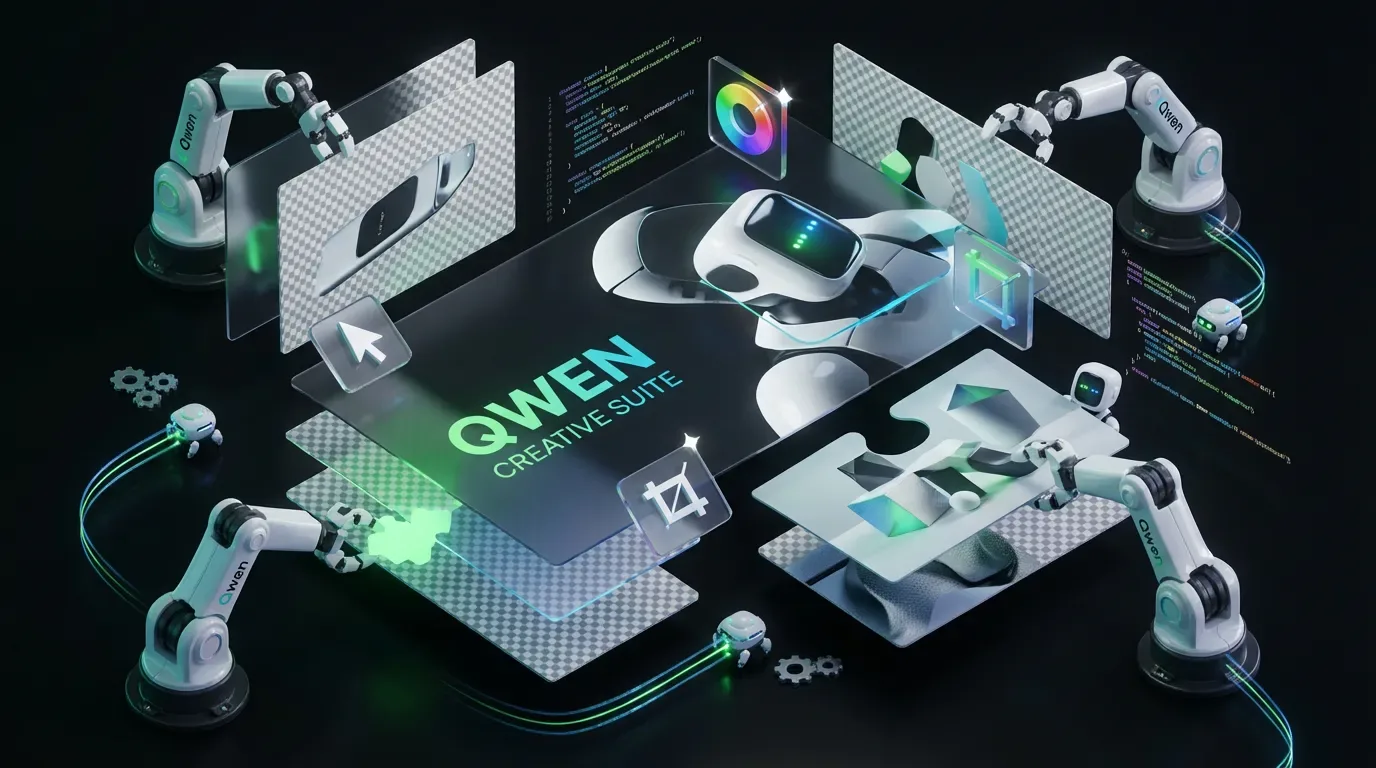
Qwen just dropped Qwen-Image-Layered, a model that decomposes images into multiple editable RGBA layers instead of one flattened “baked” picture. If you’ve ever tried to change “just the hat” in a generated image and watched the model reinvent the whole universe, this is the antidote. Qwen’s announcement is here: https://qwen.ai/blog?id=qwen-image-layered.
This matters because most generative image workflows still end in the same place: a single raster output that needs either (1) brute-force re-prompting, (2) inpainting roulette, or (3) a human doing painstaking masking in Photoshop like it’s 2014. Qwen’s bet is simple: editability should be native, not a recovery process.
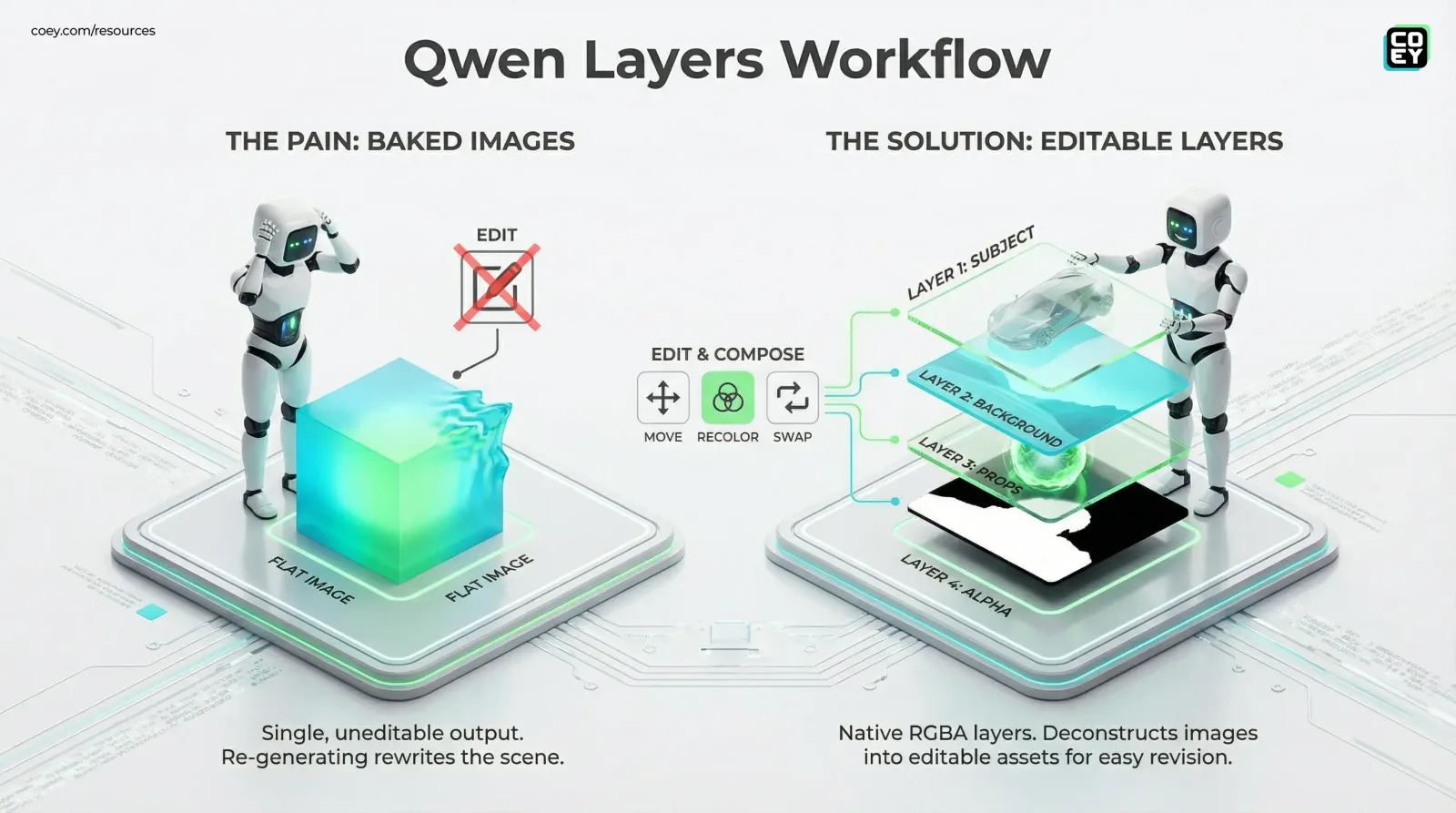
Why “baked images” break creative ops
Marketing and creative teams don’t just need “an image.” They need an asset: something that can survive stakeholder feedback, localization, resizing, product swaps, SKU variations, and platform-specific crops. A single flattened generation is the visual equivalent of shipping a PowerPoint deck as a screenshot.
The real bottleneck isn’t generation. It’s revision. And revision is where creative throughput goes to die.
Here’s the operational pain: you generate a hero image for a campaign, and then someone asks for a color change, a different background, a new headline position, or a second product variant. With most image models today, you’re back to prompting and praying that the “fixed” version doesn’t also change the model’s face, the lighting, and the brand’s vibe.
Layered output flips that dynamic. Instead of re-generating the entire scene, you can target the one element that needs to move, like you would in an actual design file.
Qwen-Image-Layered is positioned as a model that can decompose an image into semantically meaningful RGBA layers, each layer carrying color data plus an alpha channel (transparency). Think: subject, product, background, props, text-like elements, etc. The practical win is that edits become localized.
The technical report points to a key detail: you can control the number of layers (coarse vs. fine decomposition), and the approach supports recursive decomposition (decompose a layer again for more granularity), closer to “group then subgroup” behavior in design tools. See the paper on arXiv.
The headline feature: native RGBA layers
Not a flat image plus segmentation after the fact (the “mask it later” approach). The core output is layered.
Each layer has transparency , so it behaves like a real compositing element.
Edits don’t cascade across the whole frame as often, because you’re not re-rolling the entire image.
Availability: real, not vapor
Qwen has made the model accessible in the open ecosystem, including a Hugging Face listing (Qwen/Qwen-Image-Layered) and the broader Qwen-Image repo on GitHub (QwenLM/Qwen-Image).
Translation for non-technical teams: this is not locked to a single proprietary app UI. Builders can actually integrate it into pipelines if they have the engineering, or the right automation partner.
Automation lens: can this plug into workflows?
Yes, if you treat “layered outputs” as machine-readable creative components. The moment an image becomes a stack of parts, it becomes automatable in ways that flat images simply aren’t.
Here’s the difference:
A flat image can be generated automatically, but editing it reliably tends to require humans.
A layered image can be generated automatically and then transformed automatically (move layer A, recolor layer B, replace layer C) with far less risk of wrecking the rest.
API reality check
As of this release, the most direct path is via open-source tooling (self-hosted inference, scripts, or community integrations). That means:
There isn’t one universal “official SaaS API endpoint” announced by Qwen for Qwen-Image-Layered in the way some commercial image generators provide.
Automation is still absolutely possible , but it’s “bring your own infrastructure” territory.
What would need to happen for mass-market automation?
Hosted inference with SLAs (brands love reliability more than novelty).
Stable output schemas (consistent layer naming or IDs across runs).
Native integrations into creative tools (Figma or Adobe) and automation platforms (Make, n8n, Zapier).
What creators and marketers can do today
Even without a polished enterprise API, the “ready now” value is strong for teams that can run models or use a toolchain that wraps them. The best near-term use is variant production, the work that eats budgets because it’s repetitive, not because it’s creatively hard.
| Workflow | What gets automated | What stays human |
|---|---|---|
| Ad variant scaling | Recolor or reposition product layer, background swaps | Creative direction, approval, brand fit |
| Localization | Layout reflow by moving layers for new crops | Copy review, cultural nuance |
| Catalog consistency | Standardized backgrounds and lighting comps via layers | Product styling rules, QA |
| Social resizing | Auto-compose for 1:1, 4:5, 9:16 using layer rules | Platform strategy, hook selection |
The creative ops punchline: this reduces redo work. And redo work is the silent killer of output.
What’s still future (or at least “not easy yet”)
Layer semantics need to be predictable
For automation, layers need stable meaning. If “product” is layer 3 in one run and layer 7 in another, you can’t reliably script transformations. The future-friendly version of this model ecosystem likely includes:
Named layers (product, background, text, subject)
Confidence scores per layer
Rules for layer grouping (for example “hands” attached to “person” unless requested)
Export formats must match creative reality
Design teams live in PSD, Figma, After Effects worlds. RGBA layers are compatible in spirit, but operationally, teams need clean handoffs: layered PNG stacks, PSD export, or a format that plugs into their existing stack without custom glue code.
Multi-format impact: from images to video and beyond
This is image news, but the implications spill into every format marketers care about.
Video
Layered image assets are basically pre-comps. If you can generate a subject, background, prop stack, you can animate them with simple motion rules (parallax, text fly-ins, product spins) and feed those into video templates. The missing link is tighter tooling: a bridge from layered outputs into motion pipelines (After Effects automation, programmatic video tools, or template renderers).
Audio and text
Layered visuals become more powerful when paired with automated messaging systems: generate the asset stack, generate the caption and copy variants, then assemble campaign sets across channels. The “human plus machine” ideal here is clean: humans choose the story and the angle; machines scale the variations without sacrificing edit control.
What this means for brands scaling creativity
Qwen-Image-Layered is a sign the market is shifting from “wow, it generated a picture” to “cool, can my team ship this by Friday?” Editability is readiness. Layered output is closer to what real production requires: reversible decisions, modular assets, and fast iteration without quality collapse.
Generative tools don’t win because they create. They win because they revise predictably, repeatably, and at scale.
If you’re building a modern creative engine, this release reinforces a simple strategy: invest in systems where outputs are structured, not just pretty. Because structure is what lets automation collaborate with humans instead of constantly fighting them.
AI isn’t just making images anymore. It’s starting to ship ingredients. And ingredients are how you scale creative without scaling chaos.
For broader context on where Qwen is headed across workflows, see Qwen, Grok, GPT-5.1: AI Assistants Get Real.