
No AI Drops This Week? Use It to Ship
No AI drops this week? Use it to ship. A practical playbook for AI marketing agencies to close the gap between new models and real automation work.
30 December 2025Team COEY
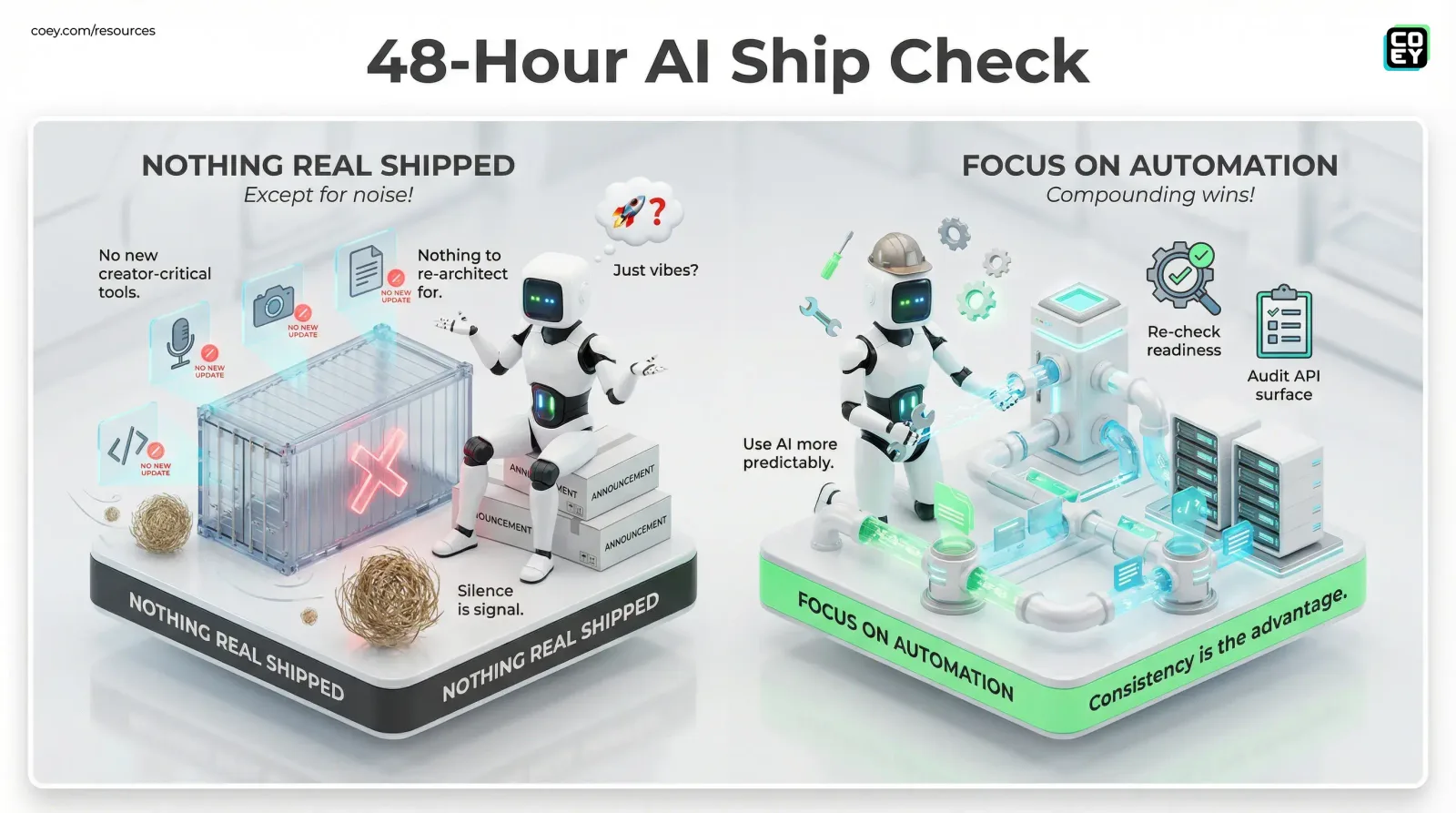
No new creator-critical AI tools have shipped in the last 48 hours that meaningfully change what marketers, creative teams, or automation leads can deploy today. We looked for the stuff that matters: public releases with real documentation, usable endpoints, and clear “you can do this right now” workflow impact, and came up empty.
That doesn’t mean nothing happened on the internet. It means nothing happened that you should re-architect a pipeline for, re-budget a quarter around, or “quick test” at 11:47 PM because someone on X posted a screenshot with a rocket emoji. In the year of infinite announcements, silence is signal.
What we checked (and why)
If you run a modern creative org, you’re not “tracking AI news.” You’re managing a production system: content, approvals, distribution, analytics, and increasingly, agents that do work on your behalf. So our filter is simple:
Is it real? (official announcement or documentation)
Is it available? (not “DM for access,” not “waitlist soon,” not “private beta with vibes”)
Can it automate? (API, SDK, webhooks, or at minimum: exportable artifacts plus reliable repeatability)
Is it ready for workflows? (not just a cool demo video and a prayer)
We scanned the usual suspects across LLMs, image and video gen, voice and audio, and “agent” platforms. Nothing crossed the threshold this cycle.
The absence of news is still operationally valuable. It means your stack didn’t become obsolete overnight, and you can focus on compounding workflow wins instead of chasing shiny objects.
The one exception: “updates” that aren’t creator stack updates
There was noise: the kind that shows up as “big news” but doesn’t change your day-to-day automations.
Google: more audio capability, but not a stack rewrite
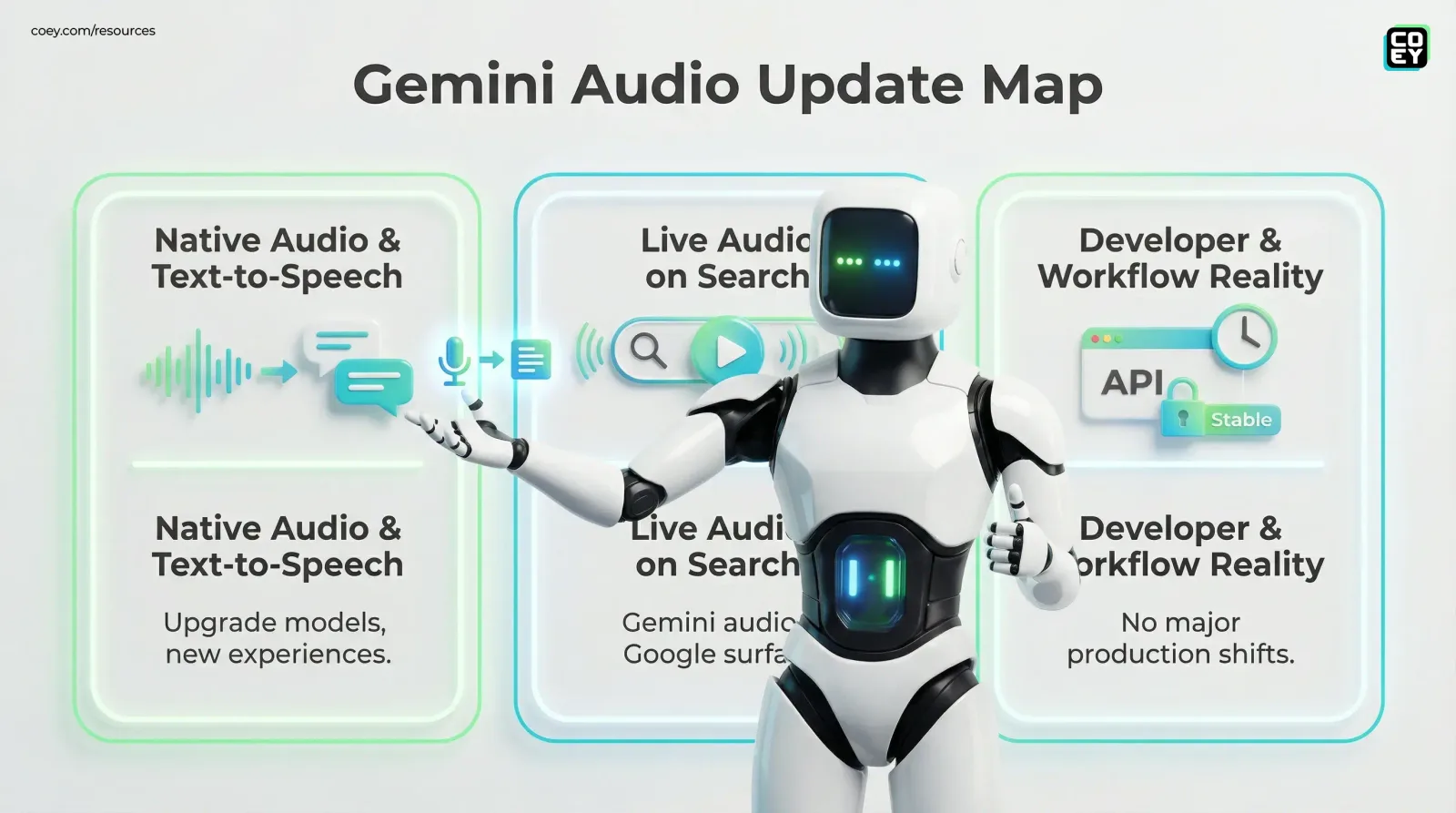
Google published updates around Gemini audio experiences. Interesting directionally, but for most teams this lands as: “cool product evolution,” not “new automation primitive you can plug into Monday.”
Official sources:
Gemini 2.5 Native Audio upgrade, plus text-to-speech model updates
Gemini native audio model comes to Search Live
Automation reality: The updates do include developer-accessible pieces, but unless a release clearly expands stable production endpoints, rollout scope, and operational constraints (quotas, pricing stability, and model and version pinning), it typically doesn’t shift how your content factory runs overnight. It’s an indicator, not automatically an integration.
Runway and OpenAI: no new drops in-window
Within the last 48 hours, no major new releases landed that change deployment reality. The most notable items remain outside this window:
Runway’s latest notable research release remains GWM-1 : Introducing Runway GWM-1
OpenAI’s most recent major model release remains GPT-5.2 : Introducing GPT-5.2
OpenAI also shipped GPT-5.2-Codex : Introducing GPT-5.2-Codex
Automation reality: If your workflows depend on these tools, you didn’t miss a new endpoint, a new model tier, or a new “holy crap now we can automate X” capability in the last 48 hours.
Chatter vs. confirmed: the leak economy is not your roadmap
The AI space has a growing problem: announcement-shaped content. It looks like a launch, it spreads like a launch, and it wastes time like a launch, but it’s not deployable.
This week’s rumors (new model numbers, “stealth drops,” alleged access expansions) failed one of these basic tests:
No official documentation page
No stable product page describing availability
No API reference or SDK update
No clear rollout scope (who has access, where, how to use it)
If you’re an exec, the takeaway is simple: don’t let social timelines allocate your team’s attention.
Why we publish “nothing shipped” posts
Because the highest-leverage move for creative teams right now is not “use more AI.” It’s use AI more predictably.
The industry is allergic to saying “nothing changed,” but operationally it’s a gift:
Your automation flows won’t break due to surprise API changes
Your prompt libraries and schemas don’t need emergency refactoring
Your procurement and security review doesn’t need a new vendor fire drill
Your creative team can focus on throughput, not tool-switching
Consistency is what turns AI from a toy into an advantage. If nothing real shipped, you get to keep compounding.
What you should do instead of hunting releases
Re-check your automation readiness
Most teams still have “AI usage” without “AI automation.” The gap is almost always one of these:
outputs aren’t structured (hard to validate, route, or publish)
no critic layer (quality and compliance don’t scale)
no provenance or receipts (can’t defend decisions later)
no cost controls (agents happily burn budget like it’s Monopoly money)
If that list stings, you’re not behind. You’re normal. But this is the week to fix it. If you want a concrete blueprint for scaling reviews without scaling headcount, start here: Why Critic Layers Matter in Marketing Automation.
Audit your API surface area
If a tool can’t be automated, it’s not part of your system. It’s a manual helper. That’s fine, but categorize it honestly.
| Area | New shippable updates? | Automation impact |
|---|---|---|
| LLMs (text and agents) | No | No new endpoints or workflow shifts detected |
| Image and video gen | No | No new API unlocks; toolchains stable |
| Voice and audio | No (for most creator stacks) | Notable platform-side improvements; developer audio updates exist, but no must-retool creator workflow shift detected in the last 48 hours |
| MarTech agents | No | No new orchestration features worth retooling for |
Bottom line
Nothing credible launched in the last 48 hours that changes the practical AI stack for creators and marketers. Your best move is to stop doomscrolling for phantom releases and use the calm to harden the system you already have, so when the next real drop lands, you can plug it in like a module, not rebuild like it’s a crisis.