
GenCast Makes Weather Forecasting Truly Automatable
GenCast makes weather forecasting truly automatable. What it unlocks for AI marketing automation in retail, travel, and weather triggered ad campaigns.
1 January 2026Team COEY
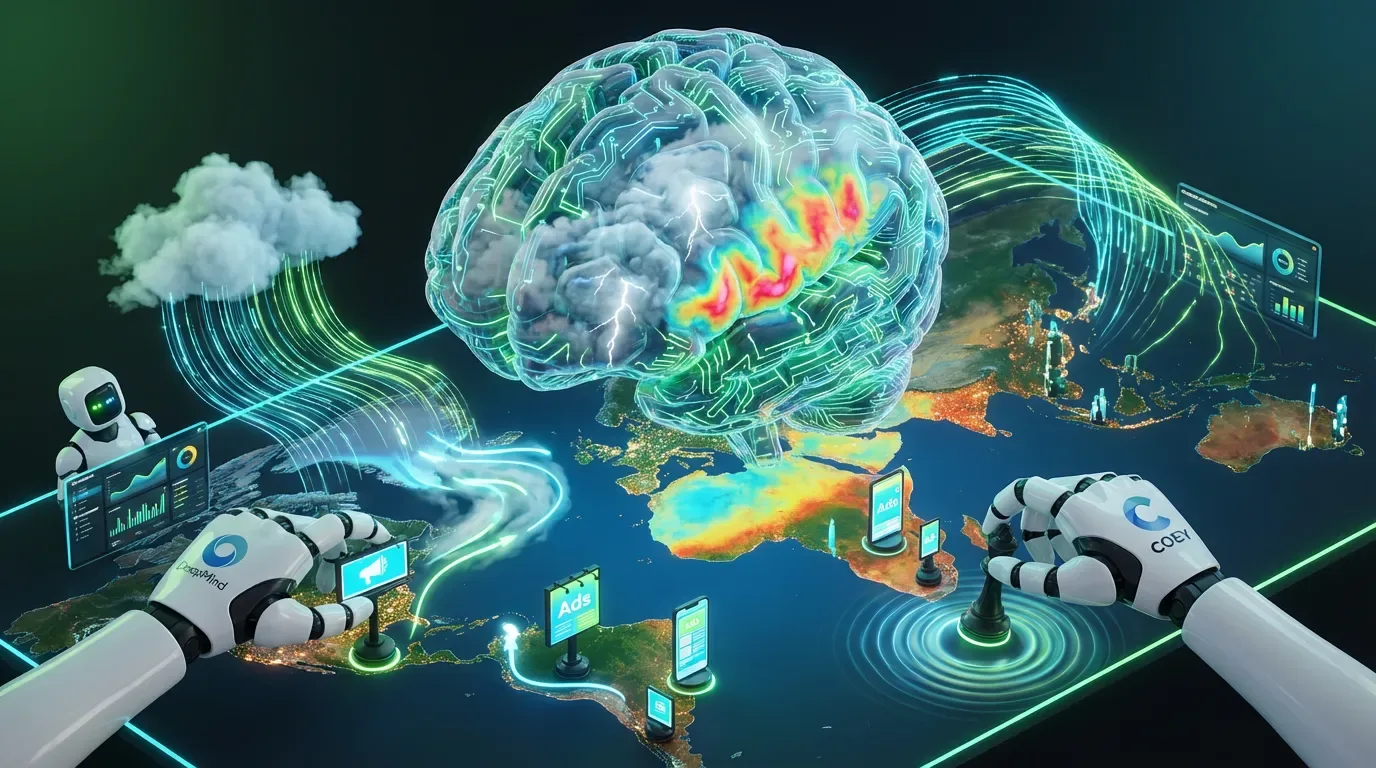
Google DeepMind just dropped GenCast, a diffusion-based ensemble weather model that aims to do something the AI world loves to promise but rarely delivers: match state-of-the-art accuracy while running fast enough to actually change workflows. This isn’t a “cool demo” for a lab’s highlight reel. It’s a probabilistic forecasting system built to compete with the big dogs (read: ECMWF) and it ships with enough openness to matter.
If you’re an exec or marketing leader, the headline isn’t “AI predicts weather.” Weather has been predicted forever. The headline is: probabilistic, high-quality forecasts are getting cheaper, faster, and more programmable, which means weather is turning into a first-class automation trigger, not just a widget on a dashboard.
Translation: GenCast makes “weather-aware marketing” less like astrology and more like a measurable, automatable decision system.
What GenCast actually is
GenCast is a machine-learning weather forecasting model that generates an ensemble: many plausible futures, not one “best guess.” That matters because the real world doesn’t care that your campaign calendar wanted sunny vibes. You need probabilities, not vibes.
DeepMind’s big technical swing is using a diffusion model, the same family of techniques powering generative image models, adapted for Earth-scale atmospheric dynamics. Instead of simulating physics step-by-step like traditional numerical weather prediction (NWP), GenCast learns patterns from historical data and produces forecasts that include uncertainty by design.
GenCast’s core outputs (the useful part)
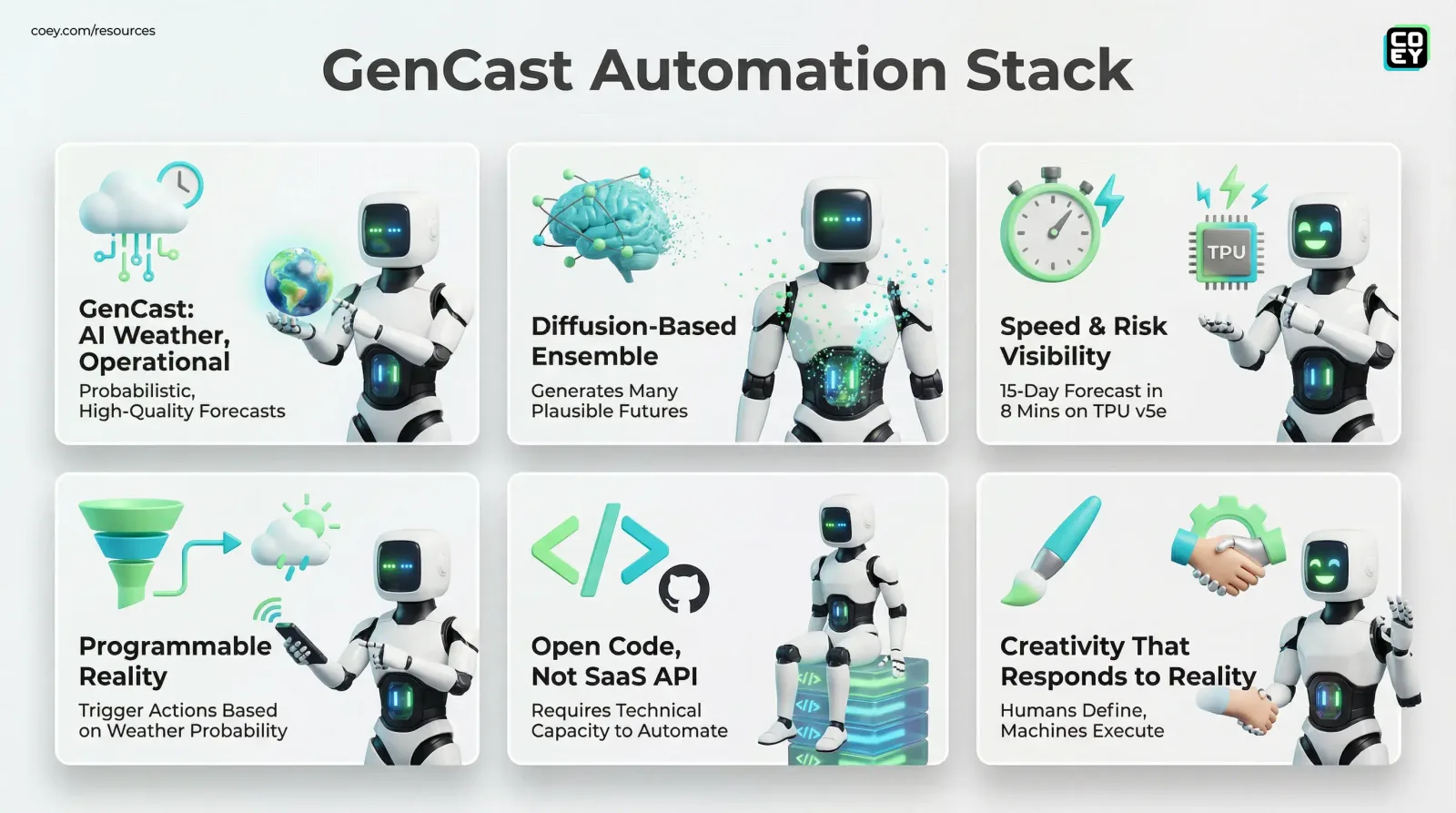
Ensemble forecasts: Multiple scenarios you can treat like a distribution, not a single answer.
Risk visibility for extremes: Useful for planning around high-impact conditions (wind, heat, cyclones) where “maybe” isn’t good enough.
Speed: DeepMind reports that a full 15-day ensemble forecast can be generated in about 8 minutes on a single TPU v5e , fast enough to refresh often, which is where automation starts to get real.
Why marketers should care (yes, really)
Weather is one of the last “massive external variables” that most marketing stacks treat as a static input: check the forecast, hope for the best, adjust manually when reality hits. GenCast pushes weather toward something you can program against.
And because it’s ensemble-based, it’s not just “rain/no rain.” It’s “there’s a 62% chance of rain in the next 36 hours in these ZIP codes,” which is the difference between a gimmicky trigger and a decision you can defend.
Real workflow implications
Creative scheduling with risk thresholds: Automatically shift outdoor-heavy creative when precipitation probability crosses a set threshold (instead of waiting for the intern to panic-refresh an app).
Geo-personalized messaging that isn’t cringe: Swap messaging when conditions are likely, not after the storm already hit and your “enjoy the sunshine” copy becomes a meme for all the wrong reasons.
Operational alignment: Weather can coordinate marketing, retail ops, and customer comms with one shared probabilistic signal.
Automation readiness: API vs. “open code” reality
Here’s where we separate shiny from shippable. GenCast is not currently positioned as a simple hosted SaaS API you can toggle on inside your martech stack. As of now, there is no official hosted GenCast API from DeepMind; the release leans toward open code + published pretrained model checkpoints, which is powerful, but it shifts the burden to your team (or vendor) to operationalize it.
DeepMind points developers to the GraphCast repository on GitHub, where GenCast code and example notebooks live alongside related tooling. Note: the pretrained weights are provided via links to a Google Cloud Storage bucket (not committed directly into GitHub).
On the ECMWF side, there’s also an integration path via ECMWF Lab’s open-source plugin ai-models-gencast (also distributed on PyPI), which is basically ECMWF saying, “Yes, we’re taking this seriously enough to wire it into our ecosystem.”
So can you automate it today?
Yes, if you have technical capacity. GenCast is automation-friendly because it produces machine-readable outputs and can be executed programmatically. But it is not “plug into HubSpot” ready out of the box.
| Question | GenCast answer | What it means |
|---|---|---|
| Is there a hosted API? | No official hosted API | You’ll run it yourself or via a platform partner |
| Are code + weights available? | Yes (GraphCast repo + GCS-hosted weights) | Real automation potential, but engineering required |
| Does it fit event-driven workflows? | Yes | You can trigger actions based on probabilities |
GenCast vs. traditional ensembles
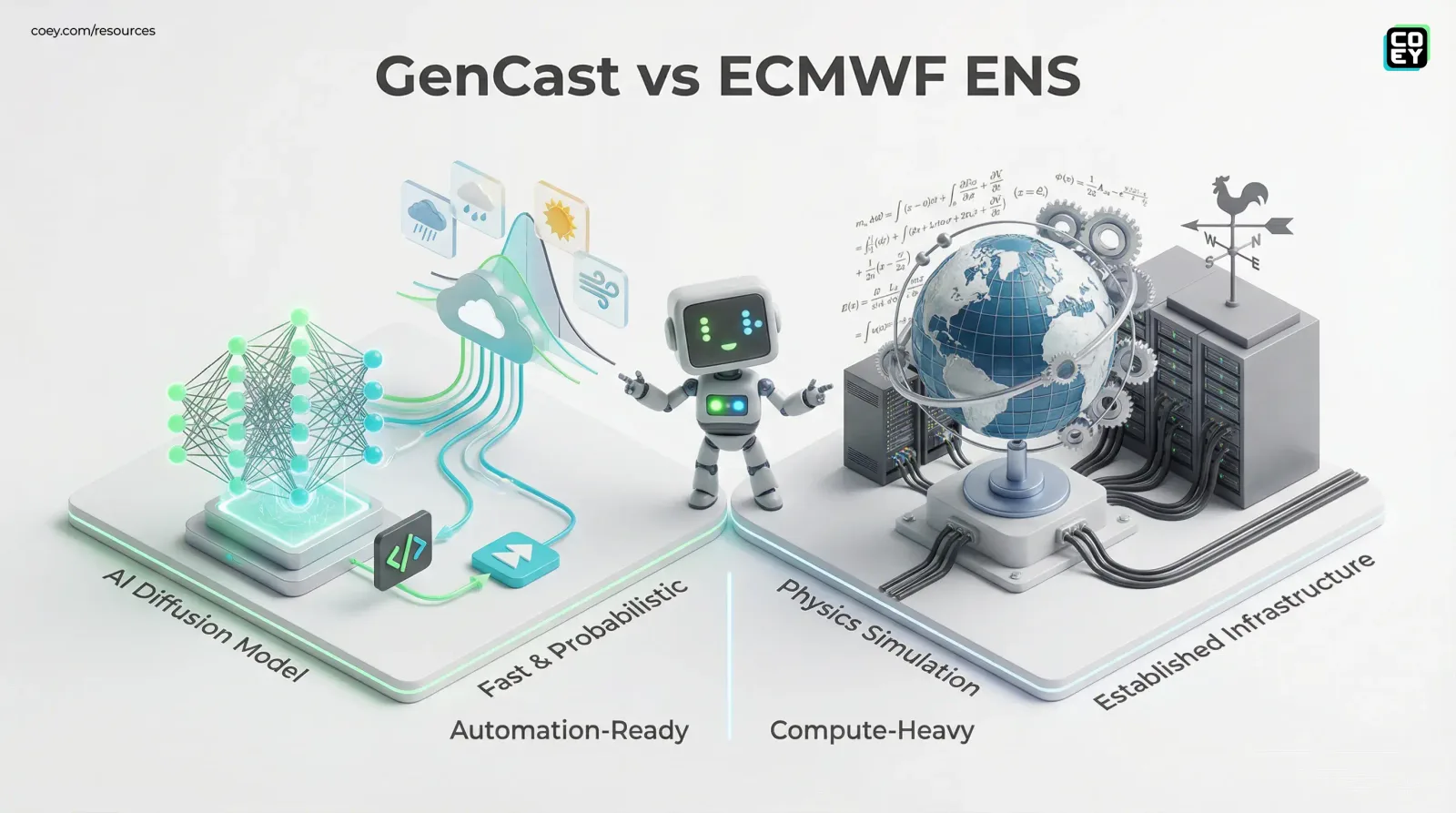
To understand why GenCast matters, you have to understand the baseline it’s poking: ECMWF’s ENS, one of the gold standards for ensemble forecasting. ECMWF describes its medium-range ensemble setup and uncertainty-focused approach in its medium-range forecasts documentation.
Traditional ensembles are powerful, but expensive. They rely on physics simulations that take serious compute and time. GenCast aims to compress that cost curve so ensembles become easier to run frequently, potentially by more organizations, and potentially closer to real-time decision loops.
The pragmatic difference
Traditional ENS: Extremely respected, operationally mature, but compute-heavy and institutionally centralized.
GenCast: Faster for teams that can run ML workloads, with strong performance claims and an open release of code and pretrained checkpoints.
If ENS is “enterprise weather infrastructure,” GenCast is trying to be “ensemble weather as software.” And software, as you know, gets automated.
Where it’s ready, and where it’s still hype-adjacent
GenCast’s readiness depends on what you mean by “ready.”
Ready for: platform builders and automation teams
If you’re building products, internal tooling, or data pipelines, and you already run Python/ML workloads, GenCast is the kind of release that can move from R&D to pilot quickly. The open tooling ecosystem (DeepMind repo + ECMWF plugin) suggests real momentum toward adoption.
Not ready for: plug-and-play marketing stacks
If you want a “connect to GenCast” button inside Make or n8n without standing up infrastructure, you’re still living in the near future. The automation opportunity is absolutely there, but it currently comes in the form of build your own endpoint or rely on a vendor who does.
What this unlocks: creativity that responds to reality
At COEY, we care about scaling creativity with intelligent machine collaboration. GenCast is interesting because it turns weather into a richer machine input: not just context, but quantified uncertainty. That’s exactly the kind of signal that lets humans set intent (“push this offer when conditions support it”) and lets machines do the grind (“monitor probabilities and route the right creative”).
The teams who win with this won’t be the ones tweeting “AI weather!!!” They’ll be the ones quietly building systems where:
humans define thresholds, brand rules, and exceptions
machines refresh forecasts, score risk, and trigger swaps
creative output stays timely without becoming chaotic
GenCast is a strong step toward that world. Not magic. Not autopilot. But more programmable reality, and that’s where automation actually starts paying rent.
Turn AI News Into Marketing Advantage
COEY turns the latest AI developments into real marketing firepower. We deploy n8n workflows, Claude Cowork agents, and OpenClaw pipelines that keep your channels running and your team focused on strategy. See our automation approach or request a proposal.