
Tencent HY-Motion turns text into shippable 3D motion
Tencent HY Motion turns text into shippable 3D motion. What it unlocks for AI marketing automation, 3D ad creative, and generative motion design pipelines.
2 January 2026Team COEY
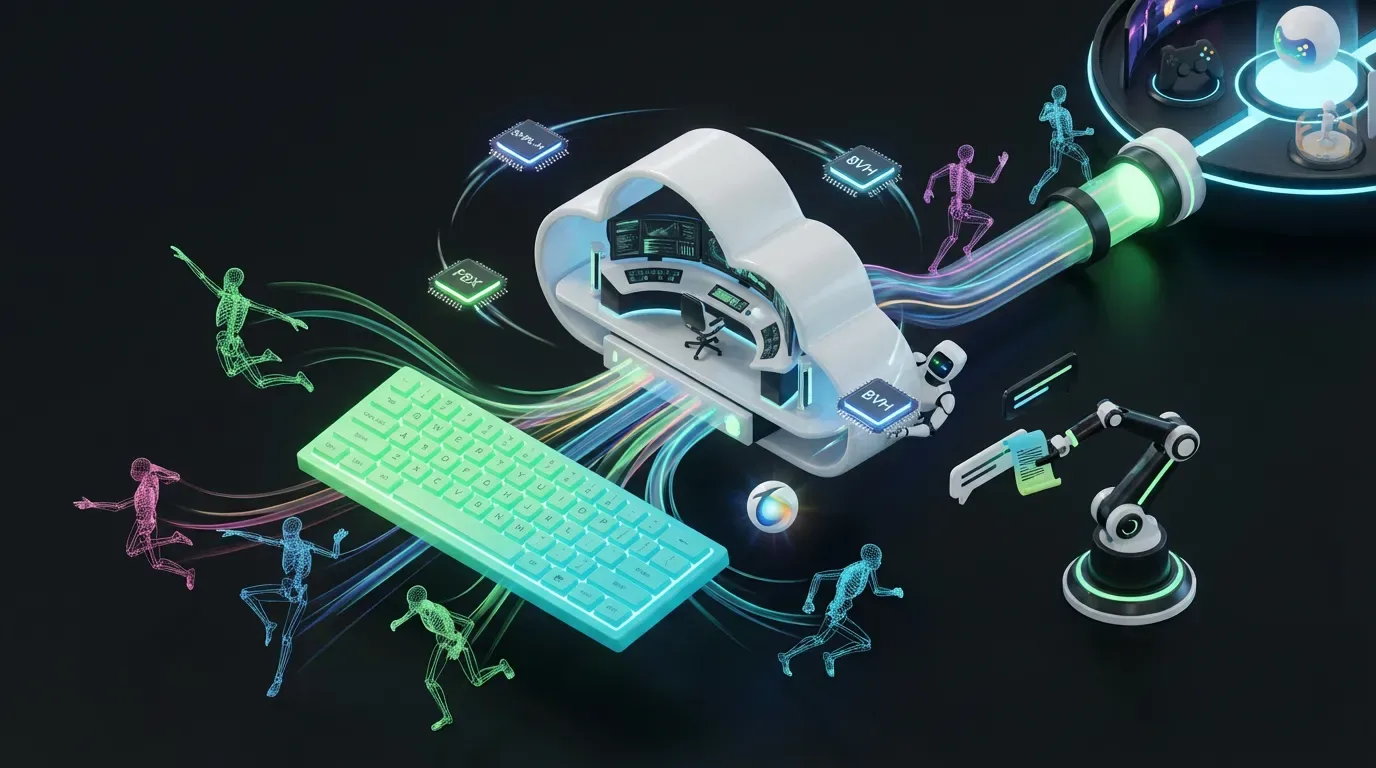
Tencent’s HY-Motion 1.0 turns “describe the move” into “ship the motion” and it’s open-source. That combo matters.
In a world where everyone’s racing to generate more video, HY-Motion goes one layer deeper: it generates 3D skeletal animation from text prompts, in formats that can actually drop into real pipelines. Not “look, it dances” demo energy. More like: “your 3D team just got a motion department you can call like a function.”
If your org touches games, virtual influencers, AR try-ons, branded avatars, or any of the “we need a character moving by Friday” requests, Tencent’s Hunyuan team just made that ask a lot less painful.
First stop for the official release and resources: Tencent-Hunyuan/HY-Motion-1.0. For the research details, there’s also the paper: HY-Motion 1.0 on arXiv. If you want a browser path, there’s a community site at hunyuanmotion.net.
What Tencent actually shipped
HY-Motion 1.0 is an open-source text-to-3D motion generation model built by Tencent’s Hunyuan team. You type something like:
“a person sprints, stops abruptly, and turns”
“a character waves, then points to the right”
“a dancer does a short hip-hop combo”
…and you get back a physically plausible motion sequence mapped to a standard human skeleton.
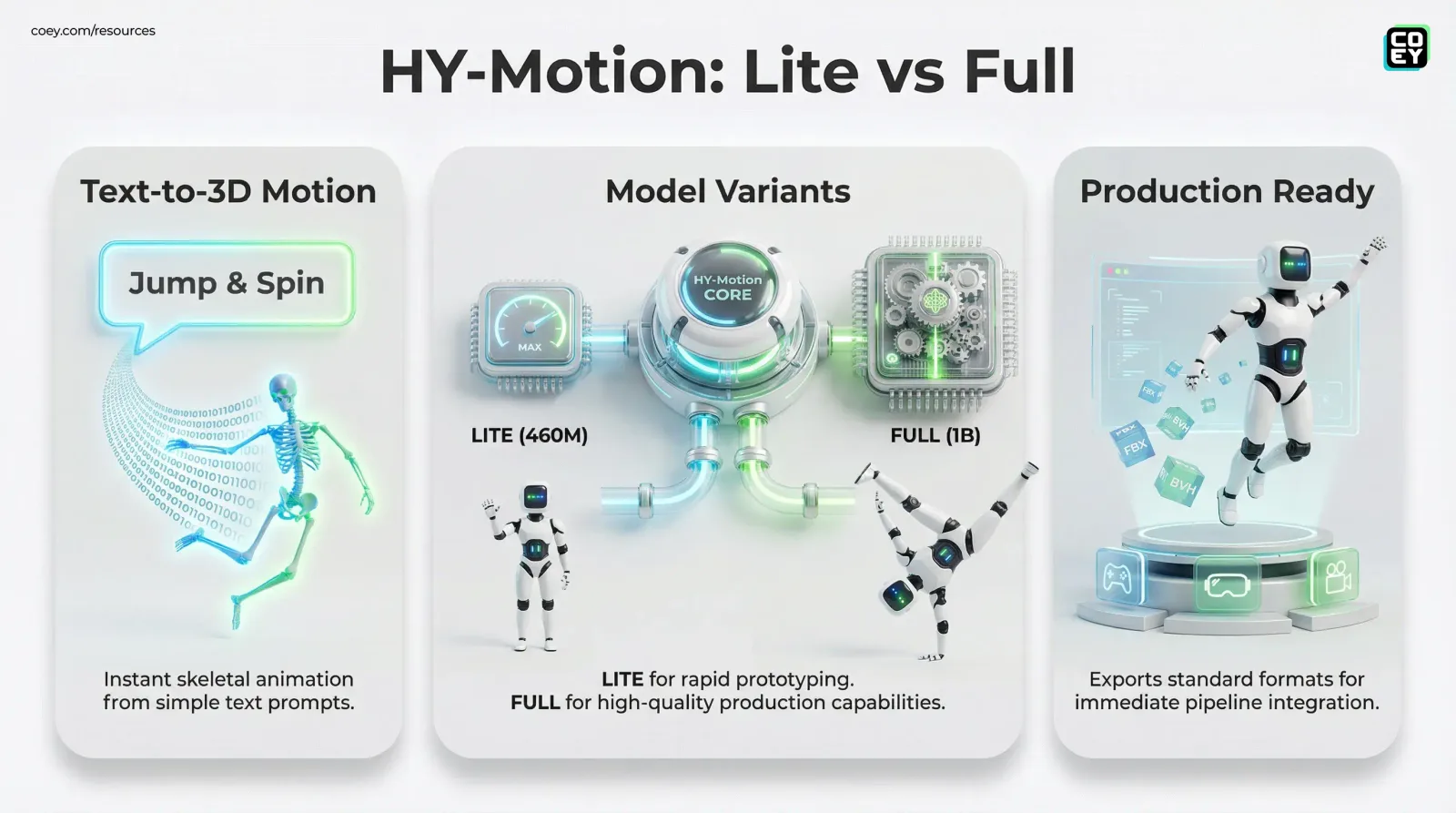
Under the hood, Tencent positions it as a Diffusion Transformer (DiT) + flow matching system, trained on over 3,000 hours of motion data spanning 200+ categories, with a multi-stage training recipe (large-scale pretraining plus quality-focused tuning and alignment) to better match intent and improve motion quality.
HY-Motion comes in two main variants discussed publicly:
Full model (about 1B parameters )
Lite model (about 460M parameters )
The release includes runnable code and checkpoints, with a workflow that’s friendly to builders: clone repo, download weights, run local inference, export.
Why text-to-motion is suddenly relevant
Generative video has the cultural spotlight, but motion is the hidden bottleneck when your output needs to be controllable and reusable.
A lot of brand teams are already producing “AI people” content, but it often breaks down when you need:
repeatable gestures across dozens of clips
consistent motion for a character series
animation that can be reused in multiple scenes and camera angles
motion you can tweak in Blender, Maya, or Unreal instead of regenerating from scratch
If your team is scaling character-led content, motion isn’t a finishing touch. It’s the system that makes the character feel real.
HY-Motion is part of a bigger shift: AI is moving from “generate a single artifact” to “generate modular production ingredients.” Motion data is an ingredient you can re-time, re-target, blend, or remix.
Outputs and compatibility (the unsexy win)
HY-Motion generates motion in SMPL-H (and related SMPL-family) skeleton representations and supports exporting to common formats like FBX and BVH (and NPY for array workflows), which makes it much easier to slot into existing 3D stacks.
That interoperability is the real story. Because the fastest way a cool model dies is: “it only works in their demo viewer.”
Where it fits in production
Game engines: retarget to in-game rigs for NPCs, emotes, cutscenes
DCC tools: Blender and Maya pipelines for previz and animation blocking
Virtual humans: social avatars, digital presenters, interactive agents
Brand worlds: retail walkthroughs, product scenes with characters, AR and VR
| Output | Why it matters | Workflow impact |
|---|---|---|
| SMPL-H (SMPL-family) | Standardized skeleton representation | Retargeting becomes realistic, not a science project |
| FBX / BVH export | Common interchange formats | Drop into DCC + engine pipelines with less glue code |
| Lite + Full variants | Different compute footprints | Prototype faster, scale up when quality matters |
Automation potential (yes, this can be a lane)
Because HY-Motion is open-source, the automation story is less “does Tencent provide a polished SaaS API?” and more: can your team operationalize it as a callable service? And the answer is yes.
This is the kind of model that becomes powerful when you treat it like a backend capability:
A creative brief generates motion prompts
Motion generation runs in a batch queue
Outputs get pushed into a shared library (your “motion DAM”)
Artists review, select, clean up, and retarget
Approved motions ship into templates (Unreal sequences, Blender scenes, etc.)
The unlock isn’t replacing animators. It’s removing the “start from nothing” tax. Humans keep taste and direction; the machine fills the pipeline with viable first passes.
What “API-ready” means here
There’s no single “official HY-Motion cloud endpoint” being marketed like an enterprise product. But it’s still automation-friendly because:
it runs locally
it can run on your GPU infrastructure
it can be wrapped with a simple HTTP service (or queued worker)
it can be triggered by workflow tools (n8n, Make, Zapier) via webhooks
For most companies, that’s actually preferable: you can decide privacy, cost controls, and throughput.
Real-world readiness (what’s solid vs what’s hype)
HY-Motion reads as “real” for one reason: it produces usable skeleton motion in standard formats. That’s what turns ML output into pipeline output.
Still, it’s not magic. Practical limits apply:
What’s ready now
Blocking / previs: text-to-motion as the fastest way to storyboard character movement
High-volume variant needs: gestures, emotes, social actions, simple sequences
R and D for character content systems: building internal libraries of reusable motion
What will still need humans
high-specificity acting (emotion nuance, comedic timing, character personality)
interaction-heavy scenes (two-person contact, props, complex physics)
brand-sensitive motion direction (a mascot’s “signature moves” still require art direction)
HY-Motion can give you motion. It can’t give you taste. That part is still gloriously human.
How this changes creator + marketing ops
Marketing teams don’t wake up wanting BVH files. They wake up wanting output: more ads, more scenes, more series, more iterations.
HY-Motion’s operational implication is that motion becomes scalable inventory. Once you have a motion library, you can do things like:
generate a set of “approved gestures” for a virtual spokesperson
localize the same character content by swapping voice + text while keeping motion consistent
build campaign templates where the character motion is modular (intro gesture, product point, CTA wave)
This is exactly the human + machine collaboration pattern that scales:
humans define character rules, brand posture, and what “good” looks like
machines generate volume and options
humans curate, refine, and ship
Bottom line
HY-Motion 1.0 is Tencent putting a serious stake in a very practical frontier: text-to-motion as production infrastructure. The open-source release plus standard skeleton outputs means it can be wired into real pipelines, wrapped into internal APIs, and scaled into a repeatable creative system.
If your organization is building character-led content (games, branded avatars, virtual presenters, immersive experiences), this is a meaningful shift: animation can start with language, and your team’s job becomes selecting, directing, and polishing, not grinding out every first pass by hand.
AI Marketing That Goes Beyond the Hype
COEY builds the marketing automation systems that agencies and brands actually need: n8n workflows, Claude Cowork agents, OpenClaw models, all connected and delivering. See our automation capabilities, explore our channel work, or request a proposal.