
OpenAI Realtime Voice API Makes Agents Deployable
OpenAI's Realtime Voice API makes agents deployable in real production. What it unlocks for AI voice agents and marketing voice automation workflows.
7 January 2026Team COEY

OpenAI has been quietly turning voice from “nice demo” into “callable infrastructure,” and the clearest signal is the company’s Introducing the Realtime API announcement. The headline is not just “more natural voices.” It is that OpenAI is standardizing the parts that make voice usable in real products: low latency streaming, interruption handling, and the ability to connect conversations to real systems (CRMs, scheduling, support tooling) without duct tape orchestration.
For marketers and creators, this is the difference between a voice that sounds human and a voice that can actually work: qualify leads, guide onboarding, capture customer intent, and generate reusable content artifacts at scale. Or, at minimum, stop sounding like a robotic voicemail tree from 2009.
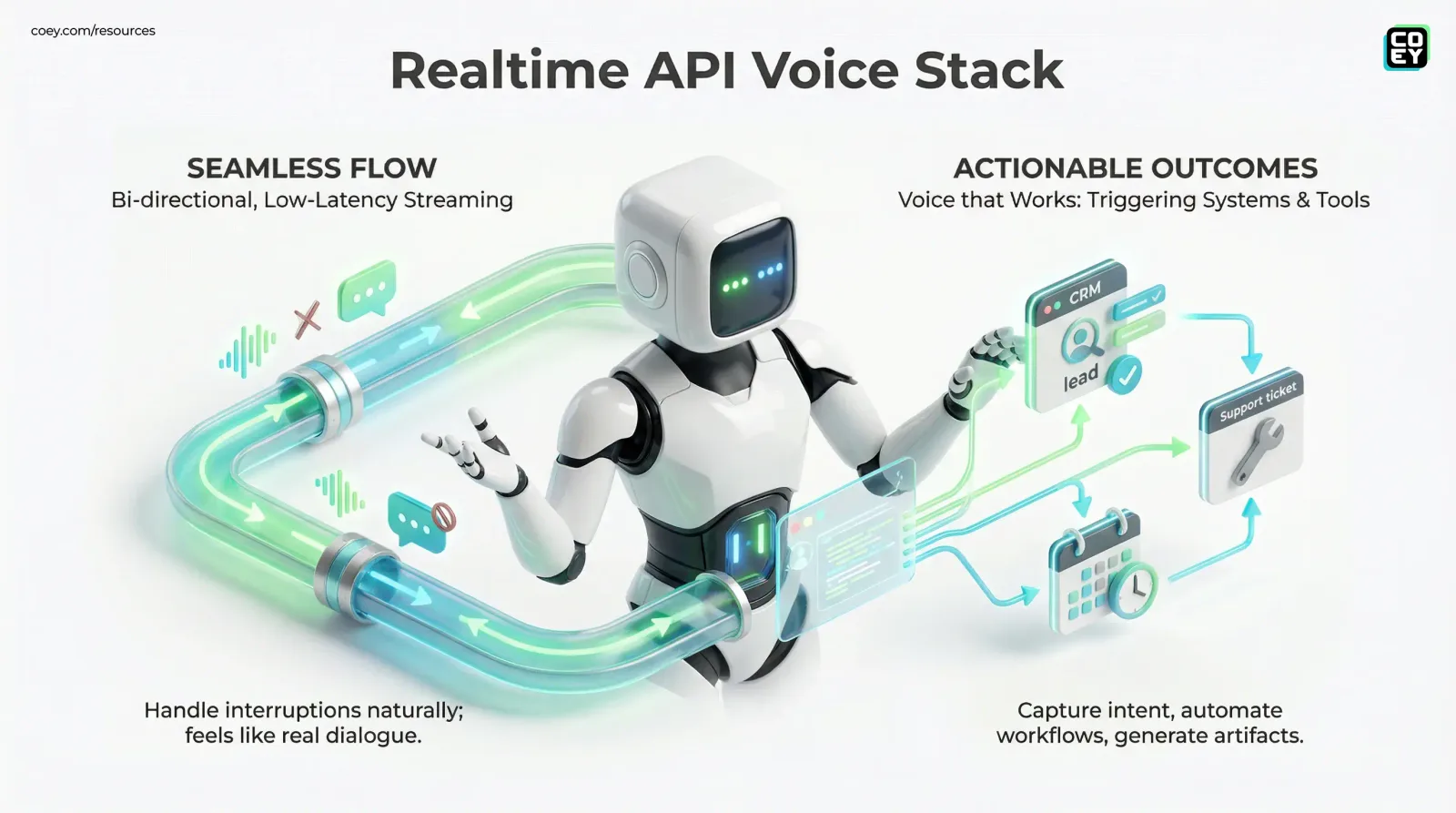
Voice AI is not winning because it “sounds real.” It is winning because it is finally getting an API surface that behaves like software: streaming in, streaming out, tool calls in the loop, and predictable latency.
What’s actually changing in voice
The old voice stack has been a Rube Goldberg machine: speech to text, LLM, text to speech, plus a bunch of buffering and awkward pauses. It works, but it does not feel conversational. OpenAI’s Realtime API pushes toward full duplex style interaction in practice: the system can keep listening while it is responding, and it can handle overlaps and interruptions.
OpenAI’s docs emphasize real time, bidirectional streaming and voice model behavior aimed at fluid conversation rather than “wait your turn” call and response. That matters because in voice UX, latency is not a metric, it is the product.
The practical upgrades marketers will notice
Interruptions stop breaking the flow: With Realtime sessions, you can configure interruption behavior so the agent does not derail when people interject.
Time to first audio gets tighter: Persistent connections and streaming responses make conversations feel more like dialogue and less like a loading screen with opinions.
More expressive output: Voice quality is not just “clear,” it is usable for brand forward experiences like narrations, interactive ads, and concierge style agents.
API availability: this is not locked in a UI
Here is the part we care about at COEY: is it callable, scriptable, and automatable? Yes. OpenAI’s Realtime API is designed to be used over persistent connections (WebRTC or WebSocket). OpenAI also supports SIP connectivity for phone calling in the Realtime stack, depending on your setup and account access.
OpenAI documents the Realtime stack here: Realtime API overview and Realtime model capabilities.
What “API first voice” enables
Streaming voice agents inside your product: Website concierge, in app support, onboarding, internal enablement bots.
Composable stacks: Voice becomes one layer in a broader automation pipeline (routing, enrichment, follow up generation).
Tool calling in the loop: Realtime supports function calling so the agent can trigger actions mid conversation (lookup, create ticket, schedule meeting) instead of just talking about doing them.
Automation potential: where the ROI shows up
Everyone loves a natural voice demo. But the deployable value is: can the conversation create outcomes in your systems of record? That is where OpenAI’s direction aligns with modern agentic workflows, voice as an interface layer on top of tools.
OpenAI’s guidance for building these systems is here: Voice agents guide.
Workflow patterns that are suddenly realistic
Lead qualification to CRM update: Capture intent, budget, timeline, then write structured fields into HubSpot or Salesforce via your own functions.
Support triage to ticket creation: Identify issue type, collect identifying details, open a ticket with a call summary and tags.
Content ops flywheel: Turn repeated questions into transcripts, summaries, FAQ drafts, and even script briefs for creators.
The magic is not that the agent can talk. It is that the agent can talk while it is doing the boring admin work humans hate and log the work cleanly.
Real world readiness: what’s deployable now
Voice agents are finally leaving the lab, but real world readiness depends on whether you are using them for structured conversations with clear success criteria or trying to automate emotionally loaded chaos.
Best “right now” use cases
Inbound routing: “What do you need?” then route to the right team with context.
Status checks: Orders, shipping, appointment confirmations, clean lookups, low drama.
Form replacement: Voice based data capture that outputs structured fields, not just a transcript.
After hours coverage: Handle first response and capture details when humans are offline.
Where teams still get burned
Billing disputes and cancellations: High emotion, high brand risk, lots of edge cases.
Regulated advice: Healthcare, finance, legal, unless you have built strict guardrails and escalation.
Identity and permissions: If your auth flow is weak, voice becomes a security liability fast.
Translation for executives: This is ready for deployment in bounded workflows, but it still needs governance: permissioning, logging, human handoff, and monitoring.
What this means for creative teams
Marketers tend to think about voice as a channel (ads, narration, brand persona). Operators should also think about voice as an input stream for creative intelligence. A good voice system does not just talk, it captures reality at scale.
Cross format impact (where voice pays dividends)
Text: transcripts to summaries to follow up emails to CRM notes to knowledge base updates.
Audio: consistent brand voice for scalable narration, dynamic scripts, localized variants.
Video: faster voiceover iteration for explainers, ads, and product walkthroughs, especially when copy changes late.
| Capability | What it unlocks | Ops reality check |
|---|---|---|
| Streaming voice (real time) | Live agents and interactive experiences | You need monitoring plus fallbacks for silence, crosstalk, and retries |
| Interrupt handling | Human feeling turn taking | Call flow design matters more than “model quality” |
| Tool calls in conversation | Voice that can do work (tickets, CRM, scheduling) | You still build the tools, permissions, and audit logs |
The competitive pressure: voice is becoming default
Once real time voice is an API primitive, it stops being a novelty and starts being a feature customers expect, especially in categories where speed and reassurance matter (travel, ecommerce, services, SaaS onboarding). The brands that win will not be the ones that slap a “talk to our AI” button on the homepage. They will be the ones that treat voice like an automation layer: measurable, governed, integrated, and constantly improved.
OpenAI’s voice direction reinforces the bigger shift we have been tracking. If you want the broader automation framing, see our related COEY post: OpenAI DevDay 2024: Real Automation Arrives.
Humans set strategy, tone, and boundaries. Machines handle the repetition, the routing, and the paperwork, while still sounding like they belong in your brand.
Voice is finally getting out of its shiny demo era. The teams that move first will not just sound more modern. They will ship faster, learn faster, and turn conversations into compounding creative advantage.