
AI Agents and the New Marketing Agency Supply Chain
See how AI agents are restructuring the marketing agency supply chain, compressing timelines and giving AI marketing agencies an unfair speed advantage.
12 January 2026Team COEY
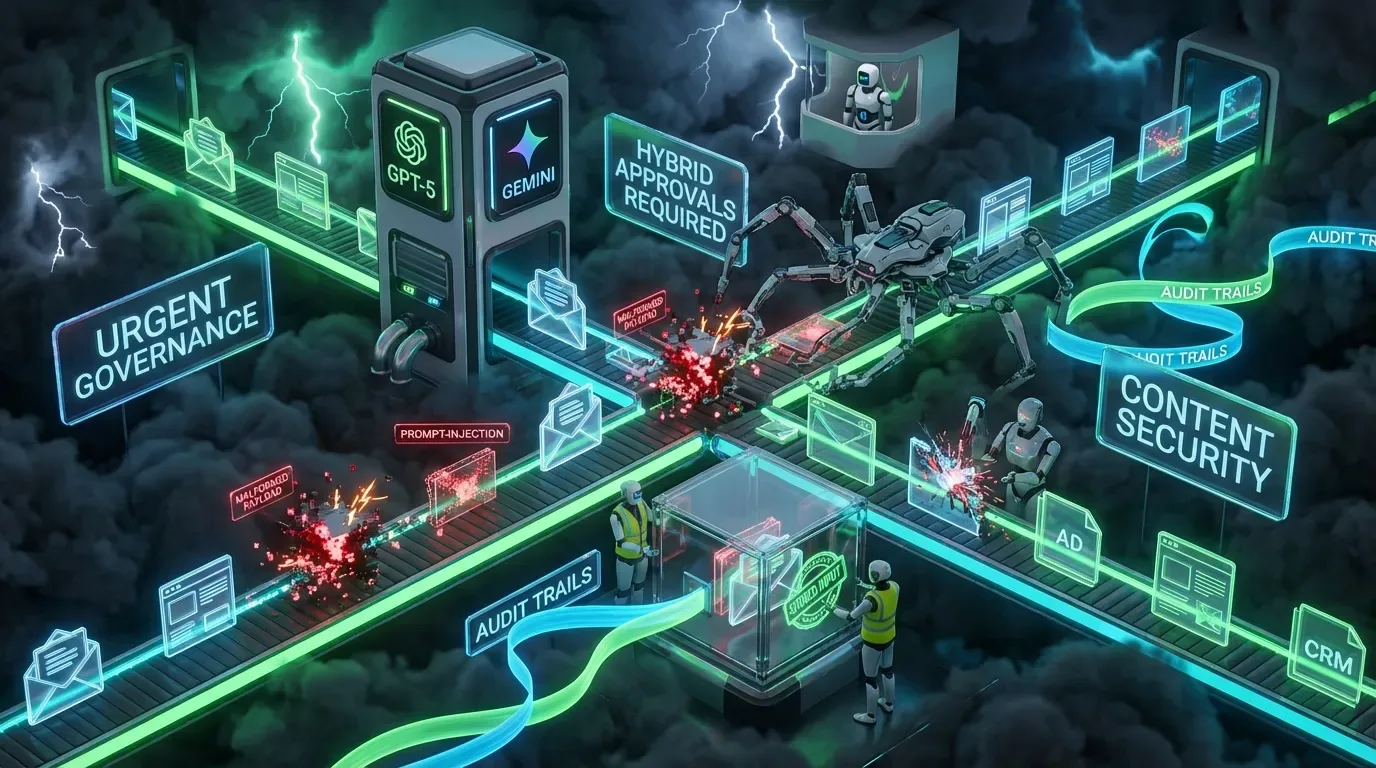
If you pine for the days when marketing ops failed adorably, a Zapier misfire, a stray UTM lost to time, the existential terror of a mysteriously renamed Google Sheet column, congratulations: you have earned your right to grumble about “the modern stack.” Now those endearing glitches are playing at enterprise speed, automated by GPT-5, Google’s Gemini family, or whatever latest skeleton key you just plugged into your toolchain.
Key Takeaways
AI agents turn your marketing stack into a supply chain, and supply chains have attack surfaces
Prompt injection in agentic workflows isn't a security edge case, it's the primary operational risk
Structured outputs (JSON schemas, tool calls) don't protect you from semantic attacks
Four-layer defense: separate instructions from data, least privilege access, deterministic critics, full audit trails
Every automated publish needs a "safe publish" contract before content goes live
Here’s the twist: with agents, your stack is faster, more privileged, much bigger (hello, API sprawl), and capable of industrial-scale mishaps you only learn about when your “AI assistant” is already halfway through a disastrous campaign launch. “It worked in the sandbox!” might become your team’s battle cry.
If you’re automating content, sales, or marketing ops with AI, prompt injection is much bigger than a security concern. It’s a supply chain liability. What’s vulnerable isn’t just your prompt. Now, it’s your entire workflow built from imports, outputs, and API calls galore.
Deep Dive thesis: In the modern agent stack, prompt injection has moved up the org chart. “Someone tricked a chatbot” is not the issue. “Someone manipulated your integrations” is. Durable defenses mean approaching your automations like hardened supply chains: signed inputs, watertight tool permissions, true provenance, and receipts you can actually trace.
When Prompt Injection Sneaks Into Automated Marketing
Old school prompt injection was like whispering “ignore your boss” into Siri’s ear. With marketing automation at scale, that “whisper” gets embedded in the content you inhale every minute:
Google Doc briefs jammed into pipelines
CMS drafts scraped on the fly
Competitor pages used as fodder for creative gen
Support tickets the sales bot recaps
Vendor knowledge base articles (“just for context”)
Let’s admit it: “untrusted input” sums up about 90% of your job.
Tool-Enabled Prompt Injection: The Real Catastrophe
If a chatbot is tricked into bad copy, you lose face. If an agent gets tricked into an API call, you lose control. Now, an innocuous-seeming text pack can trigger:
Creating junk CRM records
Silently swapping out email copy
Auto-publishing garbage to your CMS
Launching rogue ad variants
Data pulls from off-limits locations
Even the UK National Cyber Security Centre has given it to us straight: you cannot hope, prompt, or vibes-check your way out of this. Tool access is operational. And operational is where reputations (and budgets) go to be vaporized.
The AI Marketing Agency Supply Chain
INGEST
Briefs, Data, Assets Brand Policies
Attack surface #1
→
ORCHESTRATE
n8n, Claude, OpenClaw Agent Routing
Attack surface #2
→
GENERATE
Content, Creative Multi-model Output
Attack surface #3
→
VERIFY
QA, Critic Layers Safe Publish Contract
Defense layer
↓
DISTRIBUTE
CMS, Ad Platforms, Email, Social, AI Channels
Where damage becomes public
Each stage is an attack surface. COEY secures the entire chain.
Your Martech Stack Is a Supply Chain, Like It or Not
Security pros have screamed about supply chain risks since the last decade. Dependency hell, CI misfires, package shenanigans, key leaks, signature rot. Meanwhile, marketers returned to debating subject lines. But now, the AI-powered stack has forced the supply chain problem onto everyone’s dashboard:
| Supply Chain Layer | Marketing Automation Equivalent | Core Risk |
|---|---|---|
| Inputs | Briefs, web pages, docs, tickets, transcripts | Injected instructions, context poisoning |
| Build System | RAG, summarizers, rewrite chains, genAI | Silent context drift, loss of traceability |
| Deployment | Publishing or writing to CMS, CRM, ESP, ad tech | Unauthorized auto-changes, mass-broadcast errors |
Your biggest exposure? The whole supply chain, stitched together by martech and powered by code and content you probably do not audit.
How the AI Marketing Supply Chain Flows
| Stage | What Happens | Attack Surface |
|---|---|---|
| 1. Content Ingestion | Briefs, web scrapes, ticket data, and transcripts feed into your AI agents | Poisoned inputs, hidden prompt injections in source documents |
| 2. AI Processing | LLMs rewrite, summarize, translate, and generate across RAG pipelines | Context drift, hallucinated claims, silent instruction following |
| 3. Orchestration | n8n, Make, or custom workflows route outputs to CMS, CRM, ESP, ad platforms | Unauthorized writes, API sprawl, privilege escalation |
| 4. Publishing | Content goes live across channels: blog, email, social, ads | Mass broadcast errors, brand-damaging content, compliance violations |
| 5. Monitoring | Audit trails, deterministic critics, and human checkpoints validate outputs | Gaps in coverage, alert fatigue, missing rollback capability |
No, Structured Outputs Didn’t Save You
Everyone obsesses over structured outputs: JSON schemas, tool call types, constrained decoding. That’s great for consistent automation until you realize structure is just another hackable surface.
When your agent sends a pristine, “valid” payload, everyone smiles right up until a ring of malicious instructions rides inside the allowed fields.
Reminder: “Valid JSON” is to security what an attractive envelope is to phishing: utterly cosmetic.
We have harped on this for months: validation is table stakes, not a fortress. Pass or fail code checks with no semantic depth and you have built the most courteous attack vector on the internet.
The New Attacker Isn’t a Hacker. It’s Your Content Ingestion Policy.
Here’s what the movies get wrong: most prompt injection catastrophes are not hoodie-wearing hackers. They are accidental, boring, or “best practices” gone wrong, like:
Scraped web pages hiding prompt snippets in footers
Copy-paste-ready prompt templates from trending blog posts
Notion setups imported by a frazzled colleague
Vendor docs with system prompt examples right in the body
So, the antidote is not “get the LLM to be careful.” It is “treat every input as if it was pasted from a Reddit thread, because it might as well have been.”
Defending Agentic Marketing Workflows: The Grownup Playbook
Want to fix this? Throw “AI can handle it” in the trash. Actual defense is boring, layered, and governed like a grownup:
Layer 1: For Real, Separate Instructions from Data
Content equals data . Policy equals strict instructions . Never co-mingle source content and operational commands in one context window.
Agents should never infer policy from ingested content. Design your orchestration to enforce this, not wish for it.
Tool privileges cannot be awarded “if the model feels confident.”
Yes, most “RAG” pipelines out there are fetch, paste, pray. Fix it now.
Layer 2: Least Privilege Tool Access, No Exceptions
If your agent can publish, it is a production deployer. Act accordingly:
Isolate read credentials from write credentials
Staging-only access for experimental writes (CMS, ESP, etc.)
Policy gates (risk tiers) before any write can graduate to production
We have been on about the AI control plane for months. Catch up here: Your Stack Needs an AI Control Plane
Layer 3: Deterministic Critics Precede Model Critics
What can be coded, should be coded:
Block unexpected or out-of-scope tool calls
Restrict agents to only whitelisted fields and operations
Automatically quash requests for tokens or unsafe introspection
Strictly validate URLs and permitted domains
Human in the loop? Sure. But only for the gray areas. Let code guard the rest.
Layer 4: Receipts Or It Didn’t Happen
When the marketing fire alarm sounds, “maybe the agent saw something” will not cut it. You want forensic-level transparency:
Every external source snapshot archived
All tool call attempts logged
Diffs for every content writeback filed
Approvals and signoffs timestamped
We ring this bell on the blog for a reason. Receipts are not an aesthetic. They are incident response oxygen.
The Marketer’s Automation Supply Chain Checklist
Here’s what to implement now, no computer science PhDs required:
Input Hygiene
Label every input by trust: internal, partner, public
Quarantine or remove hidden or invisible markup before ingest
Ensure imported content cannot override system prompts or policy blocks
Action Hygiene
Read and write use different API keys, no exceptions
All writes flow through policy checks: block, queue, or require signoff as needed
Tool call and retry caps. Infinite retries is not resilience, it is budget hemorrhage
Validation Hygiene
Add semantic validation to schema validation. Check intent and meaning, not just syntax
Whitelists for permissible domains and integrations
Blocklists for sensitive data or forbidden operations
Provenance Hygiene
Archive retrieval snapshots, not just final outputs
Log deltas (diffs) for every content write
Version-control prompts, policies, and contracts
A Bare-Minimum “Safe Publish” Contract for Automation
Still trying to wing your approval layer? Here’s a minimalist gating contract for agents submitting content. Call it a “boring but effective” defense, not a panacea:
{
  "publish_request": {
    "destination": "cms",
    "content_type": "landing_page",
    "risk_tier": "enum:[low,medium,high]",
    "allowed_actions": ["create_draft", "update_draft"],
    "forbidden_actions": ["publish_live", "delete"],
    "fields": {
      "title": "string",
      "slug": "string",
      "body_blocks": "array",
      "cta_url": "string"
    },
    "constraints": {
      "cta_url_allowlist": ["https://example.com"],
      "max_body_blocks": 20,
      "requires_human_approval_if": [
        "risk_tier == high",
        "cta_url_not_in_allowlist",
        "contains_numeric_claim"
      ]
    }
  }
}
Hybrid Workflows: No, That’s Not a Compromise. That’s Adulthood.
Executives love “agentic.” Finance asks, “Why is this bill astronomical?” Legal wants, “Who approved this?” The answer is not to dump automations. It is to run hybrid workflows that automate what is provable and escalate everything ambiguous for real approvals.
| Risk Tier | Automation Handles | Human Responsibilities |
|---|---|---|
| Low | Drafts and staging, with receipts | Sample audits |
| Medium | Generate, validate, and queue with tracked diffs | Approve changes, not just raw text |
| High | Block or flag for explicit verification | Final signoff and claims check |
The COEY Take: Automate Like Your Brand Depends On It (Because It Does)
Prompt injection is not just a footnote in a SOC2 checklist. In an automation-first world, it is the way your “seamlessly connected stack” breaks when you are not looking. If your bots can read the internet and write into your critical apps, congrats: you are now managing a vulnerable digital supply chain.
The grown-up mitigation is to harden like the pros: least privilege, deterministic critics, policy gates, and ironclad receipts. Not paranoia, just procedure. Networks will never get more trustworthy, and your stack is only going to get more powerful.
For the deeper governance framework, dive here:
- AI Workflow Firewalls: Marketers’ New Must-Have
Set up the firewall. Then let the agents run.
Modernize Your Marketing Supply Chain With AI Agents
COEY deploys coordinated AI agent teams that compress marketing timelines from weeks to hours. See how our agentic automation works across every marketing channel, or request a proposal.