Chroma 1.0 Makes Real-Time Voice Agents Practical
Chroma 1.0 makes real time voice agents practical. What it unlocks for AI voice agents, customer support, and marketing voice automation stacks.
21 January 2026Team COEY
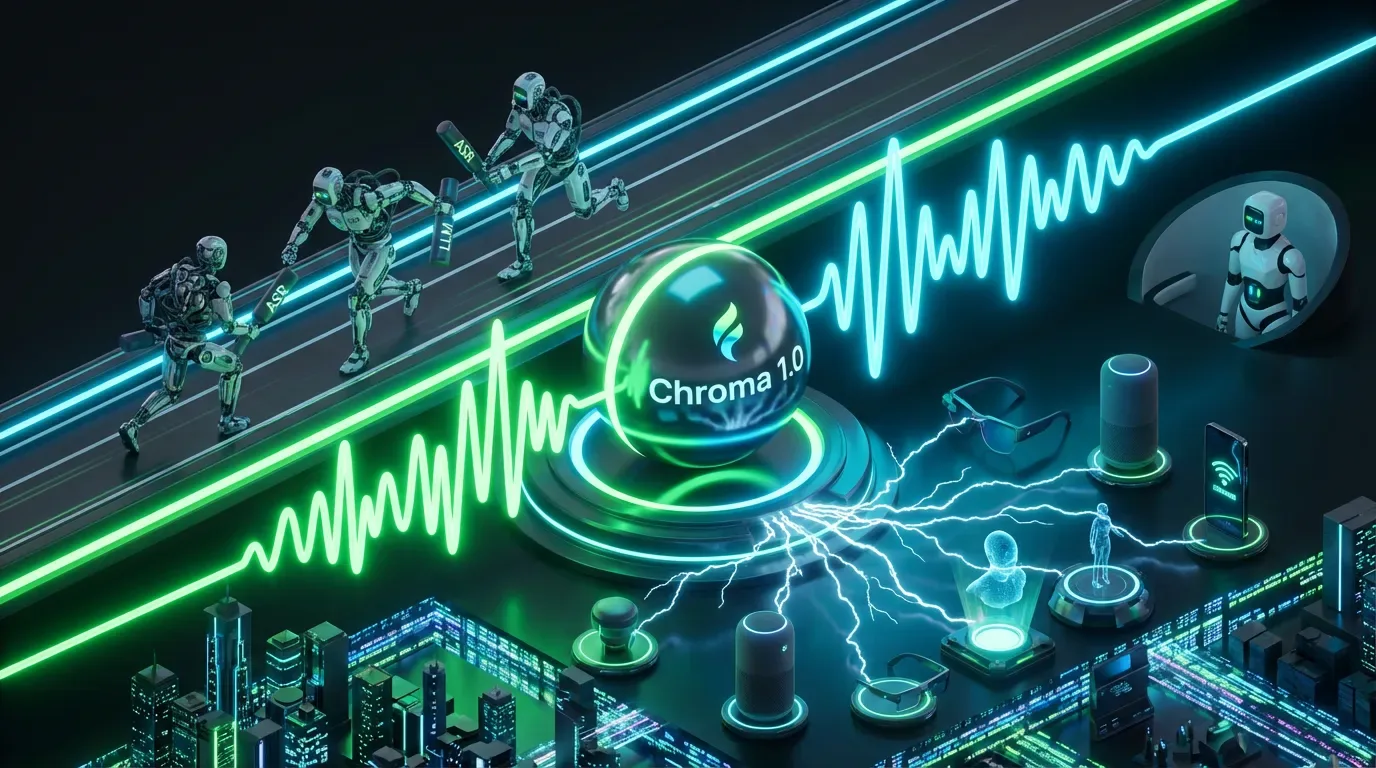
FlashLabs has released Chroma 1.0, an open-source, real-time speech-to-speech model built for low-latency voice interaction plus personalized voice cloning. The big shift is not “voice AI can talk.” We have been past that. The shift is that the voice stack is collapsing: fewer brittle components, faster turn-taking, and a more realistic path to automating conversations that actually connect to your systems.
Voice agents don’t fail because the model can’t speak. They fail because the system is a relay race: ASR hands off to an LLM, hands off to TTS, and your latency budget and user patience dies somewhere between vendors.
Chroma 1.0 is an end-to-end spoken dialogue model: it listens to audio and generates audio back, in real time, without forcing you to build and babysit the classic chain of speech-to-text → text reasoning → text-to-speech. FlashLabs frames it as a “spoken dialogue model,” which matters because it is not just a voice skin over a text chatbot. It is designed to handle conversational flow as an audio-native loop.
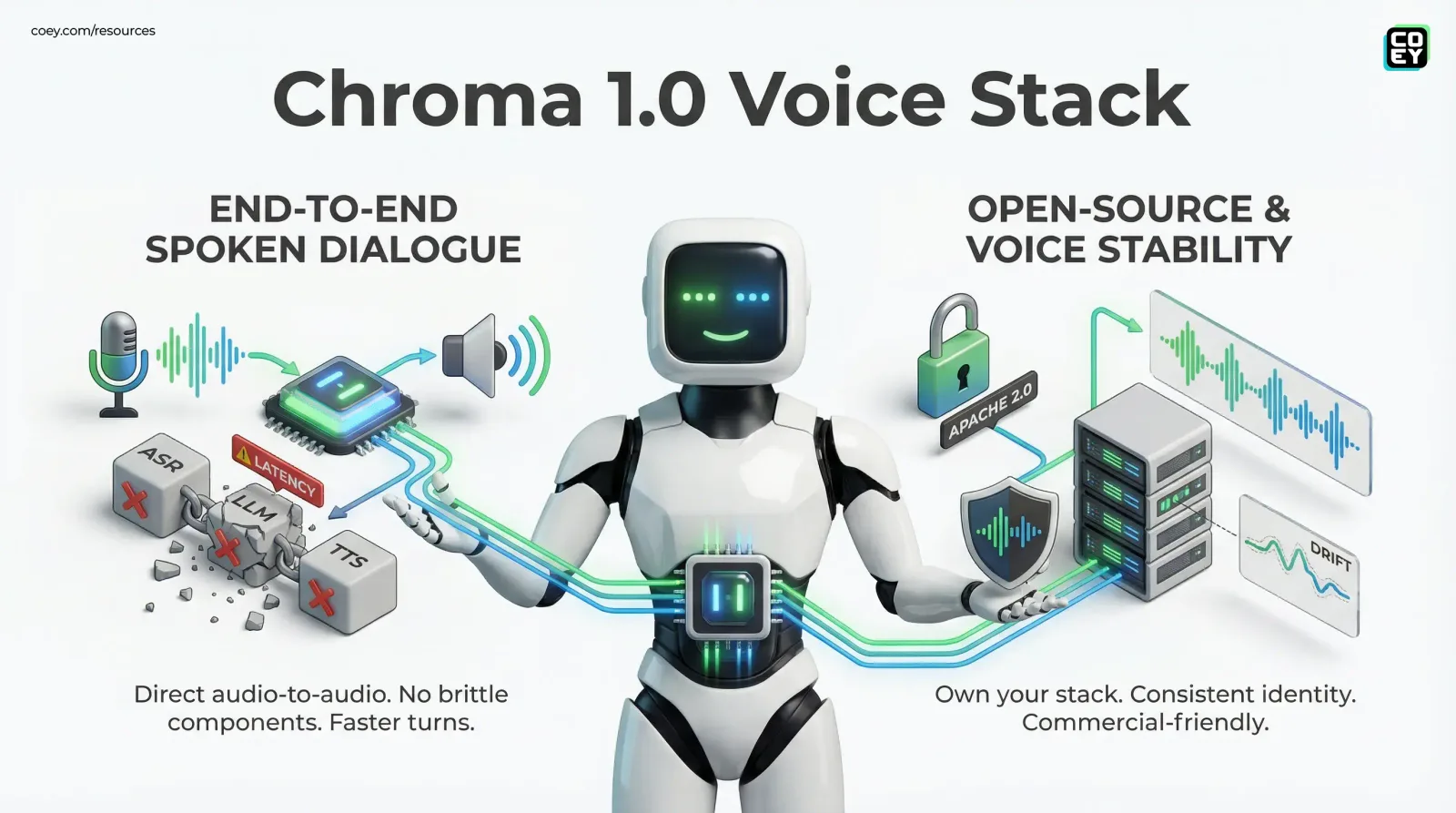
The public technical write-up frames the latency win as a core design goal, using an interleaved text-audio token schedule (described in the paper as a 1:2 text:audio schedule) to enable streaming generation. For the research details, FlashLabs published the paper on arXiv: FlashLabs Chroma 1.0: A Real-Time End-to-End Spoken Dialogue Model with Personalized Voice Cloning.
One detail that is easy to miss: Chroma is positioned around voice identity stability across multi-turn dialogue. In the real world, voice cloning is not impressive if the voice drifts after two minutes and starts sounding like a different actor. Multi-turn consistency is what makes branded voice experiences feel intentional instead of like a glitchy demo.
Why the single model approach matters
Most orgs do not realize how many moving parts a “simple” voice bot usually needs. You are juggling:
a telephony or streaming layer
ASR (transcription)
LLM reasoning plus tool calling
TTS (speech output)
buffering, retries, and state handling (why is it talking over the user)
Chroma’s end-to-end design does not magically delete engineering work, but it reduces integration surface area. That is the unsexy part that determines whether you can ship voice automation beyond a prototype.
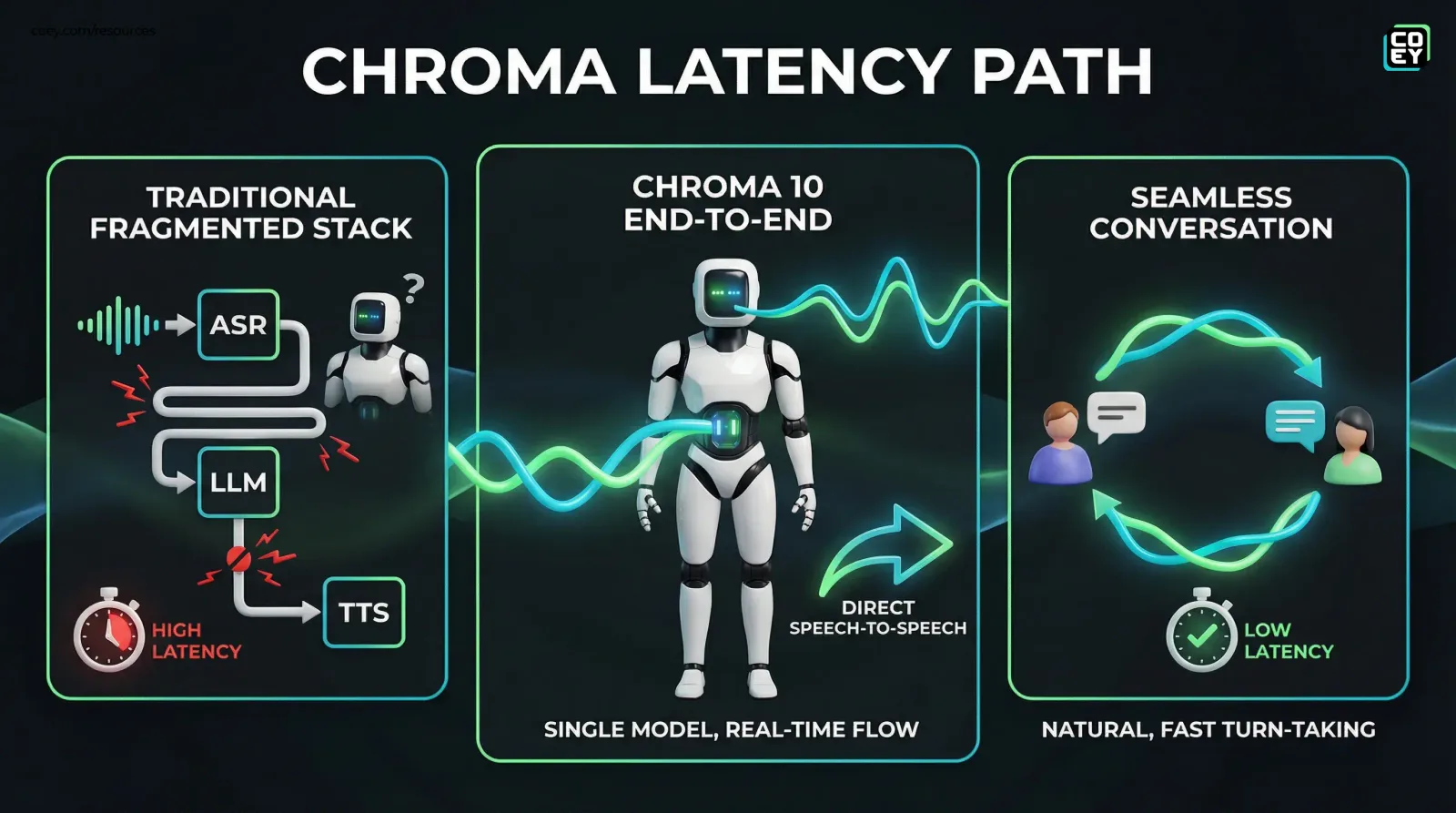
Also: latency is user experience. A human conversation has overlap, interruptions, and quick backchannels. If your bot waits like it is buffering a video from 2009, people do not think “AI is thinking.” They think “this is broken.”
Chroma 1.0 vs. the usual voice stack
| Build approach | What you manage | Operational reality |
|---|---|---|
| Classic ASR → LLM → TTS | 3+ vendors + glue code | More latency, more failure points, more billing meters |
| End-to-end speech-to-speech | One main model + your orchestration | Lower latency potential, simpler stack, easier iteration |
| Open weights (self-host) | Serving + scaling + monitoring | More control, more responsibility (choose your pain) |
Open-source is the point (not a vibe)
Chroma is not just “available to try.” FlashLabs published the weights openly on Hugging Face and the paper publicly. The model card lists the license as Apache 2.0, which is generally permissive for commercial use when you follow notice and attribution requirements. That changes the risk profile versus closed voice APIs:
Data control: sensitive calls, internal meetings, or unreleased campaign info can stay inside your infrastructure.
Cost control: you pay for compute, not per-minute margin forever.
Customization runway: you are not stuck with a vendor’s feature roadmap when you need domain-specific behavior.
But open weights do not mean plug and play. You are taking on the work that a hosted API normally hides: GPU provisioning, real-time streaming, monitoring, uptime, and guardrails. The upside is freedom. The downside is you now own the pager.
API availability: what’s callable today?
Chroma 1.0 ships as open model weights and code. FlashLabs also provides a hosted way to try it via its FlashAI voice agent experience, but the practical reality for most teams is still “your build”: you wrap the model behind your own service (REST or WebSocket) and integrate it into your stack.
For non-technical teams, translate this into: this is infrastructure-ready if you have an engineering path, or if you are working with a partner who can productize it for you. If you are hoping to connect it to Zapier tomorrow, this is not that yet.
What this looks like in real workflows
Call-center augmentation: stream audio in and out, classify intent, and hand off to humans with a structured summary.
Branded voice experiences: a consistent voice persona for product support, onboarding, or interactive campaigns.
Live localization: near-real-time voice transformation for multilingual experiences (with careful QA).
The key is you can expose Chroma as a microservice and then let your automation platform (n8n, Make, internal orchestrators) call your endpoint. That is how open models become operational: not by being open, but by being wrapped into a reliable internal product.
Real-world readiness: where it’s solid vs. spicy
Real-time speech-to-speech is absolutely trending, but not every use case is equally sane. The question is not “can it talk?” It is “can it talk with consequences without wrecking trust?”
Deployable lanes (high confidence)
Inbound triage: capture the issue, route correctly, summarize cleanly.
Status + FAQ: shipping lookups, appointment confirmations, policy answers with citations.
Lead qualification: collect fields, push into CRM, schedule follow-up.
Campaign feedback capture: turn live calls into structured objections + insights for marketing.
Still high-risk (needs guardrails + fast handoff)
Cancellations and disputes: emotional + policy-heavy + brand-risky.
Regulated categories: health, finance, legal without strict policy enforcement.
Identity and permissions: anything that changes accounts or processes transactions needs serious verification.
The model is not the system. Production voice automation requires permissions, logging, escalation, monitoring, and a kill switch, because the worst-case failure is always scheduled for your busiest day.
What it means for creative teams
The most interesting implication is not just “automate support.” It is that voice becomes a high-volume creative input stream. Every call can become structured material that feeds your content engine if you design it that way:
Objections → ad angles, landing page FAQs, sales enablement
Confusion points → onboarding improvements, explainer scripts
Feature requests → product messaging and roadmap validation
This is exactly the kind of human + machine collaboration that scales: machines handle capture and structure at speed; humans bring taste, judgment, and story.
If you want a close comparison point in the same “single-model voice loop” direction, see our internal coverage: Step-Audio R1.1 Makes Realtime Voice Agents Simpler.
Bottom line: Chroma 1.0 is credible voice infrastructure for teams who want control. If you have the ability to self-host and wrap it as a service, this is a meaningful building block for low-latency voice agents and branded voice automation. If you do not, it is still an important market signal: the three-vendor voice stack era is getting outcompeted by models that can handle the loop end-to-end.
Modernize Your Marketing With AI Agents
COEY deploys coordinated AI agent teams using n8n, Claude Cowork, and OpenClaw that compress marketing timelines from weeks to hours. See how our agentic automation works across every marketing channel, or request a proposal.