Nano Banana Pro 4K Failures Expose Pipeline Risk
Nano Banana Pro 4K failures expose pipeline risk. A practical look at QA for AI marketing automation and brand safe generative image workflows.
21 January 2026Team COEY
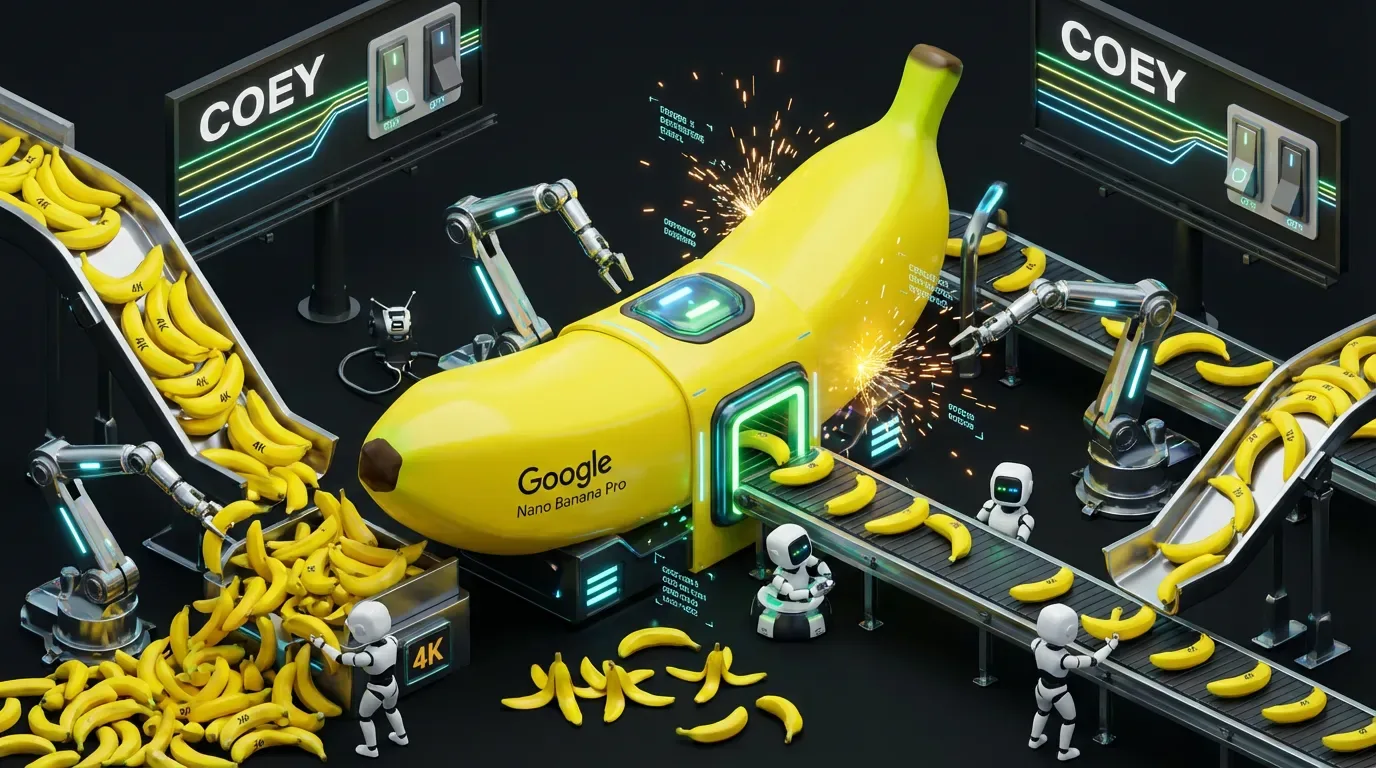
Google’s Nano Banana Pro image generation has been crashing out for a chunk of the day, and the loudest pain is showing up when teams request 4K image output. If Nano Banana Pro sits inside your automated creative pipeline (ads, PDP images, thumbnails, templates, the whole content factory), this is not a cute little hiccup. It is a reminder that even best in class models can become the weakest link when you scale.
One important clarification: the “docs” link floating around in some drafts, nanobananaproapi.org/docs, is not an official Google developer documentation property. If you want first party developer entry points, use Google’s official documentation and platforms like the Gemini API and Vertex AI.
If you need a practical baseline on how this model is positioned for automation, start with COEY’s overview: Google Nano Banana Pro: Automation-Ready Image Model.
What creators are seeing right now
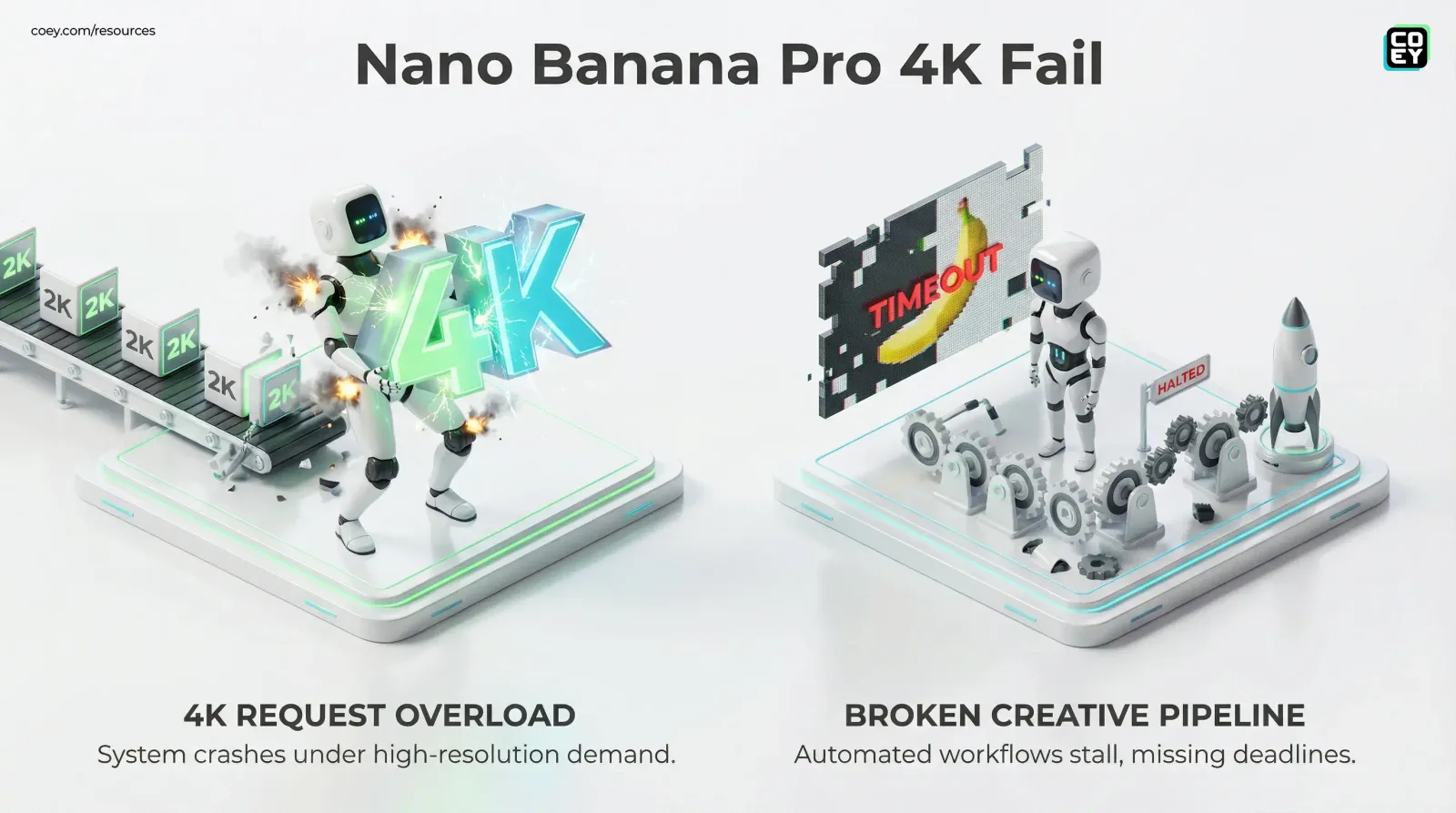
Across X, developers report 503 overload errors, timeouts, and degraded reliability when running Nano Banana Pro, with 4K generations getting hit especially hard. Lower resolution calls may still succeed more often, but 4K is consistently described as the stress point.
Translation for non technical teams: if your workflow expects a 4K image in 30 to 60 seconds and instead gets timeouts, your pipeline does not slow down. It breaks because downstream steps depend on that asset existing.
This is also the part where many teams discover they have built a modern AI pipeline that is actually just a single API call holding up an entire campaign calendar.
Why 4K is where APIs go to die
4K is the glamorous checkbox and the brutal reality in production. In automated marketing workflows, 4K is not just higher quality. It is often the minimum viable spec for:
Retail and marketplace images that need cropping flexibility
DOOH, print, and large format placements
Multi platform ad variations where you want one master asset to downscale cleanly
Generate once, repurpose everywhere content systems
The catch: 4K workloads amplify everything vendors try to hide behind “it’s serverless” vibes: queueing, throttles, concurrency caps, and background deployments. When a platform is overloaded, 4K requests are usually the first to hit the wall.
API availability: yes. Automation readiness: currently wobbly
Nano Banana Pro is positioned as an API accessible image generation model through Google’s developer platforms. In practice, that means your integration path should map to official Google surfaces like the Gemini API and Vertex AI.
For the canonical developer guidance on image generation, use: Gemini API image generation documentation.
But today’s failures are the reminder: API accessible does not automatically mean production grade under peak demand. It means easy to connect. Not impossible to break.
The operational impact on marketing teams
When image generation is embedded inside a workflow, instability does not stay contained. It cascades:
Campaign assembly breaks: your ad builder cannot render variants without the source images
Approvals get delayed: creative review tools do not receive assets, stakeholders assume the team is behind
Paid spend gets throttled: scheduled launches slip, learning phases reset, budgets get reallocated
Teams go manual: designers end up screen grabbing, upscaling, or re exporting just to ship, which defeats the whole point of automation
This is the exact moment executives ask, “Why are we relying on a single model for core output?” And the honest answer is: because it worked yesterday.
What provider agnostic actually means (in news terms)
“Be provider agnostic” gets tossed around like a motivational quote. In practice, it is an engineering decision and a workflow design philosophy: your creative system should survive a vendor wobble without a fire drill.
| Workflow design | What happens when 4K fails | Business outcome |
|---|---|---|
| Hard coded single provider | Jobs time out, pipeline stalls | Missed deadlines, manual scramble |
| Abstraction layer plus retry logic | Auto retries plus graceful fallback | Output continues, maybe slower |
| Multi provider failover | Routes to backup model or provider | Deadlines stay intact |
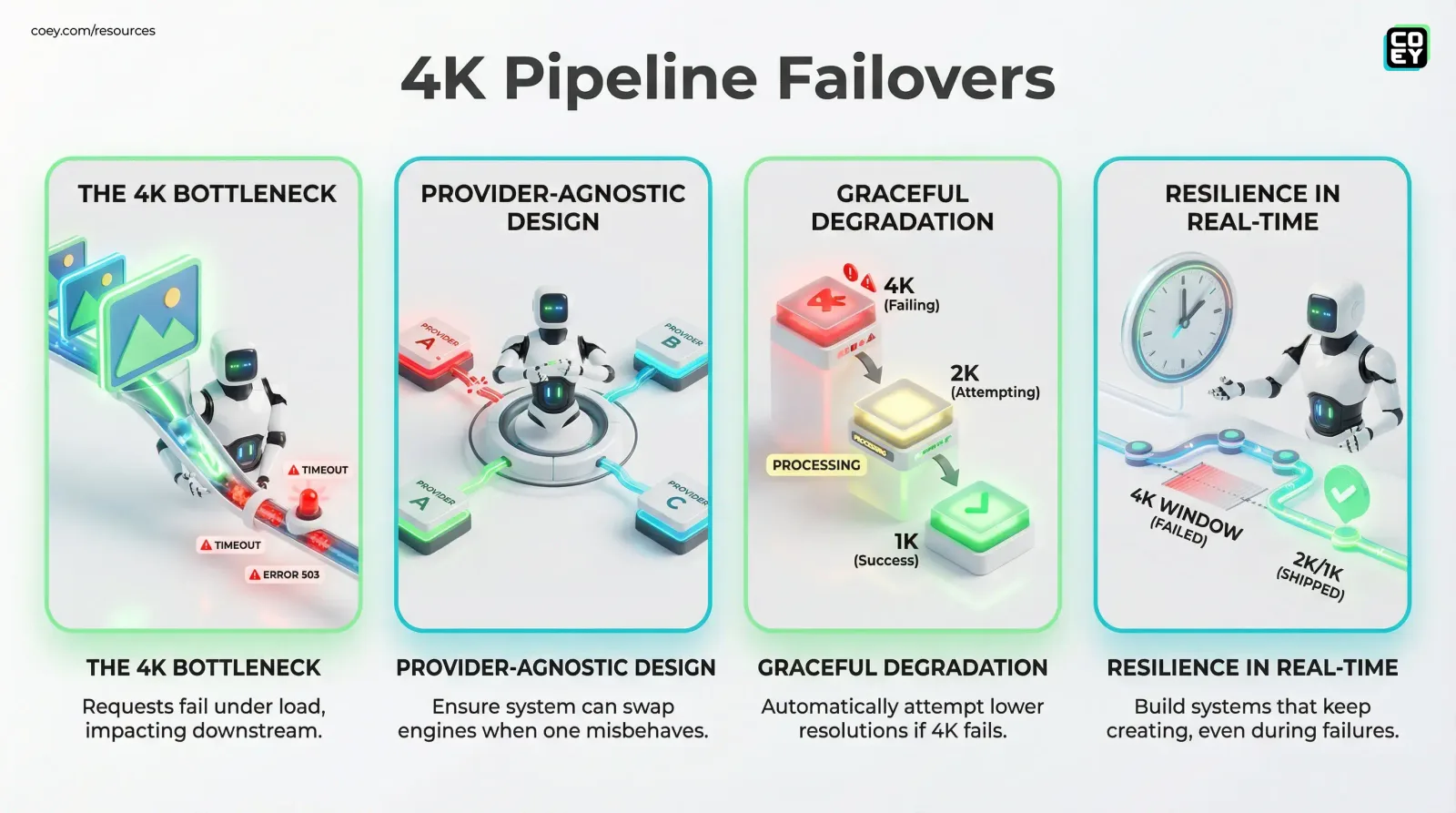
Provider agnostic does not mean “we like everyone.” It means your intent (prompt plus constraints plus brand rules) is portable, and your production system can swap engines when one misbehaves.
If you want the router pattern that makes this real, COEY has the playbook here: Model Routers: The New Marketing Switchboard.
Where this breaks the hardest: real time generation
If you are generating images in batch, you can absorb failure with retries and longer windows.
If you are generating images in real time, you are playing a different game. Real time means:
Ad variants generated on demand for a last minute media buy
Product mockups generated when a SKU goes live
Social creative generated to match trending topics because timing is the whole thing
Localization pipelines that produce country specific assets overnight
In these contexts, a temporary degradation is effectively downtime. The system is not valuable because it can generate images. It is valuable because it can generate images on schedule.
If the model cannot be depended on during the exact window you need it, it is not an engine. It is a slot machine.
How to reduce damage without rewriting everything
This incident is a good forcing function: you do not need to rebuild your stack from scratch, but you do need a few resilience muscles that most teams skip when things are humming.
Parameterize the model, do not marry it
If your workflow step is literally named “Generate with Nano Banana Pro,” you have already encoded dependency. Rename the abstraction to something like Generate Hero Image, and make the provider a variable. That one change is how you stop outages from becoming all hands events.
Add graceful degradation (4K to 2K to 1K)
If 4K fails, your workflow should automatically attempt 2K or 1080p and continue downstream while flagging the asset for later upscale or regeneration.
Build health checks into the pipeline
Before launching a batch of 500 images, run 3 to 5 test generations at the target resolution. If error rate spikes, switch modes automatically (lower resolution, different provider, or delayed run). This is basic SRE behavior, applied to creative automation.
What to watch for next
At the time of writing, there is no universally referenced official incident write up being widely linked by users in public channels, and teams are largely learning from direct experience and peer chatter. That is not unusual in fast moving AI services, but it does matter for operational confidence.
Here is what teams should watch in the next cycle:
Whether failures remain mostly 4K specific or start affecting lower resolutions
Whether Google introduces clearer status communication for the relevant cloud surfaces
Whether 4K reliability returns without changes, or whether teams need to adjust timeouts, async usage, or request patterns
If you want a place to monitor broader Google Cloud service status during an event window, use the official dashboard: Google Cloud Service Health dashboard.
What to do this week (pragmatic, not panicky)
Audit every workflow that requires 4K output and identify where failures block downstream steps.
Implement a fallback ladder (4K to 2K to 1K) so the pipeline can still produce usable assets.
Abstract your provider calls so switching endpoints is configuration, not a rewrite.
Set up basic reliability monitoring : track success rate, latency, and timeouts per resolution.
Document your backup (secondary provider or model plus prompt compatibility notes) so it is not tribal knowledge living in one person’s head.
Nano Banana Pro can still be a top tier generator. But today’s wobble is the headline: creative automation is not about picking the best model. It is about building systems that keep creating when the best model has a bad day.