
What is Clawdbot? The Self Hosted AI That Executes Tasks
What is Clawdbot? A plain English guide to the self hosted AI that executes tasks and what it means for AI marketing automation and agent workflows.
27 January 2026Team COEY

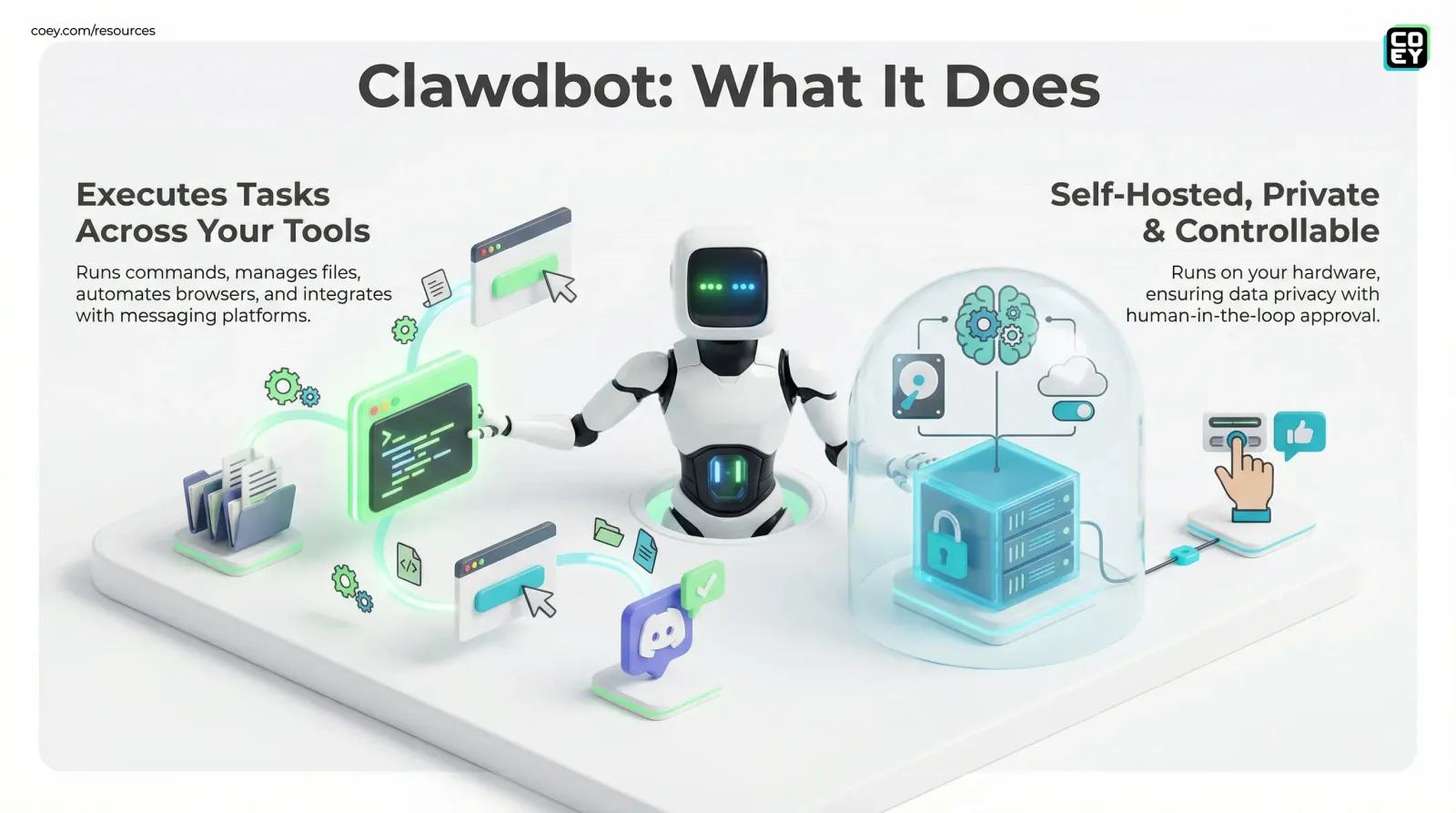
Clawdbot is a self-hosted AI assistant built for a specific kind of user: the one who is tired of AI that talks and wants AI that executes. It is positioned as a practical automation agent you can run on your own hardware or server, then message through platforms you already live in (Telegram, Discord, Slack, and more). The official front door is clawdbotai.pro.
This is part of a bigger trend: the chatbot era is getting replaced by the operator era. Less ask me anything, more here is the task, go ship it. Clawdbot is aiming to be the self-hosted, privacy-first version of that.
Translation: Clawdbot is not competing with your team’s creativity. It is competing with your team’s busywork.
What Clawdbot actually is
At its core, Clawdbot is a personal automation agent designed to operate inside your environment. That means it can touch your files, run commands, use a browser, and talk to your tools if you authorize it. The key differentiator is the self-hosted posture: you are not forced into a vendor UI, and you are not automatically sending your entire workflow through somebody else’s cloud.
A lot of agent products are essentially LLM plus integrations plus vibes. Clawdbot’s pitch is more grounded: you run it, you control it, you extend it. You babysit it as needed.
Two primary sources that confirm the positioning and distribution:
Clawdbot on GitHub (project repo, install, and architecture entry point)
clawdbotai.pro (product-facing overview)
Why creators and marketers care
If you are leading marketing, creative ops, or growth, your day is not make one perfect thing. It is:
exporting reports
resizing assets
pushing content into three systems
tracking campaign changes
cleaning spreadsheets
copying “final_final_v9” into the CMS again
That grind is exactly where agentic automation starts paying rent.
Clawdbot’s best use case is not write my brand manifesto. It is taking repeatable actions across your tools with humans setting intent and approval.
The win is not autonomy. The win is throughput with control.
What it can do (in the real world)
Clawdbot is built around execution. The practical capabilities that matter in production workflows look like this:
1) Run commands and scripts
If you allow it, Clawdbot can execute terminal or shell commands. That unlocks automation across:
file operations (batch rename, conversions)
repo workflows (linting, tests, builds)
ETL-ish tasks (transform CSVs, generate exports)
2) Work with local files
This is where self-hosted stops being a privacy slogan and becomes workflow leverage. If your assets live on a drive or server, Clawdbot can help manipulate them without uploading them somewhere first.
3) Control a browser for web tasks
Browser control is the underrated bridge between AI and automation. It is what lets an agent handle tasks that do not have clean APIs (portals, dashboards, web forms), with the usual caveat: UI automation is powerful and slightly cursed.
4) Message-based operation across platforms
Clawdbot is designed to be reachable from chat platforms, meaning the agent can become a teammate in the channel, not another tab your team forgets exists.
5) Extend via skills or plugins
Clawdbot supports a modular skills approach: add capabilities by installing community skills or building your own. That is how these systems become real inside companies, because every company’s stack is weird in its own special way.
Automation and API readiness
A lot of tools sound automatable until you ask the grown-up questions: Can we call it? Can we orchestrate it? Can we govern it?
Clawdbot’s positioning includes being controllable programmatically, and it leans heavily on API-driven integrations. It also ships tooling meant to support event-driven workflows (hooks) and callable interfaces, but the exact surface area changes quickly, so the most reliable canonical details live in the repository and its current docs rather than third-party writeups. Start with the official repo: github.com/clawdbot/clawdbot.
Here is the operational framing that matters for non-technical teams:
| Automation question | Pragmatic answer | What it means for teams |
|---|---|---|
| Can it run in your environment? | Yes (self-hosted) | Better privacy, more control, more responsibility |
| Can you trigger it programmatically? | Yes (callable interfaces and hooks are part of the pitch) | Fits n8n, Make, and custom orchestration patterns |
| Is it plug into Zapier in 5 minutes? | Usually no | Expect setup, permissions, testing, and guardrails |
If your org already thinks in webhooks and workflows, Clawdbot is closer to real than many agents because it is not trapped in a consumer chat UI.
Model backends: cloud, local, or hybrid
Clawdbot supports the idea of swapping the brain behind the agent. That matters because model choice is not a religion, it is an ops decision.
Cloud models (highest capability, higher exposure)
Using cloud LLMs tends to get you better reasoning and tool-use reliability, but you are sending prompts (and possibly content) out of your environment. This is where privacy posture and governance matter.
Local models (highest control, variable quality)
Local inference keeps data on your machine and can run offline. Clawdbot can be configured to use local model runtimes, including Ollama, but performance depends on hardware and the model you choose. If you want background context on local model ops, see Ollama Ships ARM Builds and Hardware Acceleration: Local AI Gets a Major Speed Boost.
Hybrid (the actual grown-up option)
Many teams will land on hybrid: local for sensitive tasks and internal data, cloud for heavy reasoning. That is how you scale responsibly without turning everything into a compliance fire drill.
What it can’t do (and where people get delusional)
Clawdbot is an agent, not a wizard.
It can’t access what you don’t permit. Least privilege is non-negotiable.
It won’t magically have integrations. If a skill does not exist, you build it or change the workflow.
Local models won’t match frontier cloud models in every scenario. If you are expecting perfect autonomy on a laptop, you are buying into influencer math.
High-stakes automation still needs human review. Anything destructive, financial, compliance-heavy, or brand-sensitive should have checkpoints.
The fastest way to lose trust in automation is letting it ship changes with no receipts.
Installation and setup (operational view)
This is news-style, not a step-by-step guide, so here is the real decision framework:
Deployment options
Local install for individual operators and creators
Server deployment (commonly via Docker or a daemonized service) for teams that want an internal agent others can message and trigger
You will typically set up:
model backend (cloud key or local inference)
messaging platform connectors
skills and permissions
logging and audit trail
If you are self-hosting, treat this like deploying any internal tool: basic hardening, secrets handling, access control, and versioning.
Security and privacy risks (the part people skip)
Clawdbot’s power is also its risk profile: it is close to your systems. That is the point, but it raises the stakes.
Key risks
Prompt injection: malicious inputs trying to trick the agent into unsafe actions
Over-permissioning: the classic we gave it root because it was easier
Malicious or buggy skills: third-party extensions can leak data or run unsafe code
Credential leakage: API keys and tokens must be isolated and rotated
Destructive action chains: an agent can confidently do the wrong thing very quickly
Mitigations that make it real
sandboxing or restricted execution environments
human confirmation for destructive commands
audit logs (every action, every tool call)
scoped credentials (per-skill if possible)
staging environments for agent does stuff workflows
This is also where self-hosting is a double-edged sword: you gain control, but you also inherit responsibility.
The upside: where Clawdbot is actually ready
If you want to scale human creativity through machine collaboration, Clawdbot is interesting because it targets the boring middle: the glue work between tools.
High-confidence wins
content ops automation (formatting, publishing prep, repurposing pipelines)
reporting and analytics pipelines (exports, summaries, routing to Slack)
batch file and asset workflows (renaming, conversion, QA checks)
dev and marketing glue work (landing page updates, UTM hygiene, repo chores)
Still handle with care
anything that clicks around business-critical web apps unsupervised
account permissions, billing, and irreversible actions
regulated content workflows without policy gates
The bigger signal: self-hosted agents like Clawdbot are part of the shift from AI as a chat window to AI as an internal production layer, callable, orchestrated, and governed.
And that is the lane where automation stops being hype and starts being compounding leverage.