
ByteDance Rolls Out Seedance 2.0 AI Video in CapCut
ByteDance rolls out Seedance 2.0 AI video in CapCut. What the integration unlocks for AI video marketing automation and agency social ops.
10 February 2026Team COEY
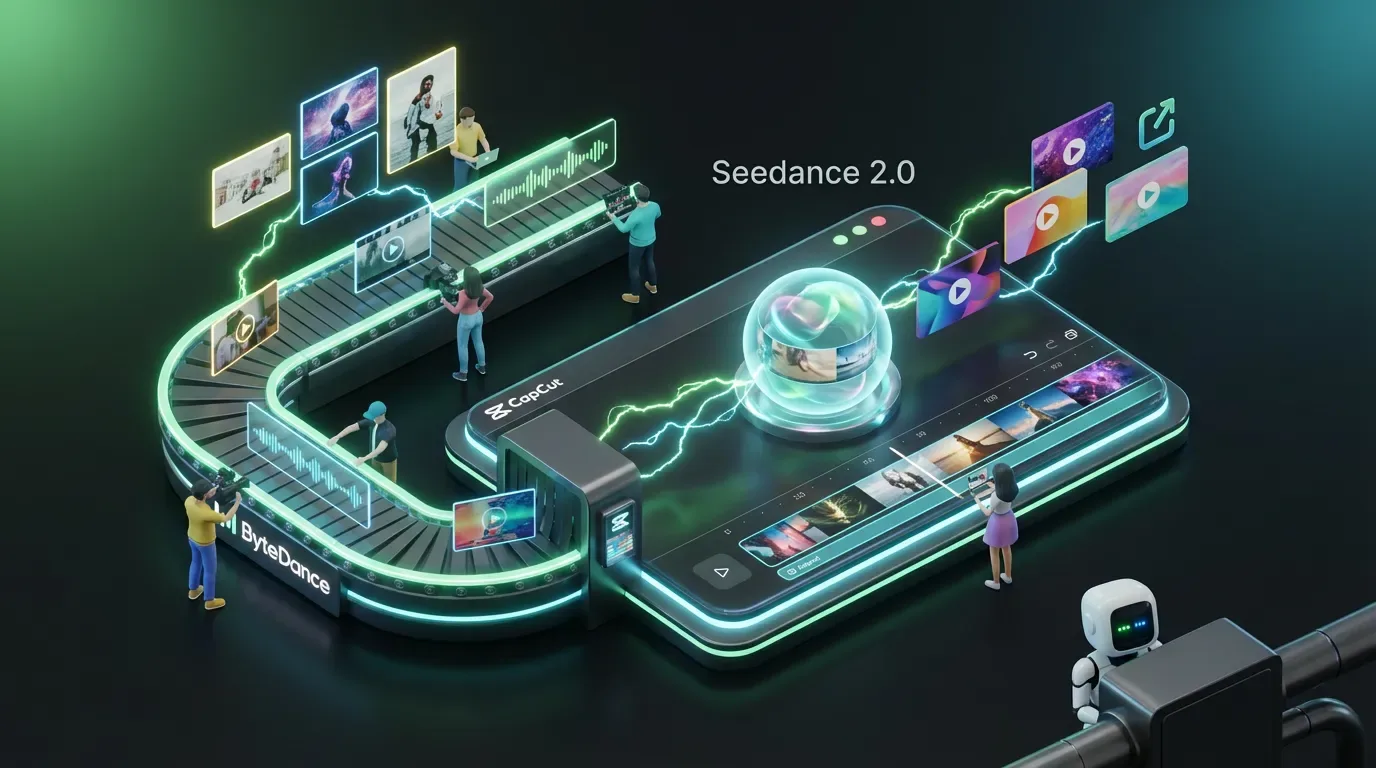
If you have been waiting for generative video to stop acting like a moody art student and start behaving like a reliable teammate, ByteDance just made a very loud move: Seedance 2.0 is now integrated inside CapCut. That means higher-fidelity AI video generation is showing up where millions of creators already edit, version, caption, and ship content.
The official product pages are live on CapCut and on CapCut’s Dreamina surface here.
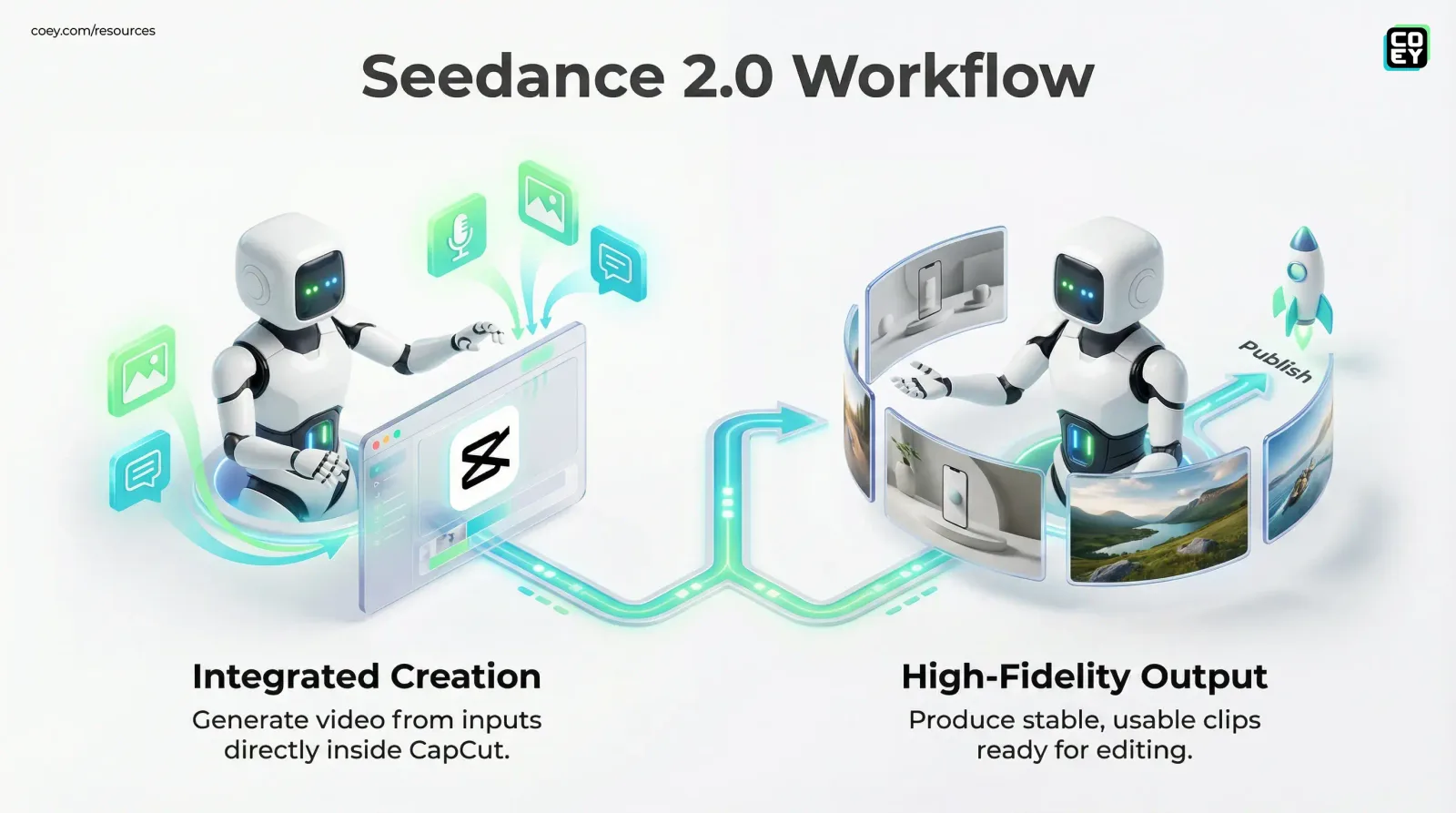
This is not just “new model, new demo.” It is distribution. The most important question for teams scaling content is not “how good is the model?” It is where does it live and whether it can slide into a real workflow without everyone rage-exporting files across five tabs.
What Seedance 2.0 actually is
Seedance 2.0 is ByteDance’s newer generative video engine positioned around higher realism, better temporal stability, and stronger multi-input control. CapCut’s own messaging leans into practical wins: smoother motion, more coherent scenes, and better adherence to what you asked for.
On the CapCut and Dreamina pages, Seedance 2.0 is framed as multimodal, not just text-only. In practice, the current tooling supports combining prompts with reference media such as images and video. Dreamina’s Seedance surface is also positioned to support audio as an input for driving timing and vibe in certain workflows.
That matters because the prompt-only era is where brand consistency goes to die. Real teams want to feed in product shots, style frames, and reference clips so the model has guardrails. Treat audio cues as a reference and control capability rather than assuming every output will always include fully generated dialogue and sound.
The big shift: Seedance 2.0 is not trying to replace editing. It is trying to make “generate a usable clip” a native timeline action like trimming, color, or captions.
Why the CapCut integration is the headline
Putting Seedance 2.0 inside CapCut is a strategic flex for two reasons:
Zero workflow friction: Your team is not learning a new AI playground, exporting MP4s, and re-importing them like it is 2014.
Speed-to-shippable: When generation sits next to captions, templates, formatting, and exports, you can iterate like a marketer, not like a VFX studio.
For creators, this means you can generate hooks, transitions, b-roll, stylized cutaways, and scene starters without leaving the editor you already use daily. For brands, it means the AI video step is closer to the rest of your production line: versioning, approvals, resizing, and channel-specific exports.
What is new versus normal AI video problems
Most generative video tools still suffer from the same three recurring nightmares:
Identity drift: the character changes face, wardrobe, or vibe mid-clip.
Motion weirdness: physics are off, limbs melt, camera moves jitter.
Scene coherence collapse: the longer the clip, the more it turns into abstract expressionism.
Seedance 2.0 is positioned as an improvement across those pain points, especially motion realism and consistency over time. CapCut’s product page leans into smooth motion and stable transitions, which is exactly what marketing teams care about when they are building modular ads where clips must survive quick cuts and repurposing across formats.
Practical implications for content teams
More first-pass usable clips , less “generate 30, keep 2” energy
Cleaner modular editing , generated shots can be rearranged without obvious seams
Less manual cleanup in the timeline, masking and patching becomes the exception, not the job
Automation potential: can you plug this into a system?
Here is the real talk: the CapCut integration is workflow-ready, but automation-ready is a separate question. CapCut is a product surface; automation requires stable programmatic access such as APIs, webhooks, job status polling, asset retrieval, and ideally metadata.
For Seedance 2.0 specifically, the public story right now is primarily in-product via CapCut and Dreamina. So today, the automation layer is best understood in tiers:
| Layer | What you can do today | What is missing |
|---|---|---|
| In-editor workflow | Generate clips inside CapCut and cut them into ads fast | True batch generation and routing |
| Team scaling | Standardize prompts plus reuse references manually | Programmatic governance and logging |
| Pipeline integration | Export outputs to DAM or shared drives like normal | Official public API endpoints specifically for Seedance 2.0 generation |
Translation for executives: This is immediately useful for teams producing volume. But it is not yet “press button, your content factory runs overnight” unless ByteDance exposes developer endpoints.
What is real in production vs what is still shiny
Seedance 2.0 has the right signals for real-world readiness because it is embedded where work already happens. But “available in CapCut” does not automatically equal “ready for fully automated creative ops.”
Solid and usable right now
UGC-style ad augmentation: generate cutaways, product moments, scene setters
Short-form content velocity: create multiple visual directions fast, then edit like normal
Pre-viz for campaigns: generate rough scenes for decks and stakeholder alignment
Still needs caution
Strict brand fidelity: logos, packaging, and regulated claims still need human review
Long narrative continuity: even improved models can drift across longer sequences
Rights and likeness issues: AI video is a compliance magnet if you get sloppy with references
If you are a brand, the safest high-ROI use is: use Seedance 2.0 for non-claim, non-regulated visual moments like transitions, scenes, vibes, background action, and keep your truth anchors under human control.
What this changes for creative ops
CapCut has already been the default editing home base for a huge portion of the social internet. Adding a higher-quality generative engine inside the same interface compresses the creative cycle:
brief → generate options → pick winners → edit → captions → exports
It all happens without swapping tools. Human intent stays central, while the machine collapses the grind of creating variants, filling gaps, and generating extra coverage.
The compounding advantage: variants
If Seedance 2.0 increases the usable output rate even modestly, it changes weekly throughput. Marketing does not scale by making one perfect video. It scales by producing enough good videos that performance data can select winners.
Competitive context: distribution beats demos
Every AI video company has a highlight reel. The difference here is that ByteDance controls a massive creator ecosystem and has a proven habit of making new creation behaviors feel normal. CapCut is not a lab. It is where content actually gets made.
That puts pressure on competitors who are still living in standalone apps or gated platforms. A model can be technically superior and still lose, because creators pick what plugs into their day.
If Seedance 2.0 keeps improving and ByteDance opens clearer automation hooks over time, this becomes more than a creator feature. It becomes an infrastructure play: AI video generation as a standard capability inside a mainstream editor.
Bottom line
Seedance 2.0 landing inside CapCut is a meaningful step toward generative video that behaves like a real collaborator, not a novelty. The biggest win is workflow gravity: creators and marketing teams can generate higher-fidelity clips directly inside the tool they already use to publish at speed.
Automation-wise, the opportunity is obvious: batch variants, prompt-to-timeline, localized creative at scale. But the current public integration story is still mostly UI-first. For now, treat Seedance 2.0 as a high-velocity creative accelerator you can deploy immediately, while watching closely for developer access that turns this from fast editing into creative pipeline infrastructure.
Related on COEY: Runway Gen-4.5: Top-Rated AI Video Goes Pro
Scale Your Content With AI Agents That Deliver
COEY helps brands and agencies automate content creation, marketing ops, and campaign execution using n8n, Claude Cowork, OpenClaw, and custom integrations. See how our agentic automation works across every marketing channel, or request a proposal.
For senior marketing leaders evaluating the broader shift, our Executive AI Accelerator is a confidential top-to-top engagement. For a structured blueprint, read How to Build an AI Content System.