
Inception Labs’ Mercury 2 Makes Text AI Feel Live (and That’s the Point)
Inception Labs Mercury 2 makes text AI feel live, and that is the point. What it unlocks for real time AI marketing automation and agent workflows.
24 February 2026Team COEY
Inception Labs just shipped Mercury 2, positioning it as the first production-ready “reasoning diffusion” LLM, and the claim is not just academic. The pitch is simple: stop generating language one token at a time like it is a typewriter, and start producing responses fast enough that AI can actually sit inside real-time products and automation loops without turning every user interaction into a loading screen.
Speed is not a vanity metric anymore. In agent workflows, latency is the hidden tax that kills throughput, breaks UX, and makes “AI teammates” feel like sleepy interns.
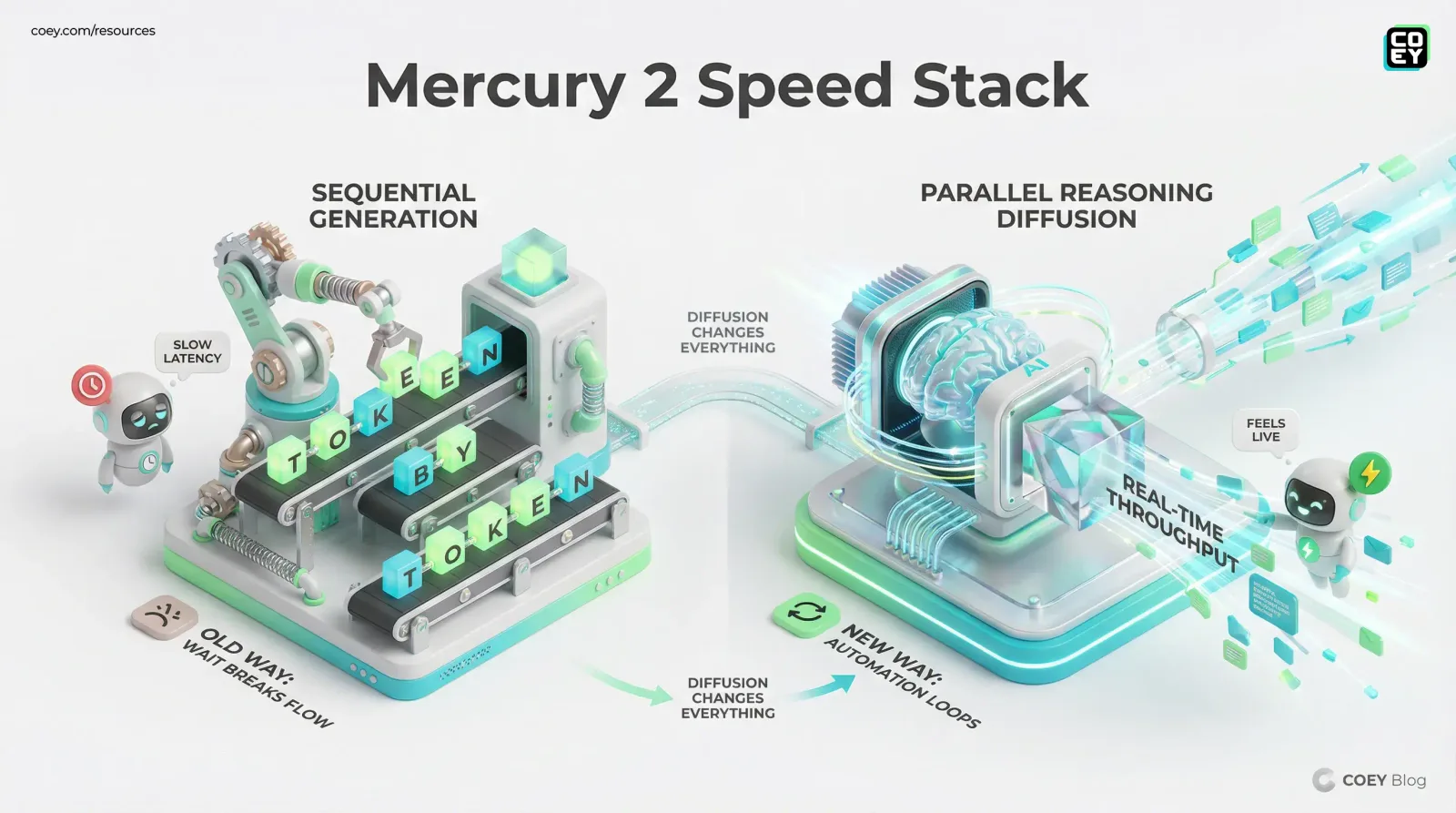
The headline number Inception keeps repeating is about 1,000 tokens per second on NVIDIA H100 GPUs, and the bigger headline is architectural: Mercury 2 uses a diffusion-style generation process adapted for text, where output is refined in parallel rather than decoded left to right. If that holds up in real deployments, this is less “new model drop” and more “new serving primitive.”
What “reasoning diffusion” changes
Most LLMs you use today are autoregressive: they predict the next token, then the next, then the next. That sequential loop is the bottleneck. It is why even strong models can feel sluggish in:
voice and live chat
multi-step agents (plan → tool call → revise → retry)
in-editor copilots where waiting breaks flow
high-volume content systems where latency compounds across thousands of calls
Mercury 2’s diffusion framing is closer to how image diffusion works: generate a rough draft “all at once,” then iteratively denoise and refine it. The practical impact is that inference becomes more parallelizable, which helps the GPU stay busy doing larger chunks of work instead of stalling on sequential token-by-token decoding.
Inception is calling it “reasoning diffusion” because the model is positioned to keep reasoning quality in the workhorse tier while moving the experience from chat to live interaction. That is the bet: not just faster output, but faster output that still holds up in real tasks.
API reality: yes, it is callable
Mercury 2 is not trapped in a demo UI. It is available via the Inception API, and Inception frames it as OpenAI API compatible, meaning teams already integrated with OpenAI-style endpoints can often swap endpoints and models with minimal refactoring. That matters because “nice model” becomes “usable model” the moment it is frictionless to test inside your stack.
Inception also publishes developer docs here: Inception API Get Started. The model lineup is listed on their models page as well: Inception Labs Models.
Automation readiness snapshot
| Question | Mercury 2 answer | What it means for teams |
|---|---|---|
| Can we automate it? | Yes (hosted API) | Callable from any workflow tool that can hit HTTPS |
| Will it plug into our existing LLM code? | Often yes (OpenAI-compatible) | Lower switching cost for pilots and A/B testing |
| Is it real-time ready? | That is the positioning | Still validate under your concurrency plus context sizes |
One extra detail that is quietly useful: Inception’s public API materials document a diffusing parameter for visualizing intermediate refinement steps during streaming. If you plan to rely on intermediate-step streaming for debugging or traceability, confirm the exact behavior you need in your own tests before building around it.
Why this matters for marketing plus creative ops
Marketing teams do not have an “LLM quality” problem as much as they have a workflow physics problem. The modern content machine is not one prompt. It is a chain:
ingest brief → extract constraints → draft variants
generate channel adaptations → format for tools
run compliance and claims checks → route approvals
publish and schedule → summarize performance → iterate
Every step adds model calls. Every call adds latency. And latency compounds until your automation becomes a glorified waiting room.
If Mercury 2 genuinely delivers a step-function latency reduction, it unlocks three things that actually scale creativity:
1) Higher throughput in agent loops
Agentic workflows are not cheap because they are not one-shot prompts. They are iterative. Faster inference makes it more realistic to run:
planner plus critic loops (draft → critique → rewrite)
tool-using loops (research → extract → generate → verify)
multi-asset packaging (one brief → 20 deliverables)
2) “Feels live” UX in creator tools
This is the Canva and Figma effect: when feedback is instant, iteration becomes playful and productive. When feedback is delayed, users stop exploring. A model that responds fast enough to feel embedded, not called, changes adoption dynamics.
3) Cost control via efficiency, not just pricing
Even if token pricing is competitive, the bigger budget win is doing more work per GPU-second. Inception’s Mercury 2 messaging emphasizes dramatically lower inference cost via throughput and utilization. Treat exact savings multiples as workload-dependent and validate with your own context sizes and concurrency.
Where Mercury 2 looks production-ready
Speed claims are fun, but production-ready means stable API, predictable behavior, and integration patterns that survive real-world abuse. Mercury 2’s strongest “ready now” lanes are the ones that benefit immediately from low latency without requiring the model to be an omniscient oracle.
Latency-critical experiences
interactive web chat that feels snappy
in-product copilots where responses cannot lag
real-time assist for sales and support agents (summaries, suggested replies)
High-volume content operations
variant generation (ads, hooks, CTAs) at scale
formatting plus transformation (CMS fields, metadata, localization drafts)
batch summarization pipelines (calls, notes, research corpora)
Tool-using agents with tight loops
multi-step automation where each step is bounded and verifiable
internal workflow bots that create structured outputs (JSON, tickets, tasks)
The model is not the workflow. Mercury 2 can reduce the latency tax, but you still need guardrails: validation, retries, permissions, and logging, or you will just ship faster chaos.
The realism check: speed does not delete the hard parts
Mercury 2’s architecture is genuinely interesting, but teams should keep a few pragmatic questions front and center before declaring victory:
Latency under load
Benchmarks on H100s are great. Your product runs at peak traffic with long contexts, tool calls, and multiple simultaneous users. Test concurrency, not just single-request speed.
Structured output reliability
For automation, the win condition is often “returns valid JSON every time,” not “writes beautiful prose.” A fast model that occasionally breaks formatting will still break pipelines, just faster.
Diffusion-style generation behaviors
Diffusion can change how models behave with partial outputs, streaming, and self-correction. That might be a feature or a risk depending on your application.
What this signals for the LLM market
Mercury 2 is part of a broader shift: LLMs are being judged less on best answer and more on best system component. Autoregressive decoding is a known bottleneck. Every lab is trying to attack it through model architecture, serving tricks, speculative decoding, distillation, or hardware co-design.
Inception’s bet is that diffusion-style generation can be the architectural leap that makes reasoning feel real-time. If it works, we will see diffusion LLMs move from novel to default in any workflow where speed is the gating factor.
And for COEY’s world, scaling creativity through intelligent machine collaboration, that matters because speed is what turns AI from an occasional assistant into continuous infrastructure. Humans keep intent. Machines keep momentum. Mercury 2 is aiming directly at the momentum problem.
Modernize Your Marketing With AI Agents
COEY deploys coordinated AI agent teams using n8n, Claude Cowork, and OpenClaw that compress marketing timelines from weeks to hours. See how our agentic automation works across every marketing channel, or request a proposal.