
xAI has turned Grok’s image skills into something operators can actually use: a callable image generation and editing API, documented in xAI’s image generation guide (xAI image generation guide). If you’re a marketer or exec trying to scale creative output, this is the difference between “cool image tool” and repeatable production infrastructure because once an image model lives behind an endpoint, it can live inside your workflows.
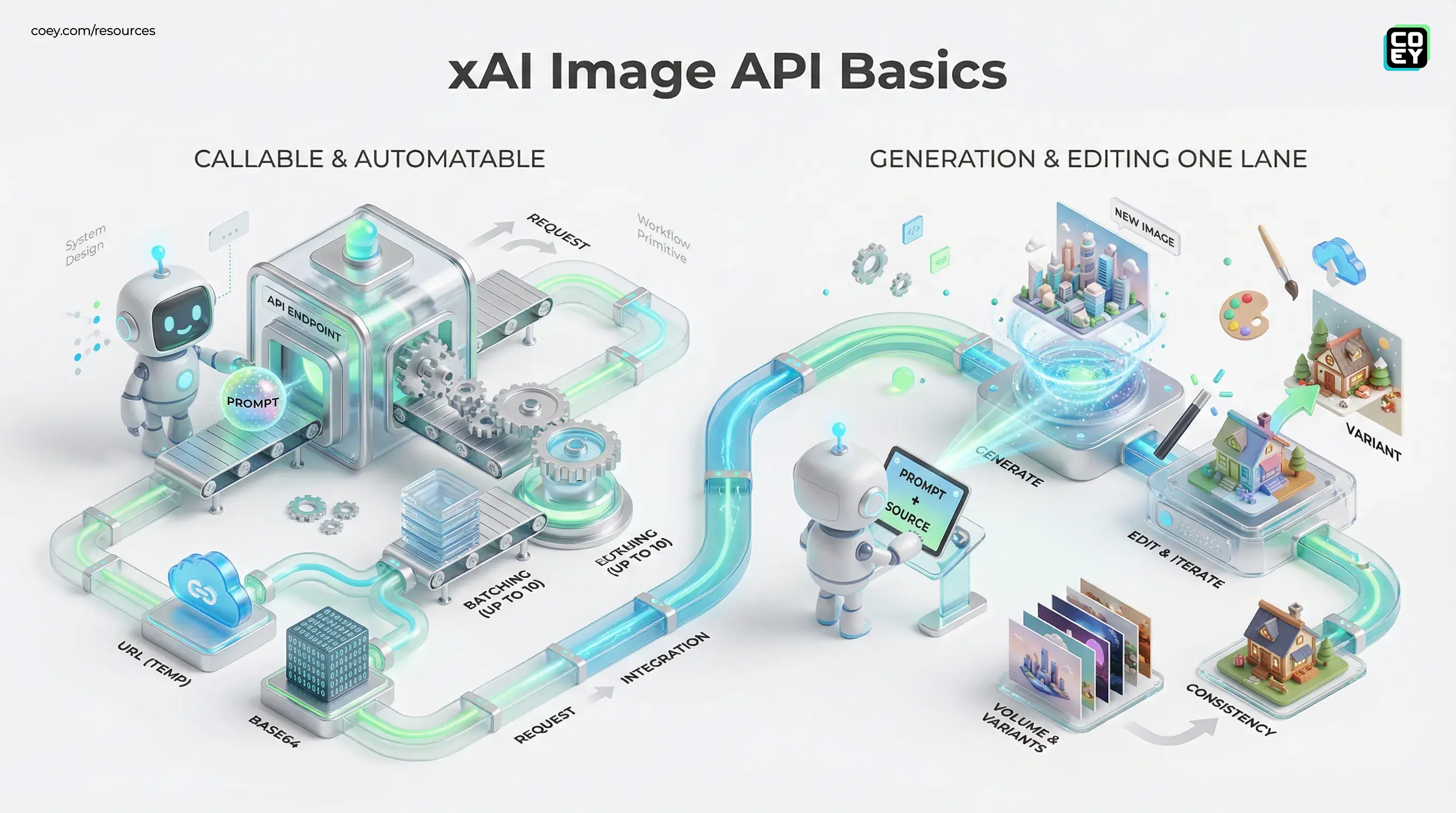
If it’s callable, it’s automatable.
If it’s trapped in a UI, it’s basically arts-and-crafts with extra steps.
What xAI actually shipped
The headline is simple: text-to-image plus image editing via the xAI API. The API image endpoint is served from the /v1/images/generations route, and the request shape mirrors what most teams already understand from modern AI APIs: you send a prompt, you get back images.
Model naming note: At launch and in some coverage, the image model was referred to as grok-2-image-1212. In current xAI docs and examples, the image model is commonly referenced as grok-imagine-image (and in some contexts grok-imagine-image-pro). If you’re implementing today, use the model names shown in the docs and your xAI Console, not an older alias.
Two operational details matter immediately:
- Batching is supported: you can request multiple images in a single call (commonly up to 10 via a parameter like
n). - The output is integration-friendly: results can return as temporary URLs or as base64 payloads, depending on what your pipeline needs.
For broader product context and official API posture, the entry point is xAI’s developer hub (xAI API).
If you want COEY’s earlier workflow focused context on these image models, see xAI’s Grok Imagine Image Models Are Here and They’re Built for Throughput.
The endpoint reality: generation and editing are one lane
xAI’s image API is designed so teams don’t have to juggle separate “generate” and “edit” products. The workflow is essentially:
- Generate from a prompt
- Or pass a source image plus prompt to modify it (edit behavior depends on the parameters supported in the current API)
The standard endpoint shown across references is:
POST https://api.x.ai/v1/images/generations
This matters because in real creative ops, “one-and-done generation” is the minority use case. The majority is iteration: background swaps, seasonal updates, localization, “make it more premium,” and “legal says the product can’t be shown that way.”

Output handling: URL vs base64 (and why this decides your automation design)
By default, the API commonly returns images as URLs, and xAI notes those URLs are temporary (xAI image generation capability page). That’s not a flaw. It’s a systems design requirement.
If you’re building automation, you need to decide which of these worlds you live in:
| Output mode | What you get | Best for |
|---|---|---|
| Temporary URL | A hosted link you must fetch quickly | Simple pipelines, quick review links, lightweight integrations |
| Base64 | Image bytes in the response | Direct upload to DAM or CMS, immediate transformations, fewer moving parts |
Translation for non-technical leaders: temporary URLs mean your workflow must immediately download and store the asset, or your automation will randomly “lose” files later. Base64 is heavier but more deterministic for pipelines.
Throughput knobs: batch size plus rate limits
xAI’s image API supports generating up to 10 images per request (commonly via n). That’s enough to make variant production practical without building your own batching layer.
On throughput constraints, launch coverage cited pricing at $0.07 per image and rate limits around 5 requests per second for the image generation API at launch (TechCrunch coverage). In practice, your effective limits and any updated pricing depend on your xAI account and current Console settings, so treat those numbers as a baseline reference, not a contractual guarantee.
- This is priced and shaped for repeated use, not just occasional play.
- If you’re doing performance creative, the unit economics are at least legible enough to model.
Automation readiness: what’s real today
This is where “image model” becomes “creative infrastructure.” If you can hit an endpoint, you can wire it into:
- n8n, Make, Zapier HTTP modules (trigger to generate to store to notify)
- CMS workflows (generate header images for posts on publish)
- Product feed enrichment (SKU data to lifestyle image variants)
- Ad variant pipelines (creative angles to 5 to 10 visual directions each)
Here’s the practical readiness snapshot:
| Workflow question | Practical answer | What it unlocks |
|---|---|---|
| Can we automate it end-to-end? | Yes, it’s API-first | Scheduled jobs, triggers, batch runs |
| Can we integrate with existing storage? | Yes, but mind temp URLs | Immediate download to DAM or CMS upload |
| Is editing included? | Yes, prompt-based edits with an input image (per current API capabilities) | Faster iteration loops, less designer grind |
Where this helps marketing teams immediately
The biggest wins show up where you need volume plus consistency, not one perfect hero image.
Performance creative at scale
If you’re running paid social, you already know the meta-game: test aggressively, kill losers fast, scale winners. Grok’s image API fits that reality because it can produce:
- multiple concepts per angle
- multiple variants per placement size (where supported by allowed sizing or aspect options)
- fast “new background, new vibe, new scene” iterations
The workflow shift isn’t “AI makes ads.”
It’s “AI makes draft inventory,” and humans pick the winners.
Content ops: visual support without bottlenecks
Blogs, newsletters, internal decks, landing pages. Most teams don’t need museum-grade art. They need on-brief visuals quickly so the content machine doesn’t stall waiting for design bandwidth.
Localization and seasonal refresh
The editing path is the sleeper feature for ops. If you can take an existing asset and prompt-edit it, you can systematize:
- holiday swaps
- regional cues
- background changes
- mood shifts per audience segment
The adult supervision section: what to watch
Even when the API is real, production readiness still has tripwires.
Temporary URLs force discipline
If your pipeline doesn’t immediately store assets, you’ll get broken links and missing files later. Classic “automation that worked yesterday” pain.
Policy and brand safety are not optional
xAI applies moderation and restrictions around image generation in response to abuse concerns, and access can be gated by plan or product tier (AP reporting). For brands, the key point is: your workflow should expect refusals and have fallback logic (retry with a safer prompt, route to a human, or switch providers).
“API available” doesn’t mean “autopublish”
If you’re pushing outputs directly into live ads or public pages, you still need:
- approvals
- logging
- versioning
- rollback paths
Because the model is not the system. The system is the model plus your guardrails.
Bottom line
xAI’s Grok image generation isn’t just another shiny generator. The meaningful development is that it’s available as a callable API with practical batch behavior, flexible output handling, and an edit loop. Exactly the ingredients you need to treat image generation as a workflow primitive.
For teams scaling creativity, this is the lane that matters: humans set intent and taste; machines generate and iterate at volume; systems route outputs through approvals and storage. Grok’s image API is built to be part of that system, assuming you respect the unsexy parts like temp URL handling, moderation fallbacks, and ops-grade governance.
Put AI to Work for Your Marketing Team
COEY builds AI marketing systems that actually run, not just demo well. From n8n-powered automation to Claude Cowork and OpenClaw integrations, we connect the tools your team needs into workflows that deliver. Explore our channel capabilities, see our AI Studio, or request a proposal.