xAI’s Grok Imagine Image Models Are Here and They’re Built for Throughput
xAI’s Grok Imagine Image Models Are Here and They’re Built for Throughput
February 7, 2026
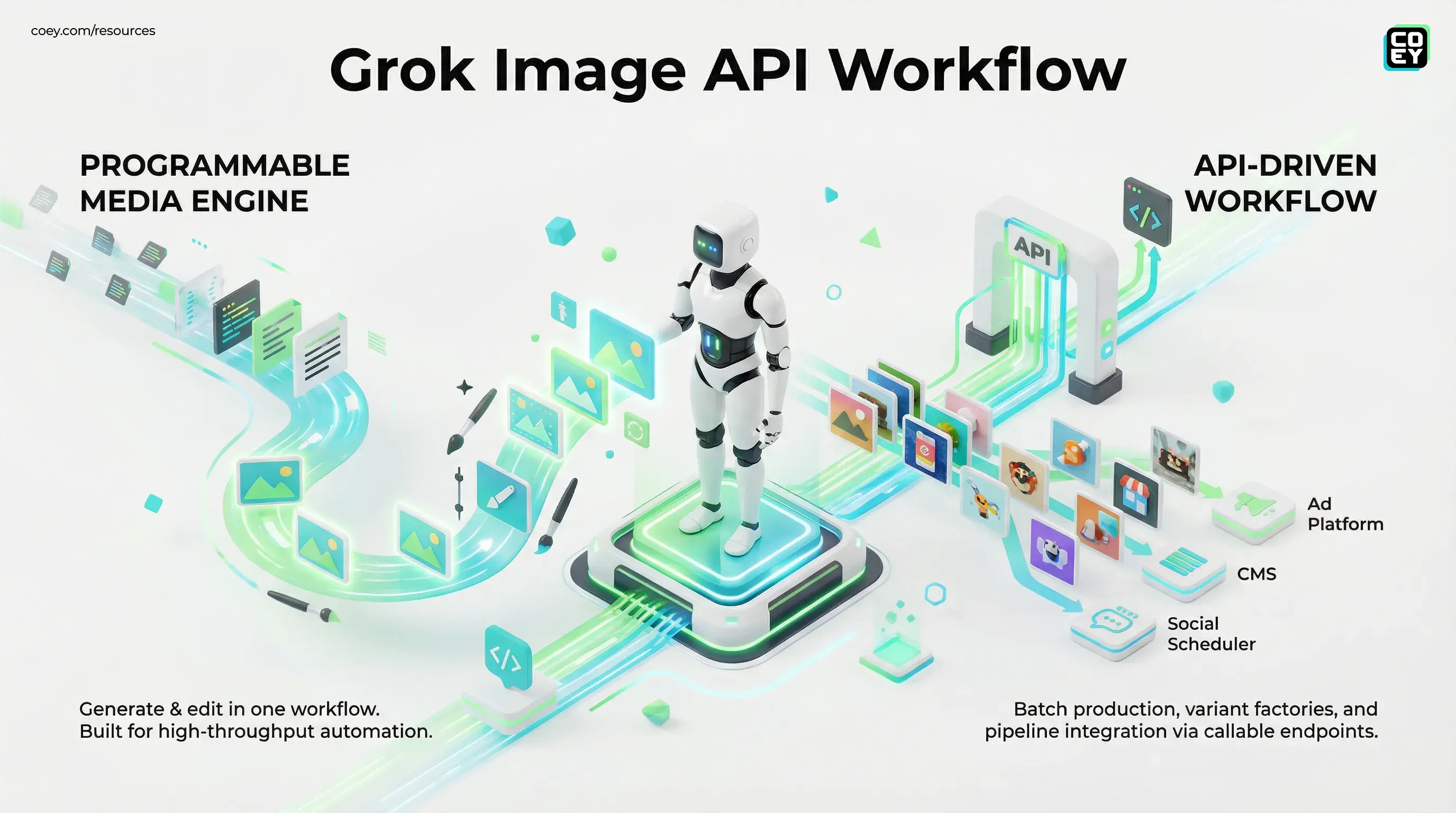
xAI just expanded Grok’s creative arsenal with two image generation models: Grok Imagine Image and Grok Imagine Image Pro. The headline is not “another text to image model.” It is that Grok is turning into a programmable media engine, one that can generate and edit images in a single workflow, and can be called via API. The official entry point is xAI’s developer documentation for image generation: https://docs.x.ai/docs/guides/image-generations.
Translation for marketing and creative ops: this is moving from “make me a cool picture” to “ship 300 variants overnight, routed into our approval pipeline.” That is the difference between vibes and systems.
xAI’s positioning also lands at a very specific moment: image generation is no longer competing on raw quality alone. The real battleground is workflow readiness, editability, repeatability, cost control, and whether your team can plug it into the stack without turning your designers into prompt babysitters.
What actually shipped (not just hype)
Both models are designed for text to image generation and image editing (including inpaint and outpaint style changes) as part of one system. That unified “generate plus revise” loop matters because most marketing work is not one shot creation. It is iterative production: new crops, new CTAs, product swaps, localization, seasonal refreshes, and the inevitable “can we make it feel more premium?”
Grok Imagine Image vs. Pro
- Grok Imagine Image: the fast, scalable workhorse. Think high volume asset generation, quick iterations, and “good enough to test” outputs that can still look polished.
- Grok Imagine Image Pro: tuned for higher fidelity and stronger edit performance. In public, xAI has positioned “Pro” as the higher quality option for teams that care about consistency and adherence across variations.
xAI has not framed this like a boutique “artist model.” It is framed like infrastructure: a model family intended to run in production loops where speed and consistency are measurable, not vibes based.
API availability: this is the unlock
The most operationally meaningful detail is that xAI supports programmatic image generation through its developer platform. If your team is allergic to engineering details, here is the simple test: Can we call it from software? Yes, via the xAI image generation guide: https://docs.x.ai/docs/guides/image-generations.
As documented, the API supports generating multiple images per request (up to 10), and returning results as URLs or base64 payloads (commonly exposed as url or b64_json response formats). For automation teams, that means you can wire this into:
- Creative request intake: brief form to structured prompt to batch images
- Variant factories: one concept to 30 headlines to 30 images
- Localization loops: same layout logic with language and cultural cues swapped
- Catalog enrichment: SKU feed to per SKU lifestyle images
Rule of thumb: UI tools help individuals. APIs help teams. If it is callable, it is composable, and composable is how you scale creativity without scaling headcount.
Automation potential: where this plugs in fast
Most orgs do not need “the best image model on earth.” They need a model that fits inside a repeatable system: triggers, batch jobs, approvals, storage, and distribution. With API access, Grok’s image models can behave like a service inside your pipeline rather than a destination app you visit.
What “automation ready” looks like
| Workflow need | What Grok supports | Why it matters |
|---|---|---|
| Batch production | Multi image requests via API | Variant volume becomes cheap and schedulable |
| Edit loops | Generate plus edit in one model family | Fewer handoffs, fewer tool jumps |
| Pipeline integration | HTTP callable endpoints | Works with orchestration tools and custom apps |
If you have ever tried to operationalize image generation at scale, you know the pain is not generation. It is the messy middle: naming conventions, versioning, approvals, “which variant shipped,” and keeping brand control when the model gets creative in the wrong direction.
Real world readiness: what to trust, what to verify
This is where we stay grounded. Grok’s image capabilities are meaningful, but “ready” depends on your tolerance for variability and how strong your guardrails are.
Where it is ready now
- Performance creative testing: generating lots of visual angles quickly (hooks, backdrops, compositions) to find what converts.
- Content ops throughput: producing supporting graphics for blogs, email, social, and internal decks without waiting on a full design cycle.
- Template driven production: when your prompts are structured and your outputs are reviewed through a consistent QA step.
Where teams still get burned
- Exact product fidelity: if you need pixel accurate packaging, regulatory perfect claims placement, or strict brand layout rules, you still want human checks and possibly traditional design tooling in the final mile.
- Consistency across long runs: “Pro” helps, but consistency is a system problem: prompt templates, reference assets, and automated QA matter more than hope.
- Policy and safety edges: xAI has faced public scrutiny around explicit and nonconsensual image generation, and has implemented restrictions and geoblocking in some contexts, which is relevant if you are deploying in multiple markets or categories (https://apnews.com/article/f0d62ec68576dcfe203cada2424bd107).
Operational truth: a model is not a workflow. If you do not have approvals, logging, and rollbacks, you do not have automation. You have fast chaos.
Why this matters for marketers (and execs)
The strategic implication here is bigger than “xAI now does images.” It is that Grok is becoming a multi format collaborator that can sit inside production systems. xAI has been building a developer platform across modalities, and image generation fits neatly into the same direction we have been tracking: models that do not just create, but can be orchestrated.
This is especially relevant for teams already thinking in automation primitives:
- Inputs: briefs, product feeds, campaign calendars
- Transforms: generate to edit to version to QA
- Outputs: ad platforms, CMS, DAM, email, social schedulers
In that world, Grok Imagine Image is not competing with a designer. It is competing with your organization’s current bottleneck: the slow, manual production layer between “we have an idea” and “we have 50 shippable variations.”
The bottom line for creative automation
Grok Imagine Image and Grok Imagine Image Pro are notable because they are built around the loop that real teams live in: generate, revise, produce variants, repeat, and they are accessible through documented xAI endpoints rather than being trapped as a closed UI feature.
If you are leading marketing, the pragmatic play is simple: treat this like a new production node. Start with a narrow workflow (ad variant testing, blog and social graphics, catalog lifestyle images), wire it into an approval step, and measure what matters: throughput, cost per usable asset, revision cycles, and brand consistency.
For a related workflow signal on Grok’s creative direction, see COEY’s coverage of Imagine expanding into short video: https://coey.com/resources/blog/2026/01/23/grok-imagine-adds-10-second-video-with-audio/.
Because the future is not human or machine. It is human intent plus machine throughput, and this launch is xAI raising its hand to be part of the throughput layer, not just the chat layer.
Put AI to Work for Your Marketing Team
COEY builds AI marketing systems that actually run, not just demo well. From n8n-powered automation to Claude Cowork and OpenClaw integrations, we connect the tools your team needs into workflows that deliver. Explore our channel capabilities, see our AI Studio, or request a proposal.
For senior marketing leaders evaluating the broader shift, our Executive AI Accelerator is a confidential top-to-top engagement. For a structured blueprint, read How to Build an AI Content System.