Meta’s Muse Spark Wants to Be Your Workflow Layer, Not Just Your Chatbot
Meta's Muse Spark pushes AI beyond chat toward real workflow orchestration across Meta surfaces. What it means for agency and brand content teams.
10 April 2026Team COEY

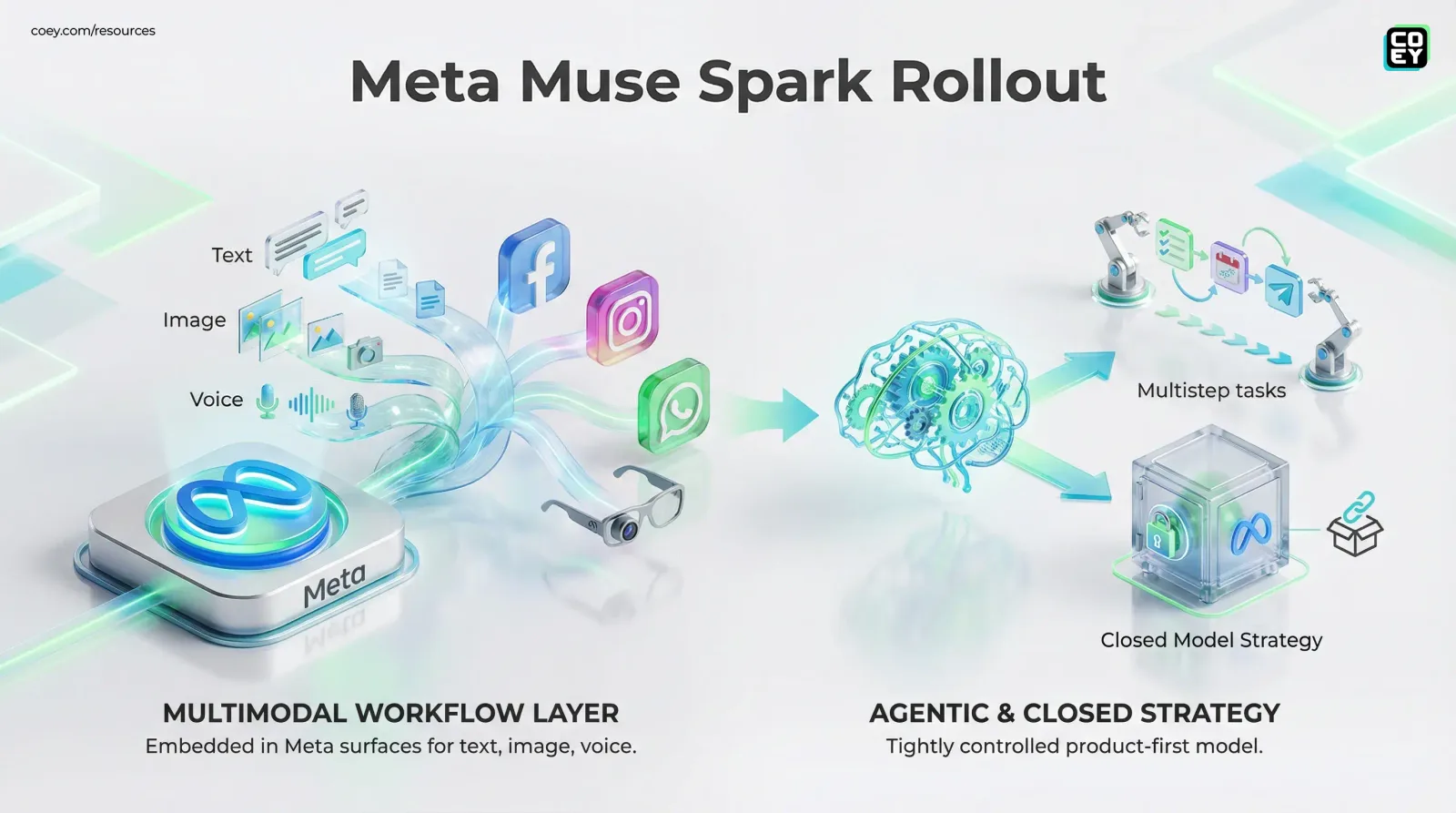
Meta has introduced Muse Spark, a new closed multimodal model now powering Meta AI in the Meta AI app and on meta.ai in the U.S., with rollout planned across Facebook, Instagram, Messenger, WhatsApp, and Meta’s AI glasses in the coming weeks. That is the official news. The more useful story for executives, marketers, and creators is what Muse Spark signals about where Meta thinks AI should live: not as a separate novelty tab, but as a native layer inside the places people already post, message, shop, and manage attention.
This matters because AI launches are now splitting into two camps. One camp says, “Here is a powerful model, go build with it.” The other says, “Here is a powerful model, but you’ll use it inside our product first.” Muse Spark lands very clearly in camp two. That makes it less open than many teams would like, but potentially more relevant to everyday work if Meta actually embeds it well. Distribution still matters. Annoyingly, it always has.
The real question is not whether Muse Spark is smart. The real question is whether it becomes a dependable collaborator inside creative and marketing workflows, or just another polished assistant that can talk a big game and then politely strand you in the UI.
What Meta actually shipped
Muse Spark is Meta’s first major public model from Meta Superintelligence Labs, and Meta says it is designed for multimodal reasoning across text, images, and voice, along with stronger tool use and more agent-like behavior than earlier consumer-facing Meta AI systems. Meta is also positioning it as capable of deeper reasoning, including a “Contemplating” mode for more complex tasks that need extra analysis before answering.
In plain English, Meta wants this thing to do more than answer prompts and generate cute one-off outputs. Muse Spark is supposed to handle more context, work across modalities, and push toward longer chains of work inside Meta’s own surfaces.
What stands out
Multimodal input: text, image, and voice handling in one system.
More agentic behavior: Meta says it is better suited for multi-step tasks instead of single-turn chat.
Product-native deployment: Meta AI app and meta.ai first in the U.S., then expansion across Meta’s ecosystem.
Closed model strategy: unlike Llama, Muse Spark is not an open-weight release.
That last point is not a side note. It is one of the main strategic shifts here. Meta spent years building credibility around openness with Llama. Muse Spark moves the company toward a more tightly controlled product-first model, which is a fancy way of saying: Meta would prefer that the best toys stay in the Meta theme park for now.
Why this is bigger than a model launch
Muse Spark matters less as a benchmark story and more as an infrastructure story. Meta owns some of the most important surfaces in digital communication and marketing: social feeds, messaging channels, creator ecosystems, ad environments, and increasingly commerce-adjacent experiences. If Muse Spark becomes the intelligence layer across those surfaces, it could quietly reshape how content gets drafted, adapted, and deployed.
That is where the practical upside shows up. A lot of AI tools still create workflow drag because teams have to jump out of the environment where they work, go prompt somewhere else, then manually bring outputs back. Muse Spark’s clearest advantage is proximity. It is being inserted closer to the channels where creative work already happens.
| Area | What Muse Spark changes | Why it matters |
|---|---|---|
| Content ideation | Works from text, visuals, and voice | Better context for campaign drafting |
| Social workflows | Embedded in Meta surfaces | Less app-switching, faster execution |
| Messaging and commerce | Planned reach into WhatsApp and Messenger | Potential for more context-aware customer interactions |
For marketers, that could mean generating variants from visual assets faster, aligning copy to real campaign imagery, and working inside the same ecosystem where distribution happens. For creators, it could mean less friction between idea, asset, caption, and post. For business teams, it could eventually mean more capable AI assistance in messaging and customer interaction channels.
Automation story: promising, not finished
This is where the hype needs to go sit in the corner for a minute.
Muse Spark is workflow-friendly in the product sense, but it is not yet broadly available as a public, general-purpose API in the way operations teams usually want. Meta says API access is currently in private preview for select partners, and reporting around the launch says there is no broad public API rollout for general developers at this stage.
That distinction matters a lot, especially for non-technical leaders trying to separate “usable now” from “infrastructure later.”
If it lives in a UI, it can speed up work.
If it lives behind a stable API, it can be orchestrated into systems.
Right now, Muse Spark looks stronger as an in-product collaborator than as a fully programmable workflow component. That is still useful. It means teams can likely use it for ideation, drafting, visual analysis, and task support inside Meta environments. But if your ops team is hoping to cleanly wire Muse Spark into n8n, Make, internal dashboards, approval layers, or multi-platform campaign pipelines today, the answer is still basically: not broadly, not cleanly, not yet.
Readiness snapshot
| Question | Current read | Implication |
|---|---|---|
| Can teams use it now? | Yes, through the Meta AI app and meta.ai in the U.S. | Good for immediate testing and hands-on evaluation |
| Is broad API access available? | Not publicly and broadly | System integration remains limited |
| Is it useful already? | Yes, with humans in the loop | Best for assisted creation, not full autonomy |
That makes Muse Spark more operator-ready than stack-ready. Which is less sexy, but much more honest.
Where marketers will feel it first
The near-term value is not mysterious. Muse Spark is built for exactly the kind of mixed-input work modern teams do all day: take a product image, generate campaign language, compare versions, summarize content, adapt messaging, and keep momentum moving without making a human manually translate between formats for hours.
That opens up a few likely high-impact use cases inside Meta’s ecosystem:
Image-grounded copy generation: upload an asset and get captions, ad angles, or product framing tied to the actual visual.
Creative iteration: explore more variants from a single campaign concept without starting from zero every time.
Messaging support: improve replies, summaries, and customer-facing assistance in Meta-owned channels.
Cross-surface coordination: concept in one ecosystem where publishing and audience interaction already live.
That is not a tiny shift. The boring middle of creative work is where teams lose time: matching copy to visuals, reformatting messages, generating variants, summarizing context, and keeping channels aligned. A multimodal assistant embedded where that work already happens can reduce real friction, which is a much better metric than “it got a very smart score on a benchmark most marketers will never read.”
The teams that win with Muse Spark will not use it to “replace creativity.” They will use it to compress the repetitive middle: draft faster, adapt faster, review faster, and keep humans focused on judgment, taste, and approvals.
The limits still matter
Muse Spark may be genuinely useful, but useful is not the same as production-complete.
There are several reasons to stay pragmatic:
Closed access: Meta controls where and how the model shows up.
API ambiguity: private previews are not the same as dependable public automation access.
Platform dependence: strongest use cases currently sit inside Meta’s walls.
Governance needs: customer-facing outputs still need human review for accuracy, brand tone, and claims.
That does not weaken the announcement. It clarifies it. Muse Spark is not yet the kind of release most teams should rebuild their entire AI stack around. It is a strategically important product layer with real near-term workflow value, especially for anyone already deep in Meta’s ecosystem. But the larger automation upside depends on whether Meta opens access further and makes Muse Spark callable, observable, and dependable for third-party orchestration.
If you want a useful contrast, our recent look at Gemma 4 shows the opposite posture: more open and deployable, but without Meta’s built-in distribution across social and messaging surfaces. Different strategy. Different leverage. Different headaches.
What this means for creative ops
Muse Spark is best understood as part of a broader industry shift: AI is moving out of standalone chatbot land and into embedded product infrastructure. Meta is betting that AI becomes more valuable when it is native to the environment, close to the work, and woven into the surfaces where creation, communication, and conversion already happen.
That is a credible bet.
For teams trying to scale creativity without scaling chaos, Muse Spark already looks relevant as a human-in-the-loop accelerator. It can likely help shorten ideation cycles, connect visual and written work more tightly, and remove some of the grind that slows campaign execution. What it is not yet, at least publicly, is a fully open automation backbone that can slot neatly into broader workflow systems.
Bottom line: Muse Spark looks less like empty AI glitter and more like a strategically embedded collaboration layer with genuine near-term usefulness. The immediate value is inside Meta’s own surfaces, where it can speed up creative and communication tasks already happening at scale. The bigger story to watch is whether Meta opens the automation path far enough for Muse Spark to graduate from in-app assistant to programmable infrastructure. That is the line between “nice feature” and “real workflow layer,” and yes, that line is still doing most of the work here.
Let COEY Wire Your AI Marketing Stack
We help brands and agencies connect n8n, Claude Cowork, OpenClaw, and other AI tools into marketing systems that produce real output. From content automation to full campaign orchestration across every channel. See how it works or request a proposal.
Related: How to Build an AI Content System , The Full Playbook for Brands and Agencies.
For marketing leaders ready to turn AI strategy into production workflows, explore the Executive AI Accelerator.