
NVIDIA Lyra 2.0 Turns One Image Into a Walkable 3D World
NVIDIA Lyra 2.0 turns a single image into an explorable 3D environment with camera guided navigation and exportable 3D representations like Gaussian splats and meshes. It signals a shift from passive AI media to reusable worlds that can support previs, interactive concepts, and simulation workflows, though product grade API access still looks early.
19 April 2026Team COEY
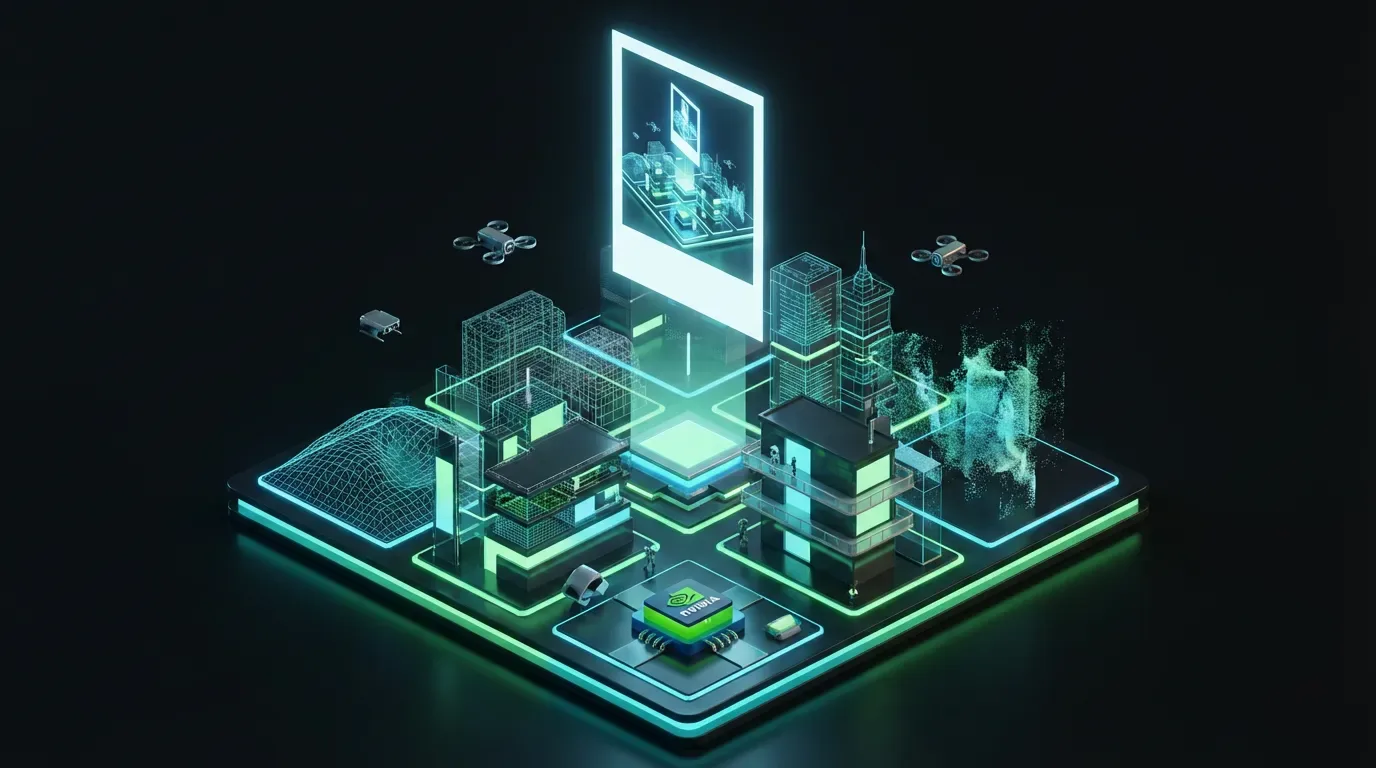
NVIDIA’s Lyra 2.0 pushes generative media one step past “make me a clip” and into “build me a space.” The system takes a single image, with optional text guidance, and generates an explorable 3D environment that can be exported for downstream use, including simulation pipelines and interactive production workflows. That is a bigger deal than the usual AI demo bait, because walkable scenes are far more useful than a pretty flythrough when your team needs assets it can actually reuse.
In practical terms, Lyra 2.0 is not just another image-to-video model wearing a 3D costume. NVIDIA is positioning it as a way to create persistent worlds with camera-controlled exploration, then turn those worlds into representations such as 3D Gaussian splats and meshes. Translation for non-technical teams: this is closer to production infrastructure than social media eye candy, even if it is still early enough to keep the champagne corked.
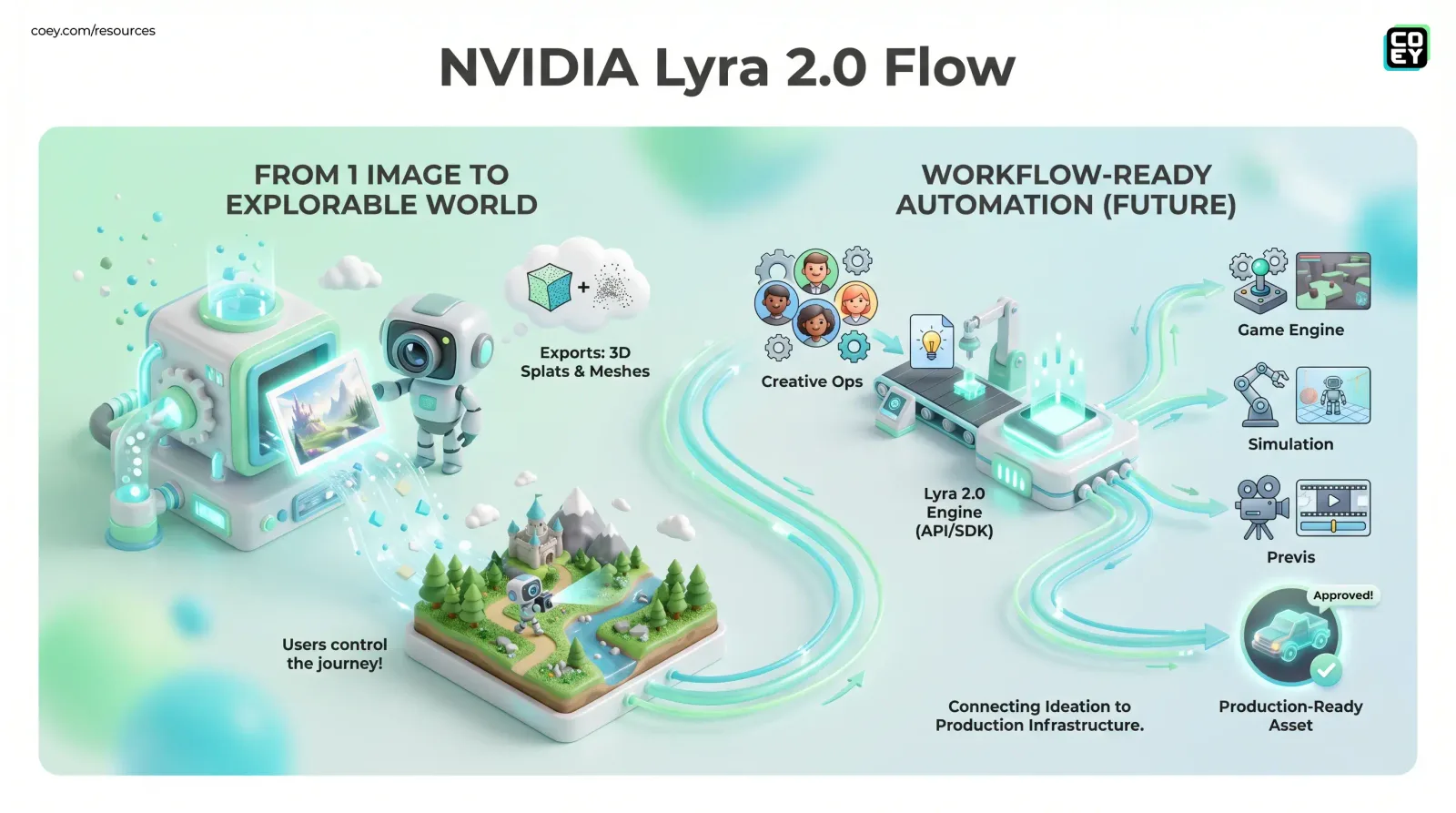
The shift here: AI is moving from generating outputs you watch to generating environments you can navigate, review, export, and potentially plug into real pipelines.
What NVIDIA actually built
Lyra 2.0 starts with a single image and generates a coherent, explorable 3D scene rather than a fixed sequence of frames. According to NVIDIA’s research materials, the system uses camera-guided generation so users can define how the scene is explored instead of accepting one pre-baked “cinematic” route. That matters because most gen-video tools still behave like a slot machine with better branding.
The bigger technical trick is consistency. Lyra 2.0 is designed to preserve spatial coherence when the camera revisits a region, which is one of the hardest problems in world generation. The web is full of AI videos that look amazing until the third second, when the staircase melts, the windows teleport, and reality quietly rage-quits. Lyra 2.0 is specifically trying to solve that.
Core output story
| Capability | What it means | Why teams care |
|---|---|---|
| Single-image world generation | Builds a navigable 3D scene from one visual input, with optional text prompting | Faster concepting with less capture overhead |
| Camera-conditioned exploration | Users control viewing paths through the scene | Better review, storytelling, and previs control |
| 3D export formats | Outputs can be reconstructed into 3D Gaussian splats and meshes | Lets work move into engines and production tools |
Why this matters beyond the demo
The short version: Lyra 2.0 makes 3D scene generation more operational. If an AI system creates only a render, your workflow stops at admiration. If it creates reusable scene representations, your workflow can continue into editing, simulation, activation, or deployment.
That distinction matters for marketers and operators. A brand team could use a reference image to mock up an interactive showroom, event concept, or retail environment. A product team could prototype a virtual space for demos. A robotics or simulation group could export the scene into a platform like NVIDIA Isaac Sim for testing. Same core generation, different business outcome.
This is where NVIDIA’s move lines up with a broader pattern we’ve been tracking: generative systems are becoming less about one-off artifacts and more about stateful environments. If that sounds familiar, it echoes other “playable world” announcements like the category we covered in Google DeepMind’s Project Genie. The market signal is clear. Video is getting explorable.
Where it fits in workflows
Lyra 2.0 is most interesting when you stop thinking like a prompt tourist and start thinking like a workflow owner.
For marketing teams
A single campaign image could become a rough interactive world for internal review, stakeholder pitches, or experiential mockups. That will not replace polished 3D production for flagship launches, but it can absolutely compress the “show me the idea” stage.
For creators and studios
Instead of manually blocking every environment from scratch, teams can use Lyra 2.0 as a first-pass scene builder. The value is not perfection on first output. The value is escaping the blank canvas.
For simulation and robotics
This may be the most immediate fit. NVIDIA’s project materials explicitly show simulation-oriented use cases, and that makes sense. If the exported environment preserves enough geometry and visual coherence, teams can spin up more test spaces faster. In simulation land, “good enough and plentiful” often beats “perfect and late.”
| Audience | Immediate use | Reality check |
|---|---|---|
| Marketers | Concept showrooms and interactive pitches | Still needs human polish for branded production |
| Studios | Previz and environment blocking | Not a total replacement for 3D artists |
| Simulation teams | Rapid test-world generation | Depends on export quality and scene fidelity |
Automation potential is promising
Here is the part executives should care about: can this plug into a workflow, or is it trapped in demo-land?
Lyra 2.0 clearly points toward automation-friendly use cases, but public availability today appears to be research and developer release territory rather than a mainstream hosted SaaS product. As of mid-April 2026, NVIDIA has released Lyra 2.0 research materials along with public code and model access, but there is still no clearly documented business-facing API product page in the way you would expect from a mature enterprise platform offering.
That means the automation story is strong in principle, but still conditional in practice.
What would make it workflow-ready
API or SDK access: so teams can call world generation from internal tools, not just manually use research code
Job control: queue generation requests, track status, retry failures, and manage costs
Structured exports: predictable output packaging for game engines, asset systems, or simulation stacks
Governance: permissions, logs, and version control so outputs do not vanish into “who made this?” chaos
If NVIDIA exposes that stack cleanly, Lyra 2.0 could become a legitimate building block inside creative ops. Think event-driven pipelines where a new approved product image triggers environment generation, review capture, and export to a staging system. That is not sci-fi. That is just modern automation with a much cooler front end.
Important distinction: Lyra 2.0 looks automation-compatible, but it is not yet a mainstream plug-and-play API product for non-technical teams.
What is real today, and what is not
This is where we resist the industry’s favorite hobby: turning every research release into “RIP entire profession” content.
What looks real:
single-image generation into explorable 3D scenes
improved persistence over standard video-only approaches
exports that matter for downstream tooling, including 3D Gaussian splats and meshes
clear relevance for simulation and early-stage creative work
What still looks early:
broad mainstream product availability
a fully documented enterprise API story
evidence that outputs are consistently production-ready for polished brand deployment without cleanup
support for dynamic, highly complex, or physics-heavy scenes without additional work
That balance matters. Lyra 2.0 is not “click once, ship the metaverse.” Thankfully. We survived one round of that vocabulary already.
The bigger competitive signal
NVIDIA is making a serious play in a fast-forming category: AI systems that generate navigable worlds, not just passive media. That has implications well beyond research bragging rights.
For creative teams, it means spatial ideation is getting cheaper and faster. For enterprise teams, it means synthetic environments could become easier to produce at scale. For operations leaders, it means a new class of AI tools may soon sit between design software and simulation infrastructure.
And because NVIDIA already has gravity in GPUs, simulation, and developer ecosystems, it is better positioned than most to move this from “cool lab page” to “actual workflow layer.” That does not guarantee mass adoption, but it does make Lyra 2.0 more strategically relevant than the average viral demo with a cinematic trailer and no integration story.
Bottom line
Lyra 2.0 is one of the clearer signs that generative AI is evolving from media generation into world generation. NVIDIA is not just making a model that animates an image. It is building a system that can turn one image, optionally guided by text, into a navigable scene with exports that may feed real production and simulation pipelines.
For COEY’s audience, the key question is not whether the demo is impressive. It is whether the tool moves work forward. Lyra 2.0 has a credible answer there: yes, especially for previs, simulation, and early-stage interactive concepting. The public code and model release improve the access story, but the enterprise API and product-access story is still not fully there, so this is not an instant “wire it into every workflow” moment. But it is absolutely a category worth watching.
Because once world generation becomes callable, controllable, and repeatable, it stops being novelty content and starts becoming creative infrastructure. That is where human plus machine collaboration gets very real, very fast.