
Claude Mythos 5 Returns Under Lock and Key
Claude Mythos 5 returns for approved U.S. institutions, showing how frontier AI access now depends on governance, compliance, auditability, and trusted enterprise workflows.
27 June 2026Team COEY

Anthropic's Claude Mythos 5 is returning to approved U.S. institutions after a temporary export-control freeze, according to reporting from Axios. The headline is simple: one of the most powerful Claude models is back online for a limited group of trusted U.S. companies, government agencies, and critical infrastructure organizations. The subtext is bigger: frontier AI is no longer just software. It is becoming regulated infrastructure.
For teams that were depending on Mythos 5 for high-stakes reasoning, cybersecurity research, regulated document workflows, and deep automation, this is a meaningful restart. But this is not a "Claude for everybody" moment. Access is narrow, monitored, and institution-first. If your brand team was hoping to casually drop Mythos 5 into a Monday morning content calendar like it's another Canva plugin, sorry bestie, that is not the vibe.
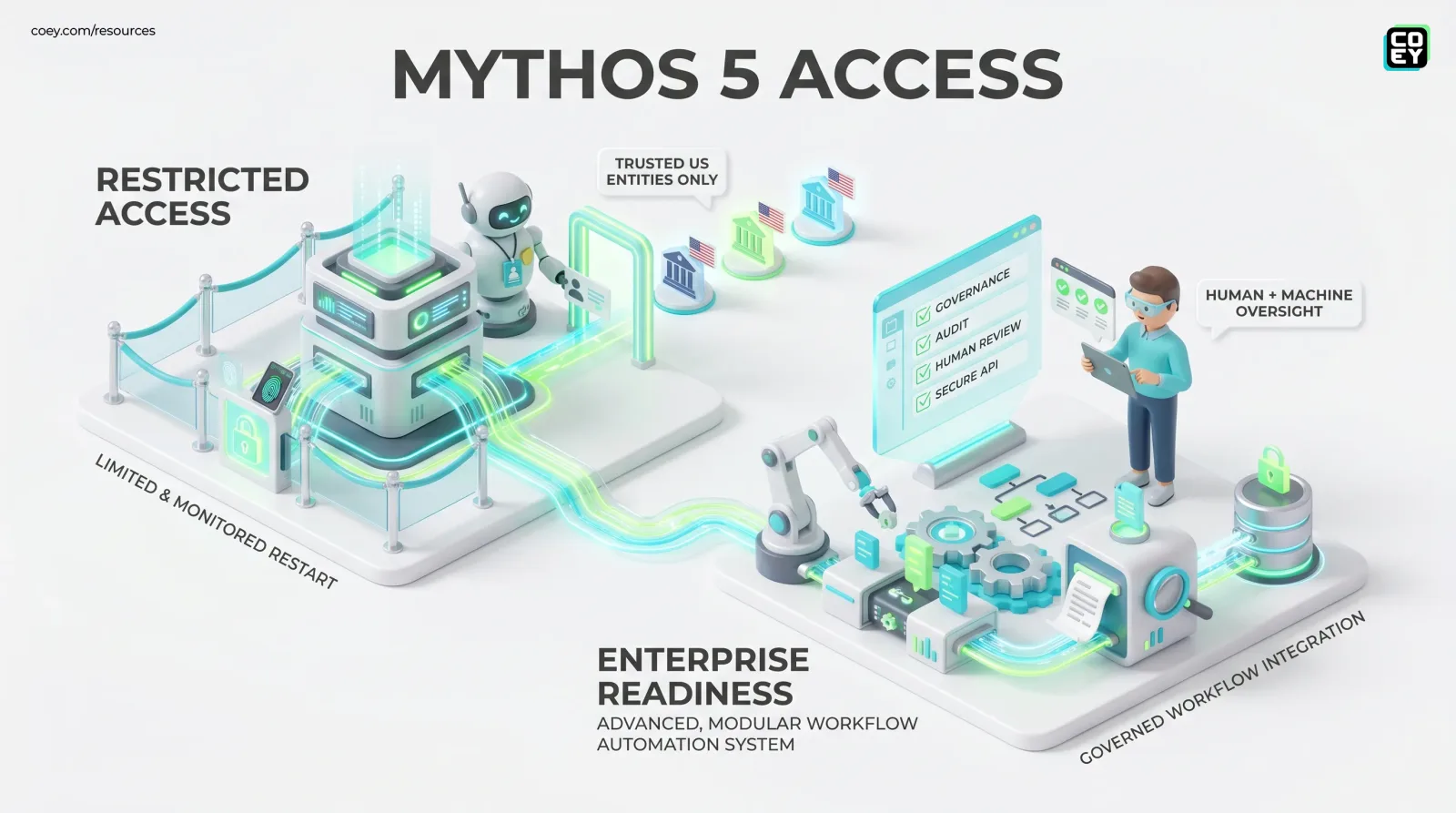
The reinstatement matters because it shows where advanced AI deployment is heading: more capability, more oversight, and more friction at the frontier. The useful question for executives and creative operations teams is not just "How smart is the model?" It is "Can we actually use it inside real workflows without breaking compliance, procurement, security, or half the internet?"
What Changed
Claude Mythos 5 and Claude Fable 5 had been caught in a U.S. export-control action that disrupted access to Anthropic's newest advanced model tier. Axios reported that the Commerce Department order, issued June 12, barred access by foreign nationals and pushed Anthropic to disable the affected models broadly because real-time nationality filtering was not workable. The concern centered on whether the models' capabilities could be made available to restricted foreign nationals or used in sensitive domains without sufficient control.
Now, limited access is being restored for Mythos 5 for approved U.S. entities under stricter conditions. TechCrunch reported that the restored access applies to more than 100 U.S. companies and agencies, including non-American employees at those approved entities. That likely includes identity checks, usage monitoring, credential controls, and institutional accountability. In plain English: the model is back, but the velvet rope is now reinforced with compliance paperwork and probably a very serious dashboard.
Anthropic's own product documentation around Claude Fable 5 and Claude Mythos 5 describes both as Mythos-class models launched June 9, 2026. The documentation frames Fable 5 as the broader access version with additional safety classifiers, while Mythos 5 is the more restricted counterpart for trusted environments and specialized use cases. As of this reinstatement, however, Fable 5 remains restricted rather than broadly restored.
The important shift is not that Mythos 5 is available again. It is that access now depends as much on institutional trust as technical demand.
Why Mythos 5 Matters
Mythos 5 is not being treated like a normal chatbot upgrade because it is not aimed at normal chatbot work. The model is reportedly built for complex reasoning across sensitive domains such as cybersecurity, biology, healthcare, and technical research. Those are areas where advanced AI can be genuinely useful, but also genuinely spicy from a risk perspective.
For enterprise teams, the value is less about one-off prompting and more about sustained cognitive throughput. Anthropic's documentation lists a 1 million token context window, up to 128,000 output tokens per request, vision support, tool use, code execution, memory tools, batch processing, token counting, and model discovery across supported Claude API workflows. That means approved users can process massive document sets, inspect code, summarize research, help evaluate risks, and support multi-step decision workflows. That is not "write me a LinkedIn post about synergy." That is "read 400 pages of technical material, extract the conflicts, produce an audit trail, and route the findings to the right team."
That kind of capability changes the economics of knowledge work. The human still sets intent, judgment, ethics, and taste. The machine absorbs the grind: retrieval, synthesis, formatting, comparison, and first-pass analysis. That is the collaboration layer COEY cares about: people doing sharper work because machines are carrying more of the repetitive cognitive load.
Access Is The Real Story
The most important product detail is not benchmark performance. It is availability. Mythos 5 may be powerful, but for most teams it is not currently a plug-and-play model. Access is limited to vetted institutions and approved providers. That means the model's real-world readiness depends heavily on whether an organization can meet the new requirements and operationalize them without turning every workflow into a legal escape room.
| Signal | What It Means | Workflow Impact |
|---|---|---|
| Restricted access | Only approved entities can use Mythos 5 | Not viable for most open-market teams |
| Institution controls | Identity and usage rules matter | Procurement and compliance join the party |
| API availability | Automation is possible where approved access is enabled | Useful for enterprise workflow orchestration |
| Domain sensitivity | High-risk use cases require oversight | Human review remains non-negotiable |
This is where hype meets the loading dock. A model can be magical and still be operationally inaccessible. If your company is not on the approved list, Mythos 5 is not ready for your stack. If your company is approved, the next question is whether your teams can use it within governed systems: secure prompts, approved data handling, logging, role-based access, and documented human review.
APIs Make It Useful
For approved users, API access is what turns Mythos 5 from an impressive interface into actual infrastructure. Anthropic's Claude API documentation supports core enterprise patterns such as message calls, batch processing, token counting, model discovery, and tool-connected workflows. Anthropic's published pricing for the Fable 5 and Mythos 5 documentation is $10 per million input tokens and $50 per million output tokens, where the models are available. Translation for non-technical readers: teams can connect Claude to internal systems instead of manually copying and pasting prompts like it's 2023 and we're all living in spreadsheet goblin mode.
The practical automation potential is strong where access is permitted. Mythos 5 could support workflows such as:
Regulated content review: checking claims, disclosures, medical language, or financial copy before human approval.
Research synthesis: summarizing large technical libraries into executive briefs, campaign inputs, or decision memos.
Security operations: triaging alerts, explaining code behavior, and assisting analysts with complex investigations.
Customer intelligence: clustering feedback, extracting themes, and routing issues into product or marketing systems.
Creative operations: generating structured campaign variants while preserving brand rules, legal constraints, and review steps.
The key phrase is "while preserving." Automation is not useful if it creates beautiful chaos at scale. The best deployment pattern is human plus machine: AI drafts, compares, routes, and summarizes; people approve, refine, and decide. That is especially true for a model powerful enough to attract regulatory attention. If you automate without governance, congratulations, you have built a faster liability machine.
Fable 5 Still Complicates Things
Claude Fable 5 remains an important part of the story because it was introduced as the broader-access sibling of Mythos 5, designed with additional safety classifiers for broader use. TechCrunch has described Fable 5 as a version of Mythos intended for public access, though sensitive query categories may be routed differently. But after the June 12 export-control order, Axios reported that Fable 5's restrictions had not been lifted as part of the late-June Mythos 5 restoration.
That split reveals an emerging pattern in frontier AI: same underlying family, different access surfaces, and access that can change quickly when regulators intervene. One model might be designed for consumers and general businesses with guardrails. Another might be reserved for trusted partners in high-sensitivity environments. Then a government action can still narrow both. This is not just product segmentation. It is risk segmentation.
For marketers and brand builders, the lesson is practical. Do not build critical production workflows around a model you cannot reliably access. If Fable 5, Mythos 5, or another Claude model is available in your environment, test against that reality. If Mythos 5 is only available to a restricted research, government, infrastructure, or security function inside your organization, do not assume your creative team can suddenly use it for campaign generation.
Enterprise Readiness Check
For approved institutions, Mythos 5 looks more "real-world ready" than experimental, but only in environments that already know how to manage sensitive AI systems. That means mature data policies, security review, logging, escalation paths, and clear ownership. The model may be advanced. Your org chart still needs to be less haunted.
Executives should ask five blunt questions before celebrating reinstated access:
Who is allowed to use it? Named users, approved teams, and role-based access should be explicit.
What data can enter it? Regulated, confidential, and customer data need clear handling rules.
Where does output go? Automated publishing without review is still a bad idea wearing a productivity hat.
Can usage be audited? Logs matter when regulators, clients, or security teams start asking questions.
What is the fallback? If access changes again, workflows need a second model or manual path.
That last point is the sleeper issue. The temporary disruption showed that even elite AI providers can face sudden access changes. Smart teams should design portability into their AI operations: abstract prompts, keep evaluations model-agnostic where possible, and avoid building one-model castles in the sky. COEY covered that early access tension in our earlier look at Claude Mythos and the open API gap, and the lesson still holds: capability only matters operationally when access is stable enough to build around.
The Bigger AI Shift
Claude Mythos 5's reinstatement is bigger than Anthropic. It signals a new era where frontier models are evaluated not only as products, but as strategic assets. Governments are watching. Enterprises are negotiating. Vendors are building tiered access systems. And creative teams are stuck asking the most practical question in the room: "Cool, but can I use it by Friday?"
Sometimes the answer will be yes. Sometimes it will be "only if legal, security, procurement, and three acronyms approve it." That may feel annoying, but it is also part of AI growing up. The same capabilities that can accelerate research, marketing, and automation can create real risk when deployed carelessly.
For COEY's audience, the takeaway is grounded but optimistic. Mythos 5 reinforces the direction of travel: AI systems are becoming more capable collaborators, especially when connected through APIs into real workflows. But capability is only half the equation. Readiness now includes access, compliance, auditability, and human oversight.
The future of work is still human plus machine. Mythos 5 just reminds us that the "plus" sign needs governance, not glitter.