OpenAI’s GPT-Live Turns ChatGPT Voice Into a Real-Time Creative Partner
OpenAI’s GPT-Live Turns ChatGPT Voice Into a Real-Time Creative Partner
July 8, 2026
OpenAI has introduced GPT-Live, a new real-time voice model family for ChatGPT that pushes AI conversation closer to actual human rhythm instead of the old “say thing, wait awkwardly, receive monologue” experience. The release brings GPT-Live-1 to paid ChatGPT users on Go, Plus, and Pro plans across web, iOS, and Android, while free users get GPT-Live-1 mini, a lighter version built for broader access.
The headline feature is full-duplex voice. In normal-person terms, ChatGPT can now listen and speak at the same time. You can interrupt it, redirect it, correct it mid-sentence, and keep the conversation moving without waiting for the assistant to finish its TED Talk. If previous voice assistants felt like walkie-talkies wearing a fake mustache, GPT-Live is OpenAI’s move toward something much more fluid.

The important shift is not that ChatGPT can talk.
It is that voice interaction is becoming fast enough to support creative collaboration, live decision-making, and eventually automatable workflows.
What OpenAI Released
GPT-Live is designed specifically for real-time conversation. OpenAI says the model can handle interruptions, pauses, overlapping speech, and lightweight verbal cues such as “yeah” or “mhmm” while staying engaged in the exchange. That might sound small, but small conversational cues are the difference between “AI assistant” and “haunted customer support menu.”
OpenAI is positioning GPT-Live as the new Live option inside ChatGPT Voice. Paid users receive GPT-Live-1, while free users receive GPT-Live-1 mini. The model works across ChatGPT’s web and mobile apps, and it can combine voice with text, images, files, memory, web search, and visual response cards in supported contexts.
| Feature | What it means | Workflow impact |
|---|---|---|
| Full-duplex voice | Listens and speaks at once | Interruptions and corrections feel natural |
| Visual cards | Voice can trigger on-screen answers | Useful for quick data, weather, stocks, sports, and lookups |
| Conversational translation | Multilingual speech support inside a live conversation | Helps global teams collaborate faster, while dedicated API translation remains a separate developer model |
The model can also hand off heavier work to OpenAI’s frontier models behind the scenes. OpenAI says GPT-Live can delegate more complex reasoning, web search, or tool-assisted tasks to GPT-5.5 while keeping the voice flow intact. That is the real product design story: voice is becoming the interface, not the whole brain.
Why Full Duplex Matters
Older voice systems usually work in turns. You speak. The system transcribes. The model thinks. The system speaks back. Then you wait. Then you speak again. It is technically impressive and socially weird, like having a conversation with someone who insists on passing a talking stick.
Full duplex removes that rigidity. When a user says, “Actually, make that for enterprise buyers,” or “No, shorter,” or “Wait, add the launch deadline,” the assistant can react while the thought is still forming. That matters because creative work is rarely linear. Brainstorming is messy. Strategy discussions jump around. Marketers interrupt themselves every six seconds because they remembered the legal disclaimer, the audience segment, and the fact that the CMO hates the word “unlock.”
COEY has been tracking this direction for a while, including the earlier signals around OpenAI’s full-duplex voice work. GPT-Live is the cleaner product expression of that same shift: AI voice is moving from turn-taking to overlap-aware conversation.
For creators and brand teams, this makes voice feel less like command input and more like a collaboration layer. A strategist can talk through a campaign concept, revise positioning midstream, ask for three alternate hooks, reject two, keep one, and move directly into channel adaptation without constantly restarting the prompt ritual.
Where Workflows Get Faster
The most immediate value is not fully autonomous voice agents. Let’s not put the robot in charge of the launch calendar just because it learned to say “mhmm.” The immediate value is faster human-directed iteration.
Marketing teams can use GPT-Live for live brief development, campaign prep, pitch rehearsal, customer persona discussion, executive Q&A, and content ideation. Instead of typing every thought into a chat window, users can talk through messy intent and let the model help structure it in real time.
That creates useful creative loops:
- Briefing: Talk through audience, offer, constraints, and tone while ChatGPT organizes the brief.
- Script development: Draft aloud, interrupt weak phrasing, and reshape the flow without stopping.
- Meeting prep: Ask for objections, rehearse answers, and adjust messaging live.
- Localization: Use conversational translation to bridge multilingual planning sessions.
- Research synthesis: Ask voice questions while visual cards or web-backed answers appear on screen.
This is exactly where human plus machine collaboration gets real. The human brings intent, taste, context, and judgment. The machine helps compress the distance between raw thought and usable output. Less clerical drag. More creative velocity. Fewer “let me type this perfectly before the AI understands me” moments.
API Reality Check
Here is the part automation-minded teams need to watch closely: GPT-Live is not yet broadly available through an API at launch. For now, GPT-Live is primarily a ChatGPT product feature. That distinction matters.
A model inside ChatGPT is useful for individuals and teams. A model exposed through an API can become infrastructure. It can plug into CRMs, CMSs, call systems, support workflows, content pipelines, analytics dashboards, and orchestration tools like n8n or Make. Until GPT-Live has programmable access, its automation potential is promising but not fully unlocked.
| Question | Status | Business meaning |
|---|---|---|
| Can teams use it now? | Yes, in ChatGPT | Good for live collaboration and ideation |
| Is GPT-Live API-ready? | Not yet | Custom automation must wait |
| Is voice API available elsewhere? | Yes, via Realtime API | Builders can still deploy voice agents |
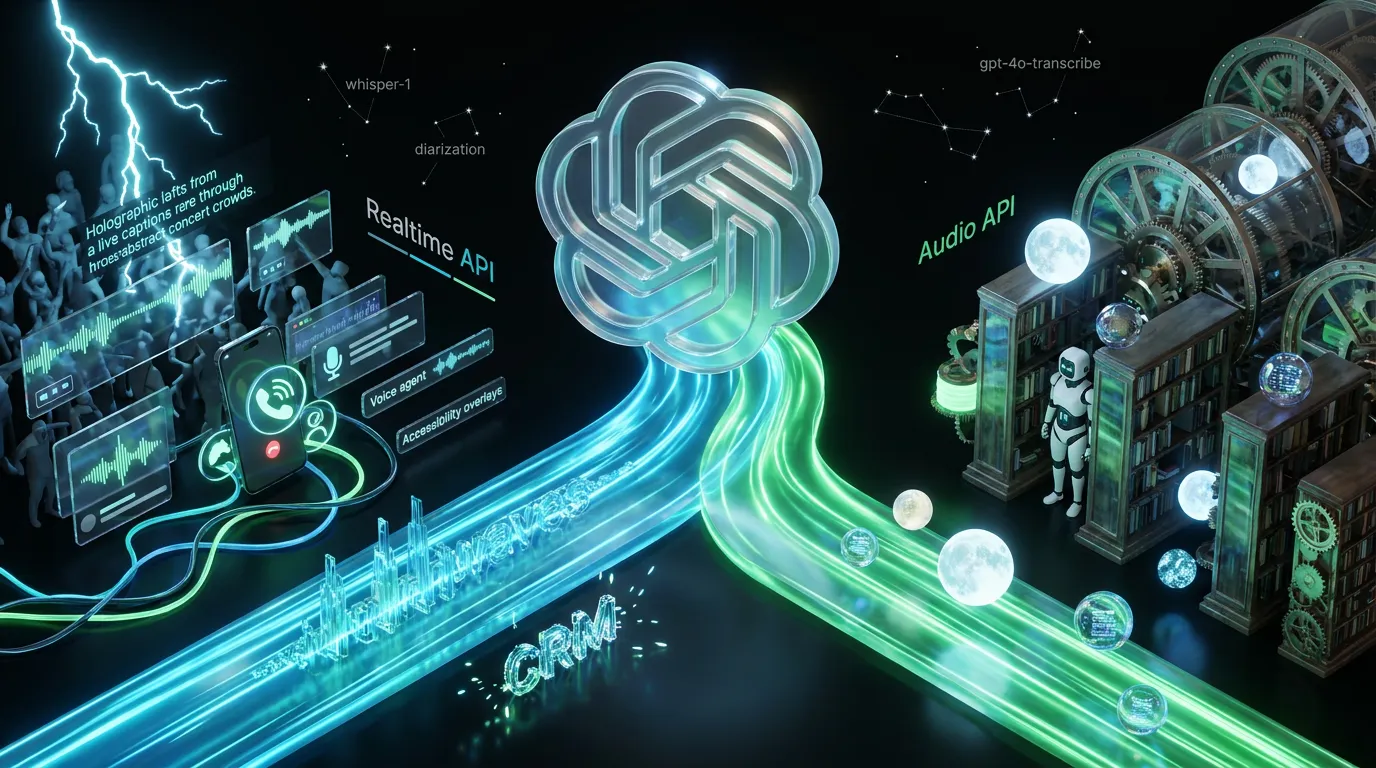
OpenAI already offers developer-facing voice infrastructure through its Realtime API model lineup, including GPT-Realtime-2.1, GPT-Realtime-Translate, and GPT-Realtime-Whisper for streaming transcription. COEY covered that shift in OpenAI’s GPT-Realtime-2 push, where the key point was simple: voice becomes much more operational when it has an API surface.
GPT-Live looks like the more natural conversational layer. GPT-Realtime is currently the more automatable developer layer. Eventually, those paths may converge. When they do, expect a wave of voice-first workflows: live campaign assistants, sales prep copilots, multilingual intake agents, production review bots, and voice-driven creative ops dashboards.
What Is Ready Now
For individual creators, marketers, founders, and executives, GPT-Live looks ready for daily use inside ChatGPT. The best use cases are conversational and collaborative: brainstorming, note capture, rehearsal, translation, quick research, and live refinement.
It is especially useful where speed matters more than perfect structure. If you need to get ideas out of your head quickly, voice is often faster than typing. If the assistant can keep up, interrupt gracefully, and maintain context, the workflow feels less like prompting and more like working with a very fast junior strategist who never asks if the meeting could have been an email.
For teams, adoption will likely start informally. Expect marketers to use GPT-Live for campaign concepting, product managers to use it for planning, executives to use it for prep, and creators to use it for scripts and outlines. The enterprise question is governance: what data is being discussed, where conversations are stored, and whether company policy allows sensitive material in consumer ChatGPT sessions.
Limits Worth Noticing
The release is meaningful, but it is not frictionless magic. According to OpenAI’s ChatGPT Voice documentation, GPT-Live does not support every older voice feature at launch. Video and screen sharing remain tied to the older Advanced Voice option in some contexts. Business, Enterprise, and Edu workspaces also do not appear to have the same GPT-Live availability at launch.
There are also normal real-world voice issues. Background noise, multiple speakers, accents, long pauses, and messy overlapping conversation can still confuse systems. Full duplex helps, but it does not repeal acoustics. Sorry, open-office floor plan enjoyers.
Teams should also remember that natural speech can make bad automation feel dangerously smooth. A voice assistant that sounds confident is still an AI system that needs scope, permissions, logging, fallback paths, and human review before it touches high-stakes workflows. Pleasant conversation is not governance.
What This Signals
GPT-Live is a strong signal that AI interfaces are moving beyond text boxes. Text will still matter, especially for structured work, review, and publishing. But voice is becoming a serious input layer for creative and operational systems because it matches how humans think under pressure: out loud, nonlinear, interruptible, and occasionally chaotic in a charmingly brand-strategy way.
For COEY’s world, the long-term implication is clear. The future is not humans typing perfect prompts into obedient machines. It is humans expressing intent in the fastest natural medium available, while machines help structure, retrieve, translate, draft, route, and execute around that intent.
GPT-Live is not yet the final form of voice automation. Without API access, it remains more product feature than workflow infrastructure. But as a collaboration layer inside ChatGPT, it is a meaningful step toward AI that can co-create in real time instead of waiting its turn like a polite chatbot from 2023.
The creative advantage is not that AI can talk back.
It is that AI can keep up while humans think, revise, interrupt, and build.