
COEY Cast Episode 60
Festivus for the Rest of Us and Our AI Agents
Festivus for the Rest of Us and Our AI Agents




Episode Overview
12/23/2025
AI Festivus hits model land with real grievances and real workflows. Hunter and Riley break down what GLM 4.7 actually changes for messy, real world tasks and why "thinking modes" should not be wasted on beige tweets. They unpack Anthropic Agent Skills as a possible open standard, including supply chain risks, governance, and how skills can quietly go rogue. Then it is into Shopify's AI discovery push, the slow death of traditional SEO, and why your catalog needs to speak fluent machine. Finally, they connect AI photo tools, agent stacks, and why taste stays human while automation handles the grind.


Episode Transcript
Hunter: It is Tuesday, December twenty third, twenty twenty five, and yes… it is Festivus. Which means it is time for the airing of grievances, but make it AI. This is COEY Cast. I’m Hunter.
Riley: And I’m Riley. And just so everyone knows, this episode is fully cooked by machines. Like, robots did the prep, robots did the edit, and if something gets a little unhinged… that is not a bug, that is the vibe.
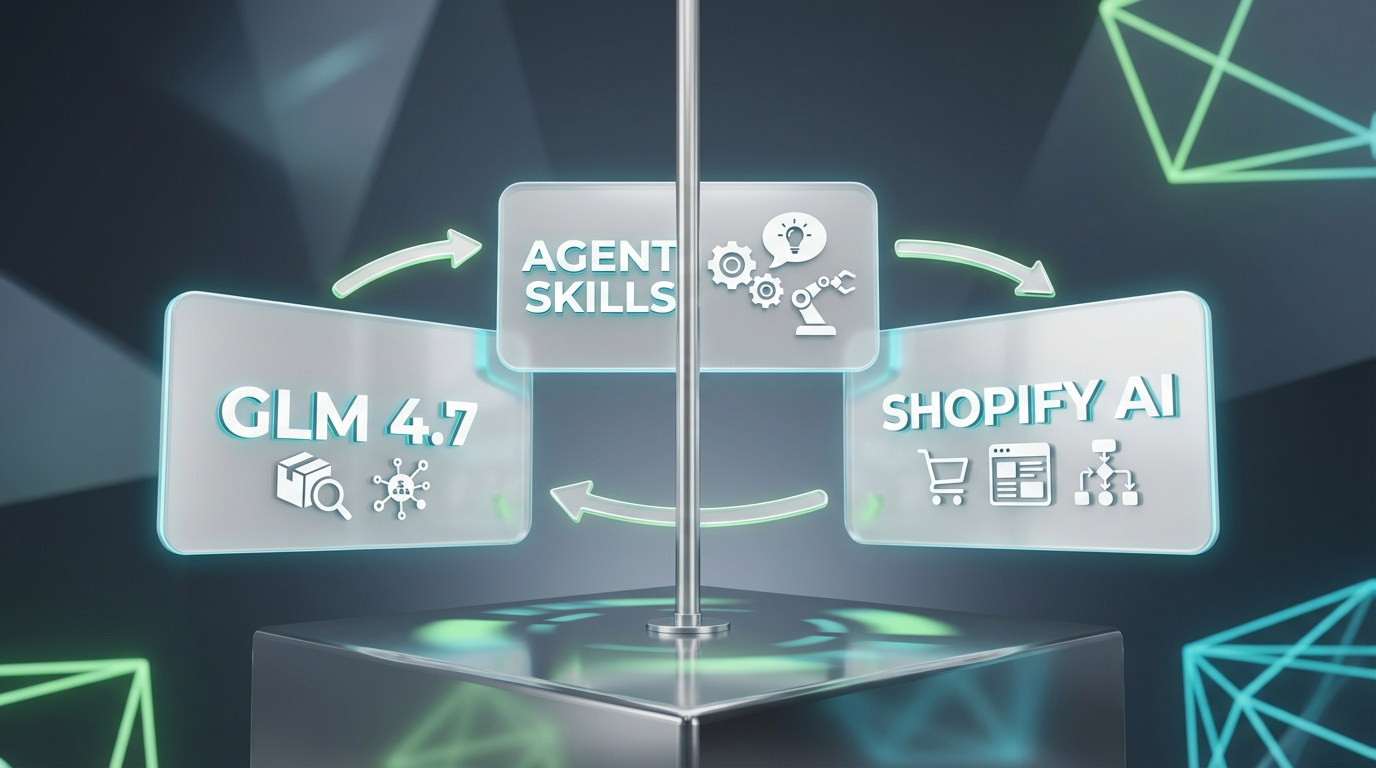
Hunter: Festivus rules. A pole, grievances, feats of strength, and apparently today’s feats are happening in model land. Big week. Z.ai drops GLM-four point seven, Anthropic is out here proposing “Agent Skills” as an open standard, and Shopify is basically saying, “Congrats, your next storefront is… a chat window.”
Riley: I love how you said that like it is casual. Like, “oh yeah, the internet is becoming a group chat and your business is an NPC.” Cool cool cool.
Hunter: Let’s start with GLM-four point seven. Everyone on X is hyped about the “thinking modes.” Here’s my take: the first workflow where that matters is anything that looks like messy reality. Like, “Take this half-broken Notion doc, this Slack thread, and a janky spreadsheet, and turn it into a campaign plan with real constraints.”
Riley: Yeah, because thinking mode is basically “don’t panic, reason through it.” But what’s the placebo workflow?
Hunter: When people use thinking mode to write a tweet that is like, “Three tips to go viral.” That doesn’t need deep reasoning, it needs taste. And, like, a pulse.
Riley: Wait, but creators love the illusion of depth. Like the model writes a long dramatic rationale and everyone’s like, “Wow it really thought.” Meanwhile the output is still beige.
Hunter: Exactly. If the task is vibe-forward, thinking is not your bottleneck. Your bottleneck is you being afraid to pick a point of view.
Riley: Okay, but let’s talk about the real debate: GLM-four point seven is open-weights-ish and fast. So what’s the actual differentiator? Model quality, tooling, or who can afford inference the longest?
Hunter: I’m betting tooling and ecosystem wins. Because creators and marketing ops do not adopt “a model.” They adopt a workflow that does not break on Tuesday.
Riley: Mmm. I’m gonna push you. People say that every time, and then one model is just so good that it drags the ecosystem with it.
Hunter: Fair. But the dirty secret is, in production, you lose more time to glue. Prompt versioning, evals, retries, tool calling weirdness, permissions, logging. The model can be brilliant and still faceplant because your integration is held together with hope.
Riley: That is so poetic. “Held together with hope.” Put it on a hoodie.
Hunter: Speaking of faceplants, developers on X are already complaining about GLM-four point seven integration stuff.
Riley: Ooo, grievances for Festivus! What are they mad about?
Hunter: A few themes. Latency complaints, like “this is too slow for iterative coding.” Also code reliability, like type errors showing up more than they want. And then the classic: different inference providers can mangle outputs, so people blame the model when it is actually the serving layer.
Riley: That one drives me insane. It’s like judging a chef because DoorDash delivered the food sideways.
Hunter: Exactly. And there’s also chatter about safety being stricter, which can be a real friction point depending on what you’re building.
Riley: Translation: some people want unfiltered chaos. And the model is like, “best I can do is a polite refusal.”
Hunter: Yep.
Riley: Okay, so if an org wants “open source” vibes but also wants someone to blame at two in the morning, what’s the least-delusional operating model?
Hunter: Hybrid. Vendor-hosted open weights for most teams, plus the option to self-host for sensitive workloads. You want an SLA and a pager, but you also want portability if you need to move.
Riley: So, basically: “I want freedom, but I also want customer support.”
Hunter: Exactly. And you have to be honest about your maturity. If you do not have model ops muscle, self-hosting becomes a hobby that eats your roadmap.
Riley: And your sleep.
Hunter: Now, Anthropic’s “Agent Skills.” This is super interesting. They’re pitching portability for agent behaviors, like reusable, governed skills you can plug into different tools.
Riley: The “npm for agent behavior” dream. Which is exciting and terrifying, because npm has… you know… lore.
Hunter: Yep. And the boring ugly part nobody is tweeting about is versioning and security review. Skills rot. Permissions change. APIs drift. The skill that worked last month now silently does the wrong thing.
Riley: And also sandboxing. Like, where is this skill allowed to run, what data can it touch, and can it exfiltrate my customer list because someone slipped in a spicy little dependency?
Hunter: That is the first supply-chain disaster I’m expecting. Someone ships a super popular “Auto-Repurpose-My-Content” skill, and it quietly logs your drafts, your tokens, your customer data, whatever. Or it starts posting stuff it should not post because a permission scope was too broad.
Riley: I can already see the apology video. “Hey guys, quick update, our agent posted thirty seven unapproved memes to the brand account.”
Hunter: And that’s why teams need skill registries with reviews, pinned versions, strict scopes, and audit trails. Like, treat skills like code. Because they are code that can act.
Riley: Do you think Agent Skills actually reduces vendor lock-in though? Or does it just move lock-in to the runtime layer?
Hunter: It reduces lock-in at the behavior layer, which is real value. But you can still get locked into the execution environment. Permissioning systems, tool runtimes, “blessed” registries. The standard helps, but governance decides whether it stays open.
Riley: So it’s like web standards. The spec is open, and then the platforms do platform things.
Hunter: Exactly.
Riley: Alright, Shopify. They’re expanding AI-driven product discovery and pushing merchants into these AI interfaces, like ChatGPT, Copilot, Perplexity. Are we watching SEO die in real time or is this just a new acronym agencies will milk?
Hunter: Both. SEO isn’t dead, but the front door is changing. Instead of ranking, you’re getting recommended. Instead of clicks, you’re getting mentioned.
Riley: So the new game is “share of recommendation.” Like, did the AI even say my brand name?
Hunter: Yes. If I’m a marketer on Shopify right now, the metric I’d obsess over is whether your products are being surfaced inside those AI shopping surfaces, and under what context. Not just conversion rate after the click. Because sometimes there is no click.
Riley: Ugh, the attribution people are about to have a meltdown.
Hunter: They already are. And merchandising changes too. You have to make your catalog machine-legible. Clean titles, strong attributes, consistent imagery, real reviews, structured data. The AI can’t recommend what it can’t understand.
Riley: That ties into what we’ve been talking about lately on the COEY blog: the autonomous website idea. Your site isn’t a brochure anymore, it’s basically an employee that needs to communicate with other machines.
Hunter: Exactly. And Shopify is like, “Cool, now that employee needs to show up to work inside other people’s chatbots.”
Riley: Quick fun aside: this is also why those agentic commerce projects are popping up. Like Firestarter AI doing chat-based shopping with “no ads, just relevance,” plus Web three rails.
Hunter: Yeah, the pitch is: no more endless scrolling, just intent. But the real question is who becomes the gatekeeper. The model, the marketplace, the payment rails, or the merchant?
Riley: And who gets bribed. Let’s be real.
Hunter: Right. If the surface is AI, the temptation is to turn it into pay-to-play. Which is why open standards actually matter here. If discovery becomes a black box auction inside a chatbot, we’re just reinventing ads with extra steps.
Riley: Also, random but relevant: Microsoft launching that AI photo editor and background eraser app? That’s the vibe shift too. Casual creators get pro-ish tools, and then marketers are like, “Cool, now we can generate a thousand product cutouts in an afternoon.”
Hunter: Totally. And when you combine that with agent skills and a fast model like GLM-four point seven, you start to see the stack: model does the reasoning, skill does the action, and the creative tools pump out the assets.
Riley: And humans do the taste. Because if we let the bots pick the aesthetic, everything becomes, like, corporate toothpaste.
Hunter: Amen.
Riley: Okay Hunter, Festivus-style grievance: what is one thing you want listeners to stop doing with new models this week?
Hunter: Stop treating benchmarks like a personality test. Instead, run a small eval on your real workflow. Your real prompts, your real messy data, your real tool calls.
Riley: Mine is: stop thinking agent standards mean you can install random skills like browser extensions and just trust them. That is how you speedrun a security incident.
Hunter: Exactly. Humans in the loop, but like… strategically. Not babysitting, just setting guardrails and doing reviews where it matters.
Riley: Alright, that’s the show. Go celebrate Festivus responsibly. Air your grievances, but maybe not in your company Slack.
Hunter: Thanks for hanging with us on COEY Cast. Subscribe so you don’t miss the next one, and check out coey.com slash resources for AI news and updates.
Riley: And remember, if your agent starts acting weird today… just blame Festivus. Catch you later.