COEY Cast Episode 168
Open Up: Nemotron, LLM jp 4, and Laguna
Open Up: Nemotron, LLM jp 4, and Laguna



Episode Overview
04/30/2026
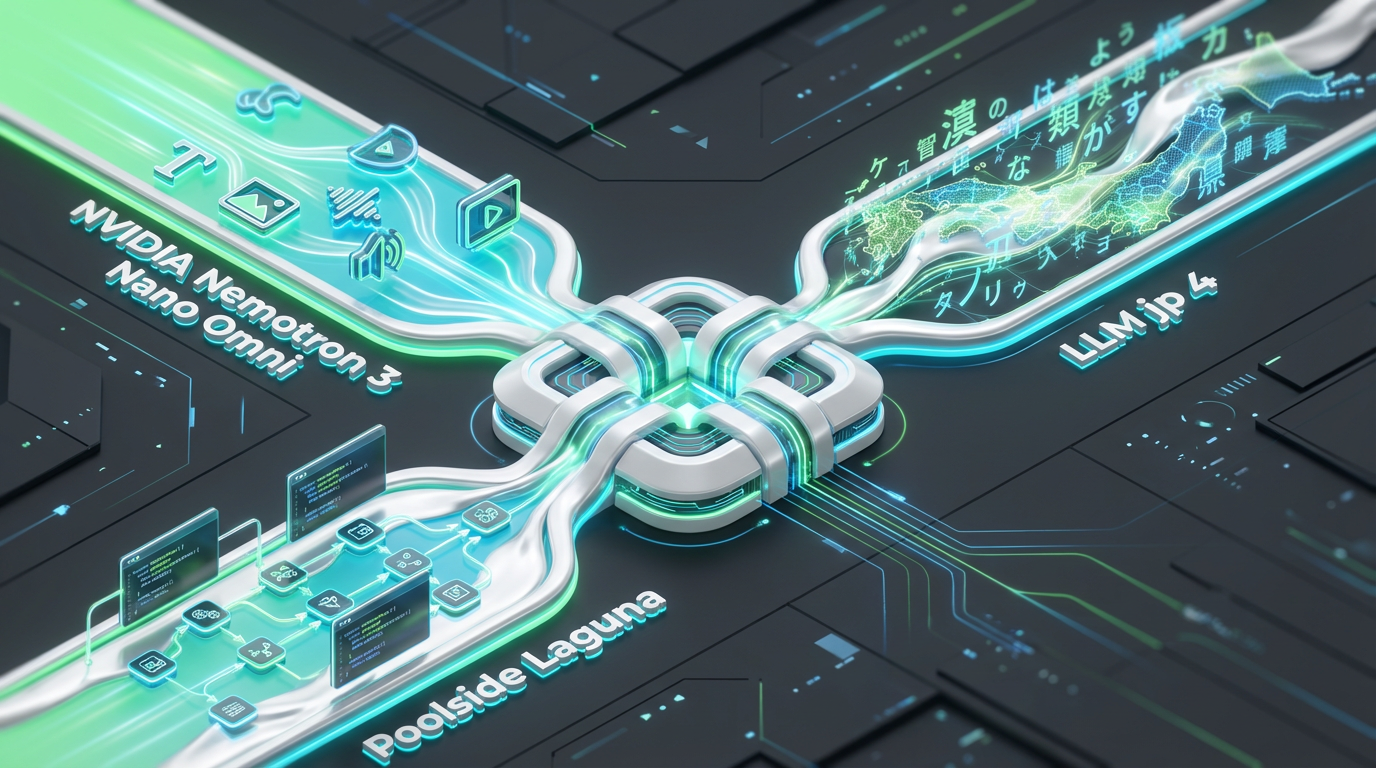
Open models are having a real moment, and this trio shows why. NVIDIA Nemotron 3 Nano Omni points to simpler multimodal workflows by handling text, image, audio, and video in one stack. LLM jp 4 shows how regional open models can beat bigger global names when language, culture, and local context actually matter. Poolside Laguna brings the coding angle, but the bigger story is automation infrastructure for marketing teams that need custom tools, connectors, and internal workflows. The takeaway is practical: open can mean more control, flexibility, and lower lock in, but it also means more responsibility. Better systems win, especially when humans stay in the loop where judgment and brand risk matter most.

Episode Transcript
Hunter: Thursday, April thirtieth, twenty twenty-six. It is Honesty Day, which feels extremely bold in AI week. So in the spirit of honesty, this episode of COEY Cast was assembled by a whole little robot band. Models drafted it, voices built it, automations stitched it together, and if anything gets a tiny bit unhinged, um, that is not a bug so much as a live demonstration. I’m Hunter.
Riley: And I’m Riley. Honestly, Honesty Day is the perfect day to talk about open models because everybody is out here saying, oh yeah, freedom, control, no lock-in, and then five minutes later they’re like wait, who’s maintaining the GPU cluster?
Hunter: Exactly. Today we’ve got a really interesting trio. NVIDIA dropped Nemotron three Nano Omni, which is this open multimodal model for text, images, video, and audio. Japan’s National Institute of Informatics has LLM-jp-four making a serious play as an open Japanese model. And Poolside launched Laguna, which is more of a coding and agent model, but honestly that may matter to marketers more than they think.
Riley: Yeah because the plot twist is the most important marketing AI model might be the one that never writes your ad copy. It might be the one quietly building the workflow that ships your campaign while you’re sleeping. Very that friend who says they’re low-key and then somehow planned the whole vacation.
Hunter: That’s the throughline. We keep talking about better models, but the real shift is better systems. Nemotron is interesting because it’s basically saying maybe you do not need one model for OCR, another for image tagging, another for transcript analysis, another for video understanding, and then one more to summarize all of that.
Riley: The anti-Frankenstack pitch.
Hunter: Right. One multimodal stack. For enterprise teams, that’s attractive because every handoff between models is another place for latency, failure, formatting weirdness, and governance headaches.
Riley: Mmm. But I want to challenge the fairy tale a little. Just because one model can technically do all the things does not mean it should do all the things. We’ve all seen demos where the model is like, yes, I can watch the ad, read the packaging, transcribe the voiceover, and tell you the vibe. Then you put it into production and it misses the logo in the corner or confuses sarcasm in the creator read.
Hunter: Totally fair. I don’t think the question is can one model replace five specialists across the board. I think the question is whether good enough multimodal understanding is now strong enough for the first pass of production workflows. And for a lot of teams, the answer is yes.
Riley: Like asset triage.
Hunter: Exactly. Campaign analysis, media monitoring, metadata generation, transcript plus screenshot summarization, flagging brand mentions across video and audio, routing content to the right human reviewer. Those are very different from asking the model to be the final judge of creative quality.
Riley: Oh, I get it. So Nemotron is less your final creative director and more your very fast ops assistant who can look at the whole messy pile.
Hunter: That’s a great way to put it. And the X chatter around it seems to reflect that. People are excited about speed, openness, local and cloud flexibility, and the fact that it’s agent-friendly. There is still some side-eye around vision quality compared with the absolute best closed systems, and I think that skepticism is healthy.
Riley: Healthy skepticism is hot. Also practical. If I’m a brand team, I’d ask, what mistakes are acceptable here? If the model is tagging ten thousand clips and it gets a few vibes wrong, ok, maybe fine. If it’s reviewing regulated content or high-stakes brand compliance, um, no babe, that needs a human and maybe a second system.
Hunter: Yes. The production rule is not best model wins. It’s lowest risk model that gets the job done at the right cost and speed wins. If Nemotron can collapse three or four steps into one pass, your workflow gets simpler. But you still set thresholds. Human review for edge cases, brand-sensitive materials, and anything customer-facing that can blow back.
Riley: This is very in line with what we’ve been saying lately. The models are getting less performative and more operational. It’s not just, wow, look at the demo. It’s, can this save my team from spending all afternoon renaming files and scrubbing through call recordings.
Hunter: Exactly. And that takes us to LLM-jp-four, which I think is one of the more important stories here. We spend so much time in English-first AI discourse that people forget how much performance depends on cultural context, language nuance, and local data.
Riley: Thank you. Because every global model company loves to act like multilingual means spiritually fluent. And sometimes it does not. Sometimes the translation is technically correct and culturally dead on arrival. Like when a brand tries to sound local and ends up sounding like a help center article wearing sneakers.
Hunter: That is painfully accurate. LLM-jp-four matters because it suggests region-specific open models can outperform bigger global names on the tasks that actually matter in that region. The reporting around it says benchmark results beat GPT-four-oh and Qwen on several Japanese evaluations, and the training was heavily grounded in Japanese-language data.
Riley: Which is huge for brands in Japan. Not just for translation, but for customer support tone, campaign localization, product copy, internal knowledge workflows, all of it. Language is never just language. It’s context, hierarchy, rhythm, what sounds respectful, what sounds too casual, what sounds imported.
Hunter: Yep. If you operate in Japan, the smart move over the next couple years may not be just renting intelligence from the usual closed model suspects and hoping they keep improving. It may be building optionality around open regional models that understand the market better.
Riley: But hold up. Optionality is not the same as maturity. An open model can be amazing and still come with a baby ecosystem. Fewer wrappers, fewer polished admin tools, less enterprise support, less plug-and-play boring stuff that companies secretly need.
Hunter: That’s the tradeoff. Open models can reduce vendor lock-in, but they often increase responsibility. You own more of the tuning, hosting, evaluation, safety, and lifecycle. Some teams hear open and think easy. Open does not mean easy. Open means you get the keys.
Riley: And now the robot has permissions.
Hunter: Exactly. Which brings us to Poolside Laguna. On the surface, it is a coding story. But I think this is actually a marketing operations story in disguise. Because a stronger coding agent lowers the cost of building internal tools. Little automations. Connectors. Dashboards. Content pipelines. Landing page generators. QA bots.
Riley: Thank you. I have been waiting for people to admit this. Half of marketing pain is not, I need a better paragraph generator. It’s, why are five people copy-pasting from one tab to another like it’s two thousand thirteen.
Hunter: Right. SaaS solved some things, but it also trained teams to buy another tool every time they hit friction. A capable coding agent gives you a shot at building the thin layer you actually need.
Riley: A little gremlin engineer in a box.
Hunter: With supervision, yes.
Riley: Fine. A leashed gremlin engineer.
Hunter: Much better. Laguna XS dot two being open-weight is especially interesting because local serious coding agents can make enterprise automation more accessible. You can keep more of the workflow in-house. Better privacy. More control. Potentially lower long-term cost.
Riley: But let me do my responsible internet citizen thing for a second. People always underestimate maintenance. They’re like, yay, local agent, no vendor tax. Then three months later they’ve invented a whole internal platform team by accident.
Hunter: That is very real. The model is only part of it. You still need prompt scaffolding, tool permissions, testing sandboxes, rollback plans, observability, and someone who can tell when the agent silently wrote nonsense. Open coding models lower the barrier to entry, but they do not remove the need for systems thinking.
Riley: Hmmm. So if we zoom out, we’ve got open multimodal with Nemotron, open regional specialization with LLM-jp-four, and open-ish or open-weight coding infrastructure with Laguna. This is kind of the whole board changing at once.
Hunter: It is. And the realistic path forward for companies is not to flip one giant switch and automate everything. It’s to design a stack with layers. Use the general models where breadth helps. Use specialist or regional models where nuance matters. Use coding agents to build glue and internal leverage. And keep humans in the loop where judgment, brand risk, and accountability matter.
Riley: So basically, do not automate yourself into chaos just because the demo looked smooth.
Hunter: Precisely. Start with recurring jobs. Pick workflows where the cost of being kind of wrong is manageable and the gain from speed is obvious. Evaluate constantly. Keep the stack modular. Date the model, marry the workflow.
Riley: Ah, a classic. Also, procurement teams, if you’re listening, a slick UI is not strategy. It’s makeup. Cute, useful, love that for you, but not the same thing.
Hunter: I’m glad you said it. Enterprise buyers are getting more open-source literate, but there is still a lot of, does it have a dashboard, then it must be mature. Real maturity is governance, interoperability, fallback plans, and knowing where the human signs off.
Riley: And knowing whether your beautiful all-in-one stack is actually saving time or just hiding complexity in a prettier menu.
Hunter: That’s Honesty Day in one sentence.
Riley: Honestly, yeah. Open models are growing up. But the winners are not the teams with the most model names in a slide deck. It’s the teams that know what work they want to remove, what judgment they want to keep, and where co-creation actually helps.
Hunter: Well said. Thanks for hanging out with us on COEY Cast this Thursday, April thirtieth. Happy Honesty Day. May your automations be truthful and your agents ask permission before doing something spicy.
Riley: Please subscribe if you’re into AI, automation, creative workflows, and occasional robot mischief. And go check out COEY.com slash resources for AI news and updates.
Hunter: Thanks for listening.
Riley: Catch you next time.