COEY Cast Episode 169
Open Source Vibe Check with VibeVoice and MOSS Audio
Open Source Vibe Check with VibeVoice and MOSS Audio



Episode Overview
05/01/2026
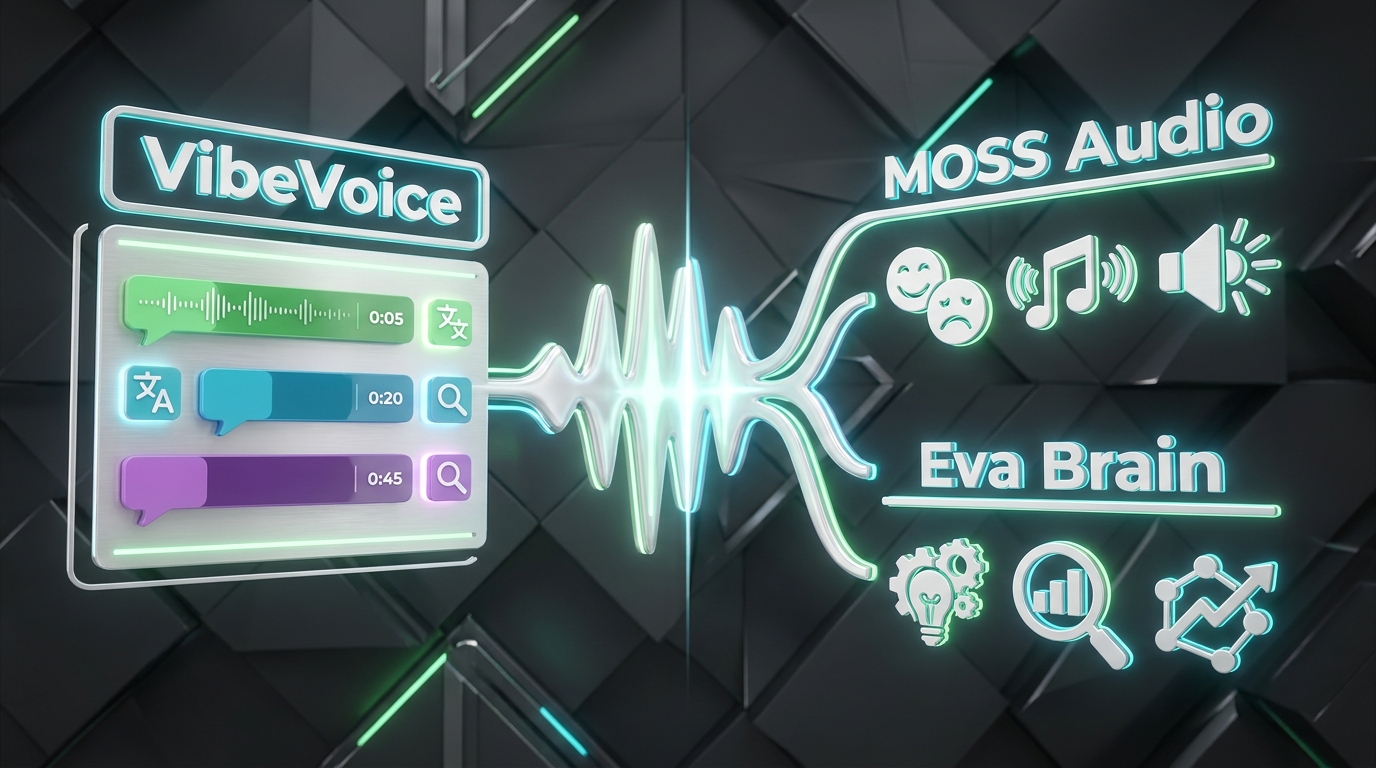
Microsoft's open source VibeVoice puts real pressure on audio workflows with multilingual transcription, speaker tracking, timestamps, and long context that can turn recordings into searchable assets. MOSS Audio adds a broader layer of audio understanding with emotion cues, music recognition, sound events, and time aware analysis that could help media teams mine podcasts, calls, ads, and live recordings for actual insight. Then Eva Brain enters with a bigger question for marketers: which parts of campaign management can agents really handle, and where do humans still need to lead? The bigger takeaway is simple. The model matters, but the workflow matters more when teams want automation that is useful, reliable, and still grounded in human judgment.

Episode Transcript
Hunter: Happy Friday, May first, on COEY Cast. It is somehow Batman Day, No Pants Day, and Space Day, which honestly feels like the most internet-core holiday combo possible. I’m Hunter.
Riley: And I’m Riley. Also, wow, if you’re listening in a cape and absolutely no pants while thinking about the cosmos, this episode was made for you.
Hunter: Honestly, yeah. And quick heads-up, this whole thing was stitched together by an unruly little orchestra of AI tools. Voices, workflow glue, automation, the whole gremlin parade. So if anything gets a little weird, just know that is part of the charm.
Riley: Part of the experiment. Part of the bit. Part of the future, babe.
Hunter: Today we’ve got a really interesting cluster of stories because they all point at the same bigger shift. Audio AI is getting way more usable, and marketing agents are trying to grab the keys to the car. Microsoft’s VibeVoice is probably the headline on the audio side. Open source, multilingual, long-context audio, speaker diarization, timestamps, and a lightweight real-time version. That is not just cool research. That is workflow infrastructure.
Riley: Yeah, this one feels less like, oh cute, another model card, and more like, oh, somebody’s about to rebuild half the boring parts of content ops. Because when you can take long audio, know who said what, when they said it, and do it across a ton of languages, that’s podcasts, webinars, sales calls, interviews, support logs, live events. That’s a lot.
Hunter: Exactly. The moat here is probably not the raw model for long. Open source tends to flatten that. The moat ends up being the workflow around it. Who can take that audio and turn it into something useful, reliably, fast, with clean approvals. That’s the game.
Riley: Wait, yes, and thank you for saying that because every time open source drops, the timeline acts like the trophy has already been awarded. Like, congrats on your benchmark screenshot. Do you also have a usable product, or are we all just clapping at a demo in a trench coat?
Hunter: That’s the right challenge. VibeVoice sounds strong on paper. The real win is if a media team can plug it into their system and go from recorded meeting to transcript to highlights to quote pulls to translated clips to caption files without babysitting every step. If you can do that, now audio becomes a searchable asset instead of a black box.
Riley: And marketers need to hear this part carefully. Better voice tooling does not mean every brand should launch some cursed AI podcast nobody asked for. Please. The smarter move is invisible value. Better localization. Better customer call summaries. Better repurposing. Faster review of creator interviews. Searchable archives. Stuff that removes grind.
Hunter: Right. Use voice AI to make existing content more useful, not to flood the zone with synthetic talking. If you already have a good human show, a good human spokesperson, a good human strategy, then these tools help you scale around that.
Riley: Human spark, machine assist. We do love a recurring theme.
Hunter: We do. And this also connects to what we’ve been talking about lately. Audio models are getting specialized. Last few episodes, we were already seeing more practical audio infrastructure show up, from Foundry bundles to open audio stacks. This is the continuation of that trend. Less magic trick, more actual plumbing.
Riley: Which, low-key, is when the money starts moving. Like the flashy era gets all the reposts, but the plumbing era gets the budgets.
Hunter: That’s really well said.
Riley: Thank you, Hunt.
Hunter: Now the other audio story is MOSS-Audio, which people on X are hyping as this broad audio understanding stack. Not just transcription. Emotion analysis, music recognition, sound event detection, time-aware question answering. If that holds up, it’s pretty important.
Riley: This is the one where the internet immediately went, open source wins again, the closed labs are cooked, everybody go home.
Hunter: Which is, ah, maybe a little early.
Riley: A little? Hunter, be serious.
Hunter: Fair. Way early. Benchmarks are useful, but they are not deployment. The smartest real-world use case for something like MOSS-Audio is probably not a giant moonshot. It’s a layered media intelligence workflow. Think brand teams trying to understand what is actually happening inside ad creatives, customer calls, podcasts, creator submissions, or live event recordings.
Riley: Yeah. Like if I’m a social team or agency, I don’t just want words. I want context. Was the speaker excited, annoyed, flat? Was there music? Was there crowd noise? Did the product mention happen before or after the punchline? That starts to matter when you’re trying to understand why content performs.
Hunter: Exactly. Or if you run a large podcast network or creator program, being able to ask time-aware questions about audio is huge. Which guest talked about a competitor. Which moments had high emotional intensity. Which clips mention a feature launch. That’s real leverage.
Riley: Also ad analysis. I think people sleep on that. Audio is not just speech. It’s pacing, energy, music cues, vibe. And yes, I said vibe. If a model can help score that across a large creative library, then creative strategy gets less gut-feel-only.
Hunter: Totally. Though, again, I’d keep a human in the loop. Emotion analysis can get weird fast. Confidently weird.
Riley: Oh, one hundred percent. Machine says, this caller sounds calm, and meanwhile they are two seconds away from sending your support brand into the sun.
Hunter: Exactly. So the opportunity is triage and prioritization, not blind trust.
Riley: Speaking of blind trust, let’s talk Eva Brain because this one is the most commercially spicy. A fully autonomous marketing agent that says it can manage campaigns across Google, Meta, TikTok, Taboola, and Outbrain with minimal human intervention. That is either category-shift energy or SaaS wearing an AI wig.
Hunter: That line is staying with me. I think the right way to look at Eva Brain is not, will it replace marketers tomorrow. It’s, which parts of performance marketing are becoming agent-friendly first. Budget pacing, channel allocation, bid adjustments, creative rotation, reporting loops, testing sequences. Those are all candidates.
Riley: So basically the machine is volunteering for the spreadsheet Olympics.
Hunter: Yes, and honestly, good. A lot of those jobs are repetitive, high-frequency, and rules-driven. But strategy, positioning, offer design, creative judgment, brand safety, escalation decisions, those should still stay human-led.
Riley: I agree, but I’m gonna push you a little. Because if these systems get good enough, a lot of mid-level button-pushing roles are gonna feel pressure. Not because the whole person is obsolete, but because the task bundle changes.
Hunter: I think that’s true. Some jobs get upgraded. Some tasks get compressed. The awkward performance plan, to borrow the prompt’s language, is really for work that is purely operational and not evolving. If your value is only manually moving budgets around dashboards, yeah, that is getting shaky.
Riley: But if you’re the person who can guide the agent, set constraints, diagnose weird behavior, connect campaign data back to creative and business goals, you become way more valuable.
Hunter: Exactly. Operator becomes orchestrator. That’s the shift.
Riley: And companies should not hand the keys over just because the dashboard looks confident. Fast plus wrong at scale is how you set money on fire in multiple channels at once.
Hunter: That’s the real risk. Human in the loop should live at clear checkpoints. Budget caps. Brand safety thresholds. Creative approvals. Audience exclusions. Escalation triggers. The machine can run the loop, but the human needs the kill switch and the policy layer.
Riley: Also, can we please retire the fantasy that autonomy means no oversight. That’s not futuristic. That’s lazy. Real automation is more like, okay, the system handles the repetitive loop, and the team handles intent, exceptions, ethics, and strategy.
Hunter: Well put. And this ties into a broader thing we’ve covered all week. Quietly, AI is becoming more operational. GPT updates, specialist models, open audio systems, voice templates. The throughline is not, wow, look at the demo. It’s, can I ship with this on Monday.
Riley: Yes. And the ecosystem around this week is kind of hilarious too. We’ve got a model trained only on texts from nineteen thirty-one, which is basically the most elegant possible version of time-travel cosplay.
Hunter: That one is amazing.
Riley: Then Lovable is doing no-code mobile app building with vibe prompts, which feels very now. Build me an app, but make it emotionally available and kind of minimal.
Hunter: And apparently AI dolls are getting smarter too, which is both fascinating and at least a little unsettling.
Riley: We are truly speedrunning every sci-fi shelf in the bookstore.
Hunter: We really are. But zooming out, the advice for teams is actually pretty simple. Sequence adoption. Don’t try to roll out open-source audio, autonomous media buying, and full agent frameworks all at once. Start where the workflow is repetitive, measurable, and low-risk.
Riley: So maybe first do the audio layer. Transcription, archives, localization, content mining. Then test agents in bounded environments, like campaign recommendations or controlled budget slices, before you let anything run wild.
Hunter: Exactly. And if you want sovereignty with open models, remember you are also volunteering to own reliability. Open source is freedom, but it is also maintenance, infra, evals, governance, and a few late-night headaches.
Riley: Escape vendor lock-in, enter reliability nightmare. Pick your fighter.
Hunter: That’s why I keep saying, date the model, marry the workflow.
Riley: There he is. There’s the line.
Hunter: Had to do it. But it fits. VibeVoice and MOSS-Audio matter because they make audio workflows more portable and more customizable. Eva Brain matters because it pressures marketing teams to define where humans still add judgment. The winners are not the people who adopt every new thing first. It’s the people who build systems that stay useful when the model changes.
Riley: And maybe, just maybe, the people who avoid becoming an accidental weird AI podcast factory.
Hunter: Strong bonus.
Riley: Alright, that’s our Friday download. Thank you for hanging with us on COEY Cast.
Hunter: Go check out COEY.com slash resources for AI news and updates, and subscribe so you don’t miss the next one.
Riley: Enjoy Batman Day, Space Day, or No Pants Day. Preferably not all at once in public.
Hunter: Please not all at once. Catch you later.