COEY Cast Episode 163
Open Source, Open Questions: MiniMax, Orion1, LTX 2.3
Open Source, Open Questions: MiniMax, Orion1, LTX 2.3



Episode Overview
04/14/2026
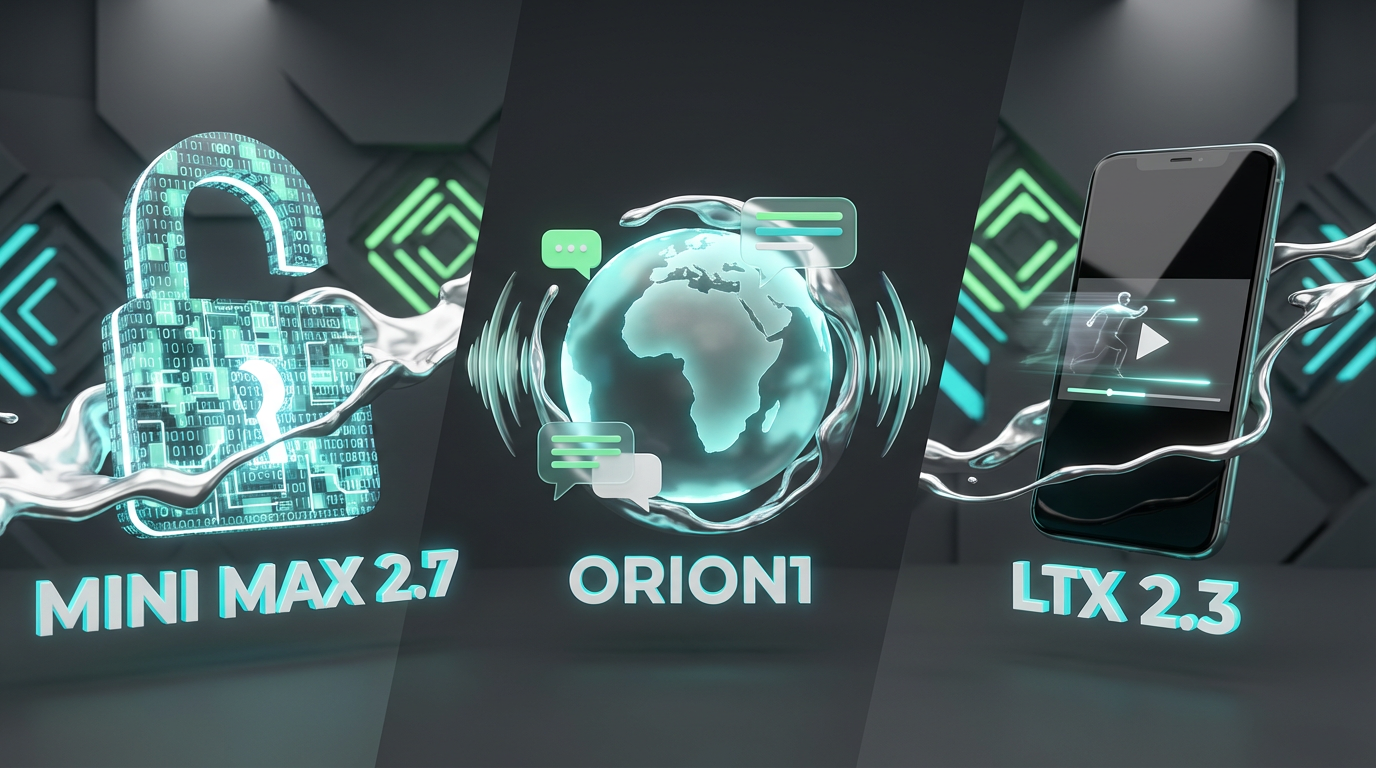
Open models are growing up fast, and that changes how teams should build with AI. MiniMax 2.7 puts fresh pressure on closed platforms with strong coding, long context, and agent potential, but the real story is workflow portability and avoiding vendor lock in. Orion1 pushes multilingual speech recognition forward with better support for lower resource languages, opening new possibilities for transcription, localization, and audience reach. OpenArt LTX 2.3 makes open video more practical for social content with better prompt adherence, smoother motion, audio sync, and portrait output. The bigger takeaway is simple. Date the model, marry the workflow, and keep humans in the loop where judgment still matters most.

Episode Transcript
Hunter: It is Tuesday, April fourteenth, twenty twenty-six, and somehow it is both International Moment of Laughter Day and Look Up at the Sky Day, which feels correct because the AI timeline is either comedy or astronomy at this point. This is COEY Cast, the show assembled by a suspiciously competent stack of machines, prompts, and automation glue. If a sentence comes out a little too confident, just know the robots were feeling brave today. I’m Hunter.
Riley: And I’m Riley. Happy Tuesday, everybody. We made this episode the way modern chaos intended, with AI doing the heavy lifting and us letting the weird stay in frame. So, you know, if the vibes get a little unlicensed and multilingual, that’s part of the art.
Hunter: Today’s big thread is open models getting a lot more serious. MiniMax two point seven is all over X as this high-capability open-weight alternative. Orion1 from Hasab AI is getting love for multilingual speech recognition, especially for lower-resource languages. And then OpenArt’s LTX-two point three is making open video feel a lot less like a science fair project and a lot more like a social content machine.
Riley: Which is kind of the whole week in AI, right? Less launch-cinema, more, wait, can I actually use this in my workflow on Monday morning?
Hunter: Exactly. And that’s why MiniMax two point seven is interesting. The buzz is not really, wow, look at the shiny benchmark flex. It’s more, hey, this thing is useful for coding, long-context work, and agent flows, and it’s not tied to one giant closed platform.
Riley: Okay, but hold up. We have to do the annoying but important distinction. Open-weight is not the same thing as open like a free-range internet utopia. Because a lot of people online hear open and immediately start planning their liberation arc.
Hunter: Yeah, that’s the trap. Open enough to matter means you can actually run it, adapt it, integrate it into your own stack, and avoid getting boxed into somebody else’s product roadmap. But if the license is restrictive, or commercial use is fuzzy, or the economics only work for hobbyists, then congrats, you invented lock-in with cooler branding.
Riley: Thank you. That’s the tweet. Because some of the MiniMax excitement is real. People are saying it performs super well, especially in coding and agent tasks, and the local deployment chatter is strong. But if your business team can’t legally turn it into a real workflow, that freedom is a little cosplay.
Hunter: Right. And still, even with that caveat, the strategic signal matters. If open models keep getting cheaper, smarter, and easier to adapt, then organizations should not build their AI strategy like they’re marrying one closed vendor forever.
Riley: Date the model, marry the workflow.
Hunter: There it is.
Riley: Sorry, I had to. But seriously, if I’m a media team or a brand right now, I want my orchestration layer, my prompts, my review logic, and my approvals to be portable. I do not want my whole business logic trapped inside one platform’s vibe swing.
Hunter: One hundred percent. You want a model-routing mindset. Use the best tool for the job, keep your data layer clean, keep your automation logic outside the model, and make sure you can swap pieces as the market moves. Because the market is moving fast.
Riley: Like, violently fast. We were just talking on recent episodes about Muse Spark getting dropped into actual Meta apps, Veo getting cheaper and easier to wire into workflows, and open source shifting from hobby flex to business infrastructure. MiniMax just adds more pressure to that same idea. The center of gravity keeps sliding toward capable alternatives.
Hunter: And the tradeoff conversation online is getting better, but it’s still messy. People get the freedom part right. They get the control part right. They sometimes forget the maintenance part. Open can save you from vendor lock-in, but it can also hand you a beautiful new responsibility called now you own operations.
Riley: Yeah. Open source is not a cute little houseplant. It’s a dragon egg. You might raise something powerful. You might also burn down your weekend.
Hunter: Especially once agents get involved. And OpenClaw has been part of that broader chatter too. Local, agentic, open infrastructure sounds great until someone gives it too much permission and suddenly your calendar, docs, and internal tools are all being managed by an overconfident intern made of YAML.
Riley: Industrialized regret. That’s what that is. And I’m not anti-agent, to be clear. I’m just anti pretending that autonomy is the same thing as judgment. The smartest teams are still using agents for bounded tasks. Monitor this. Summarize that. Route this request. Draft the first pass. Don’t let it freestyle policy.
Hunter: Exactly. Recoverable work, not irreversible work. That’s the line.
Riley: Mmm. Okay, now let’s get into Orion1 because I actually think this is one of the more meaningful stories in the bunch. Multilingual speech recognition for lower-resource languages is the kind of thing that should matter way more than it usually does.
Hunter: I agree. From what people are saying, the big deal is automatic language detection and better support for underserved language contexts, especially in African markets. And that’s important because a lot of speech AI has been weirdly narrow. Very polished if you sound like the default demo. Much less helpful if you don’t.
Riley: English-first AI has had main character syndrome for way too long.
Hunter: It really has. And for marketers and media teams, the practical unlock is pretty big. If your audio workflows stop assuming one dominant language, you can expand transcription, subtitling, translation, archive search, and localization without forcing teams to manually guess what language they’re even dealing with first.
Riley: Which is huge. Because the current workflow in a lot of orgs is basically, um, let me drag this file into a tool, pick a language, hope I guessed right, rerun it, clean up the mess, and then apologize to everyone involved.
Hunter: Exactly. Auto-detection removes a lot of babysitting. And the biggest real-world win, to me, is not just speed. It’s coverage. Teams can finally include audiences and regions that were quietly getting ignored because the tooling was too narrow.
Riley: I’d push that even further. It’s accessibility and localization, sure, but it’s also market imagination. If your tools only work well in a handful of high-resource languages, your campaigns start reflecting that limitation. Your creative brief gets smaller than your audience.
Hunter: That’s a great point. Tool limitations become strategy limitations if you’re not careful.
Riley: Exactly. And there’s also a creator angle. Podcasters, publishers, education brands, community media, all these teams can reach more people if speech recognition actually respects the way people speak in the real world. Not just the way demo videos speak.
Hunter: And because this is an audio model story, it also connects to what we’ve been covering lately with voice AI becoming infrastructure. We talked before about audio shifting from novelty to production layer. Orion1 fits that trend, but with a much more substantive regional and linguistic angle.
Riley: Yeah, this one feels less like, wow, new voice toy, and more like, oh, okay, speech workflows might finally be expanding beyond the same few markets everybody always optimizes for.
Hunter: There is still a caution, though. Better transcription is not automatic cultural fluency. You still need human review, especially if you’re doing translation, captioning for campaigns, or anything brand-sensitive. Human in the loop still matters.
Riley: Always. The machine can catch more, faster. It cannot fully understand every nuance, every idiom, every joke, every local reference. And if you’re a marketer, you really do not want to discover that after the ad is live.
Hunter: That would be a rough postmortem.
Riley: A spiritually expensive postmortem.
Hunter: Alright, let’s shift to video. LTX-two point three is one of those releases where the conversation is actually kind of grounded for once. Sharper detail, better prompt adherence, smoother image-to-video motion, cleaner audio sync, and native portrait support. That matters.
Riley: Native portrait support matters a lot. Because if your content team lives on social, vertical is not some bonus export setting. Vertical is the job.
Hunter: Exactly. And that’s why I think the bigger message here is not just open video is improving. It’s that open and accessible video tooling is getting close enough that teams need to rethink when they’re paying premium prices for closed systems.
Riley: Ooh, spicy. But true. Because a year ago, the conversation was basically, should we even use AI video. Now it’s becoming, wait, why are we paying extra if open tools can cover a lot of our draft, concept, and even some production use cases?
Hunter: That said, realistic expectations matter. Open video right now is genuinely useful for concepting, social-first creative, stylized clips, image-to-video motion, and fast iteration. It is not magical truth serum. It can still wobble on fine control, exact brand details, product accuracy, and long narrative continuity.
Riley: Yes. Some of the internet is acting like open video put on a blazer and became a studio overnight. And I’m like, ah, let’s breathe. Some of it is still demo magic with very good lighting.
Hunter: Very confident blazer energy.
Riley: Exactly. But for mobile-first teams, especially people making reels, shorts, ads, creator-style content, this gets pretty compelling. Better prompt adherence plus vertical output means less fighting the tool and more actually directing the result.
Hunter: And that changes workflow. If your team can go from brief to rough visual to alternate versions in one system, with open tools you can host or adapt, that’s a meaningful shift. Fewer handoffs. More iteration. More control over the pipeline.
Riley: It also connects to what we’ve talked about with Seedance and Wan and Veo and all the rest. The winners are not just the prettiest models. It’s the tools that fit the workflow. Can I get from idea to testable asset without ten extra steps and a prayer circle?
Hunter: Exactly. The model matters. The handoff matters more.
Riley: Okay, so let me challenge you. If I’m a company that is pro-AI, wants to move fast, but does not want to tell the board that the robots now run half the building, how do I phase this stuff in without turning my stack into fan fiction?
Hunter: I’d do it in layers. First, use open or flexible models for low-risk drafting, tagging, search, and internal copilots. Second, bring in audio AI where the workflow pain is obvious, like transcription, localization, and archive processing. Third, test agent tools only on bounded, reviewable tasks. And for video, start with concepting and social variants before trying to automate mission-critical brand assets.
Riley: Mmm. So basically, automate the grind first. Not the judgment.
Hunter: Exactly. And keep approvals human. Keep governance simple. Keep logs. Keep the whole thing reversible.
Riley: I like that because it avoids both fake utopia and doom cosplay. The future is not, the machine replaces everybody. It’s more like, your best people stop doing formatting prison and start doing higher-level creative calls.
Hunter: That’s the goal. Human plus machine. Not human or machine.
Riley: Also, tiny culture note, I love that the hottest AI stories right now are getting less theatrical. The industry is still chaotic, obviously. But the vibe is shifting from, behold the benchmark throne, to, cool, does this help my team ship better work.
Hunter: That’s the mature question.
Riley: Well, mature-ish. We’re still online.
Hunter: Fair. And since it’s International Moment of Laughter Day, maybe that’s the closing lesson. Do not let your agent book meetings, publish assets, and localize campaigns unsupervised just because the dashboard looked confident.
Riley: Please. Look up at the sky, laugh a little, and then go put a review layer on your workflow before the machine starts inventing brand strategy in six languages.
Hunter: That is solid Tuesday advice. Thanks for hanging with us on COEY Cast.
Riley: Thanks, everybody. Check out COEY.com slash resources for AI news and updates, and definitely subscribe.
Hunter: Enjoy the rest of your Tuesday, celebrate International Moment of Laughter Day responsibly, and we’ll catch you later.
Riley: Later.