
Practical AI Automation: Gemini 3, SAM 3, CORE-1
Practical AI automation with Gemini 3, SAM 3, and CORE 1. A working guide for AI marketing automation teams shipping real workflows on the latest stack.
19 November 2025Team COEY
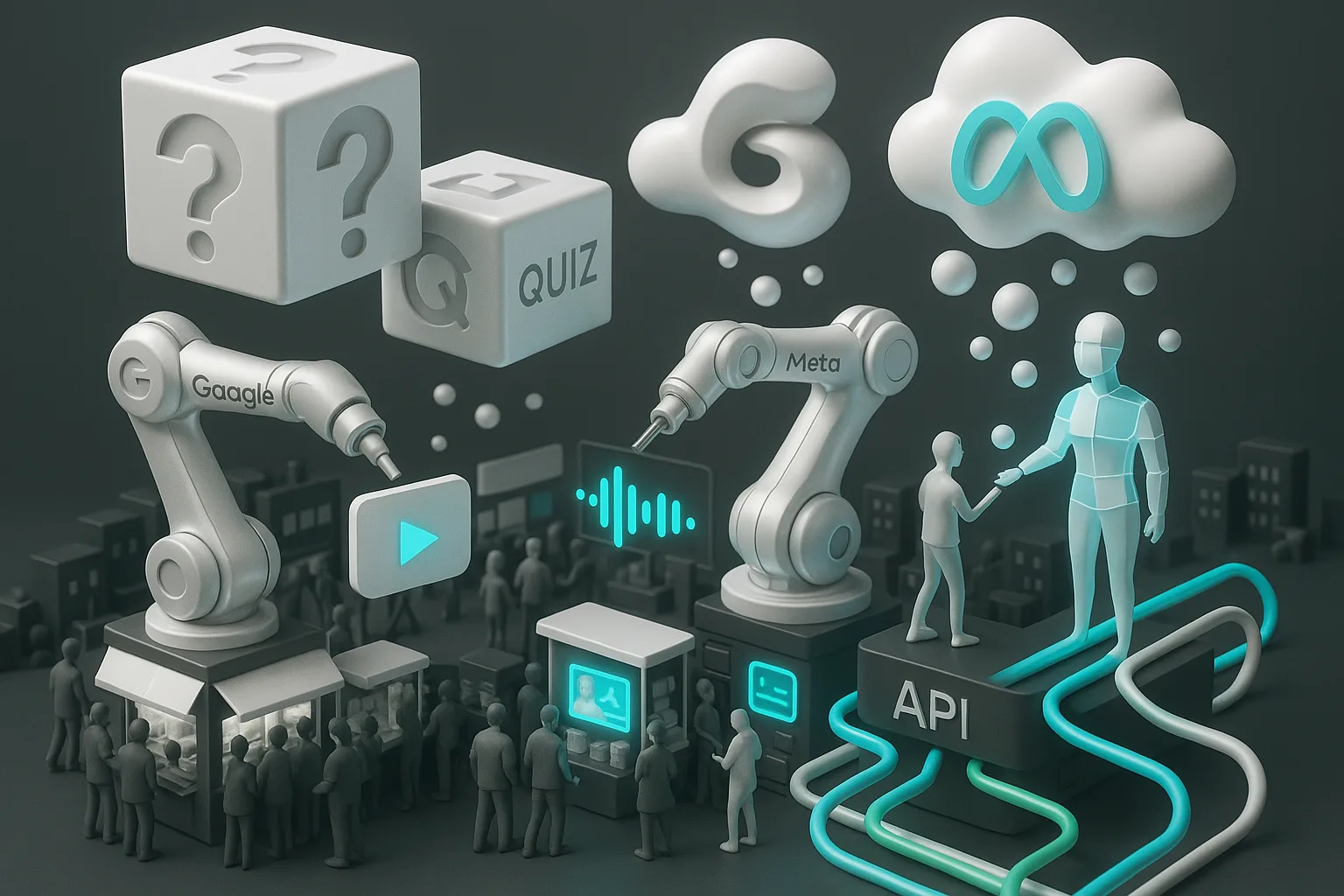
Today’s AI drops are unusually practical for anyone building automated creative workflows. Google’s Gemini 3 rolls into core Google surfaces with developer access, Meta upgrades its segmentation tech to full video and text-prompt control, and Octane AI pushes agentic commerce beyond static quizzes. Below, we break down what’s live, what still needs APIs or guardrails, and how creators and marketers can plug this into text, photo, video, and audio workflows right now.
Automation lens: Can it be automated today? Does it have APIs or integrations? If not, what would need to happen? We answer that for each item below.
Google’s Gemini 3: Wider rollout, stronger reasoning, and API access
What shipped: Google announced Gemini 3 with broader availability across the Gemini app, Search’s AI mode, and developer tooling. The model pushes reasoning and multimodal understanding (text, image, video) and introduces a forthcoming “Deep Think” mode for longer, tougher tasks aimed first at premium tiers.
What you can automate today:
Text: Campaign planning, brand-safe copy, and research assistants that can cite, summarize, and transform materials across channels.
Images & video: More reliable multimodal prompts for creative briefs, scene breakdowns, storyboard planning, and structured extraction from visuals (for example pulling shot lists or talent mentions).
Audio: Transcription and summarization; prompt scaffolding for podcast show notes and ad reads. Pair with your preferred speech-to-text pipeline if you need full control over files and formats.
APIs and integrations: Gemini 3 is accessible via the Gemini API in AI Studio and enterprise-grade via Vertex AI. If you are running no-code stacks, you can call the API via standard webhooks or HTTP requests in your automation platform. That means many existing workflows can upgrade model calls without re-architecting the entire system.
Current vs. future:
Now: Use Gemini 3 for faster, more robust multimodal prompts; build assistants that combine text + images + structured data; integrate via the existing Gemini API endpoints.
Soon: “Deep Think” mode (rolling out to premium tiers) promises longer-horizon task planning and more complex reasoning , useful for market research deep dives, multi-asset campaign synthesis, and multi-step creative briefs. Expect higher latency and cost; plan your automations to call it sparingly where it moves the needle.
Reality check: This is a meaningful step, not magic. You will still need data governance, prompt scaffolds, and evaluation for brand tone and factuality. The good news: it is ready for production tests with clean API paths and enterprise controls.
Meta’s SAM 3: Text-to-object segmentation and real-time video tracking
What shipped: Meta’s latest Segment Anything Model, SAM 3, extends from still images into long-form video, with text prompts like “segment all red cars” and improved multi-object tracking. There is also an extension for 3D reconstruction to support AR and VR workflows. Meta says models and code are available for the community, and features are starting to appear in Meta creative surfaces.
What you can automate today:
Video: Batch segmentation and tracking for product demos, UGC moderation cues (logos, faces, categories), and dynamic ad overlays that follow objects across frames.
Image: Bulk background swaps, subject isolation, and rapid mask generation for asset packs and template libraries.
AR/3D: Faster scene prep for filters and simple object reconstructions as part of prototyping pipelines.
APIs and integrations: With code and weights available, you can deploy SAM 3 on your own infrastructure or preferred cloud with GPU acceleration. For non-technical teams, expect hosted services and third-party wrappers to pop up quickly , bridging SAM 3 into no-code automations via REST endpoints. That is the unlock for templated workflows like “drop video in, get object-tracked overlays out.”
Current vs. future:
Now: On-prem or cloud-hosted SAM 3 for batch pipelines; programmatic segmentation for catalogs, shorts, and reels; streamlined mask creation for design tools.
Next: Deeper native features across Meta’s creative apps could make object-aware editing routine. If Meta exposes a hosted API with usage-based pricing, adoption in no-code stacks will accelerate dramatically.
Reality check: You will need GPUs for speed and cost control, plus basic MLOps to keep latency predictable. But the text-prompt interface is a genuine usability win , less frame-by-frame labeling, more creative direction at scale.
Octane AI’s CORE-1: Agentic commerce goes beyond static quizzes
What shipped: Octane AI introduced CORE-1 to power “agentic marketing” , AI that adapts in-session and acts on context. Their Smart Quiz Builder can generate and deploy quizzes from a single prompt, capture zero-party data, and feed recommendations and messaging across the stack.
What you can automate today:
Lead capture and segmentation: Spin up on-brand quizzes that route customers into nuanced segments based on needs, preferences, and goals.
Personalized merchandising: Dynamic product recommendations (including bundles and fallbacks) that reflect quiz answers and onsite behavior.
Lifecycle messaging: Sync zero-party data into email or SMS platforms to trigger targeted flows and A/B test creative at the segment level.
APIs and integrations: Octane AI leans into Shopify-native workflows and popular marketing tools (for example email, SMS, CRM). For automation, look for data syncs, webhooks, and catalog-aware logic you can call from your orchestration layer. Non-technical teams can go live with no-code builders; technical teams can wire deeper personalization and BI.
Current vs. future:
Now: Deploy quizzes, collect structured signals, and feed recommendations to storefronts and messaging channels.
Next: Fuller agent behaviors (for example cross-channel experiments, creative variations, and merchandising tests) as more granular controls and programmatic endpoints mature.
Reality check: The magic here is data gravity. Quizzes work when the captured signals route cleanly into your CRM and content systems. Vet how the data flows, how fast it syncs, and whether you can export for your warehouse.
Quick hits (with an automation filter)
- xAI Grok 4.x: Early reports highlight better biomedical reasoning and lower hallucinations. Useful for research assistants in regulated contexts, but note the limitation: broad, stable API access is still evolving, which caps automation potential for now. Official details from xAI here .
Automation readiness at a glance
| Release | What you can automate today | APIs / Access | Multi-format impact | Key blockers |
|---|---|---|---|---|
| Google Gemini 3 | Reasoning-heavy assistants; multimodal prompt chaining; structured extraction for campaigns | Gemini API (AI Studio, Vertex); callable via standard HTTP or webhooks | Text, images, video; supports audio workflows via paired tools | “Deep Think” not fully rolled out; cost and latency planning for complex tasks |
| Meta SAM 3 | Batch video segmentation, tracking, and mask generation; AR and 3D prep | Models and code available; self-host or use emerging hosted wrappers | Images and video today; 3D extension for AR and VR | GPU requirements; hosted API availability and pricing not yet standard |
| Octane AI CORE-1 | Agentic quizzes; segmentation; dynamic product recommendations; data syncs | Shopify-native and marketing tool integrations; data syncs or webhooks | Text-forward flows; pairs with images for merchandising | Depth of programmatic control varies; ensure clean data exportability |
The bigger picture: Open vs. closed and where scale comes from
There is a visible split in AI right now. Closed platforms (Google, Meta surfaces) are shipping polished experiences with guardrails and some API access. Open-source energy continues to push technique (like segmentation and efficiency tricks), but compute and hosting costs keep a lot of teams from end-to-end ownership. The practical strategy for most creators and marketers: blend both. Use hosted models where they remove friction, and keep critical, repeatable transformations (like segmentation or brand tone enforcement) portable so you can swap vendors without rewriting your stack.
Bottom line for builders: Treat models like interchangeable parts behind clear interfaces. Your defensibility is the workflow: how data comes in, how content gets transformed, and where it is delivered.
What this means for creators, marketers, builders
Creators: SAM 3 removes much of the grunt work in masking and tracking , particularly for shorts and reels. Gemini 3 helps consolidate research, scripting, and visual planning. Expect faster concept-to-draft loops.
Marketers: CORE-1 plus Gemini 3 is a strong insight-to-action combo: use Gemini for research and creative variants, then route zero-party signals from CORE-1 to trigger channel-specific content automatically.
Founders: If you are automating production, build modularly: API calls for reasoning, a hosted or self-hosted segmentation service, and a message bus for orchestration. That lets you scale output and swap components as pricing and quality evolve.
Our take: Today’s releases are workflow pieces you can actually plug in. Gemini 3 strengthens the reasoning layer with straightforward API paths. SAM 3 makes video editing more programmatic. CORE-1 operationalizes zero-party data for personalization. None of these replace creative direction; they remove friction so you can spend more time on taste, brand, and story , and less time wrestling files and labels.