Qwen-Image-2512 Targets Uncanny AI Marketing Visuals
Qwen Image 2512 targets uncanny AI marketing visuals head on. What the new model unlocks for AI marketing agencies and brand consistent ad creative ops.
31 December 2025Team COEY
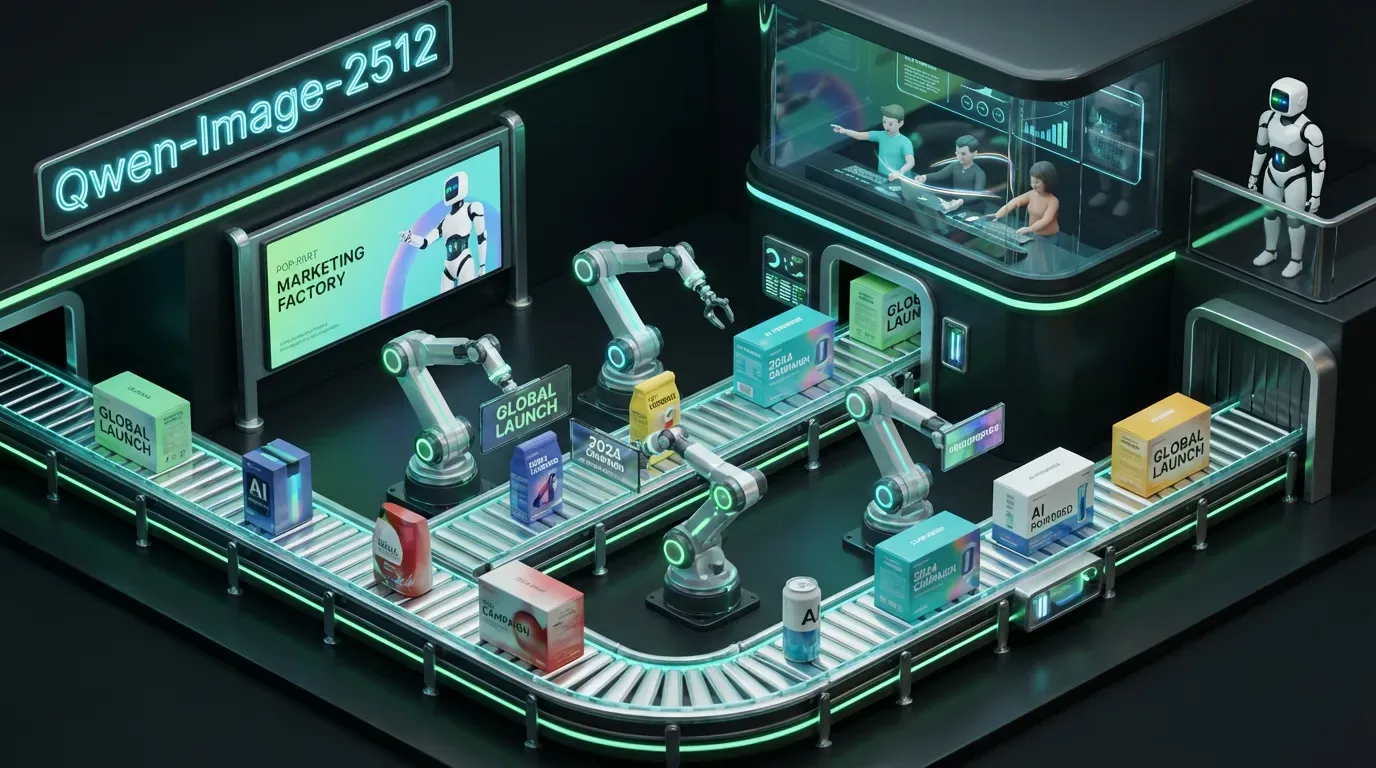
Alibaba just open-sourced Qwen-Image-2512, an image generation model pitched as a practical upgrade for commercial creatives: more believable people, richer textures, and text-in-image that is finally readable enough to ship, or at least to stop embarrassing you in client review.
If you have ever tried to generate a “smiling person holding our product with a tagline” and got back a wax museum intern holding a cursed object next to “BRÄND ÑÅMË,” this release is for you. And not in a “look at this shiny demo” way, more in a “this might actually plug into a creative production line” way.
What actually shipped
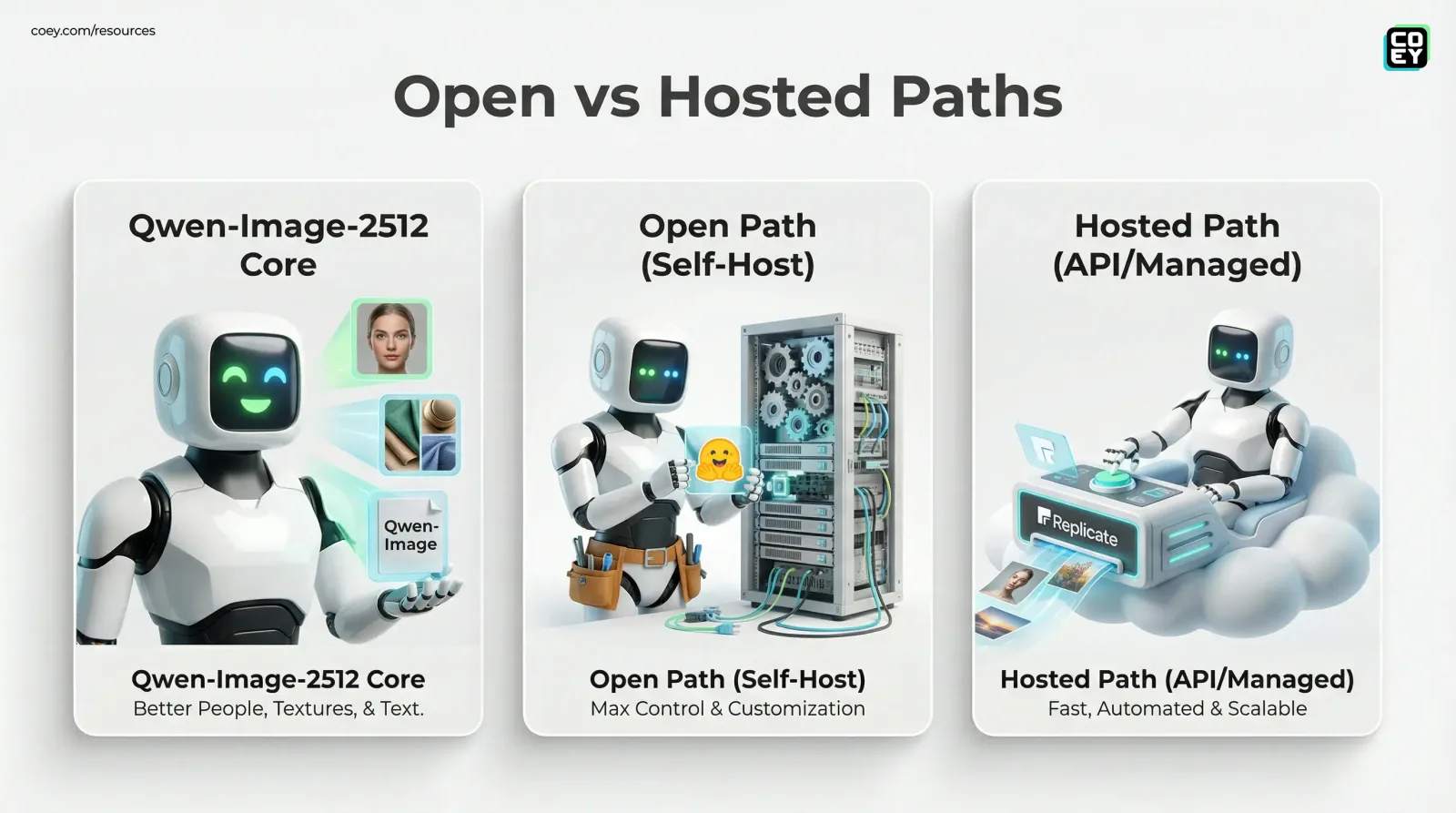
Qwen-Image-2512 is the latest checkpoint of Alibaba’s Qwen image model series, published as open weights and distributed in the places developers actually look: Hugging Face and GitHub. The official repository positions Qwen-Image as an image generation foundation model and documents text rendering as a key strength, along with image-to-image usage for edit-like workflows. Source: Qwen-Image on GitHub.
The model is also available through a hosted, API-accessible surface via Replicate, which matters for teams that want to test and automate without standing up GPUs on day one. Source: Qwen-Image-2512 on Replicate.
What it claims to be better at
Human realism: fewer uncanny valley faces, more natural skin and hair detail, and, per public examples, a higher hit rate on photoreal portraits.
Texture and materials: improved rendering for fabrics, surfaces, fur, and product finishes that tend to look cheap in weaker open models.
Text-in-image: clearer, more accurate text placement and character rendering, especially important for posters, packaging mocks, signage, and social graphics.
Prompt adherence: better at translating detailed constraints into actual composition choices, not vibes loosely inspired by your request.
The quiet headline: Qwen-Image-2512 is trying to be a marketing asset engine, not just an art generator. That is a higher bar, because marketing requires legibility, consistency, and fewer weird accidents.
Why this matters for creative teams
Most image generators can make something pretty. The workflow tax comes afterward: fixing faces, correcting hands, repainting logos, and rebuilding typography in Photoshop because the model thinks letters are optional.
Qwen-Image-2512’s improvements target exactly that tax. If it delivers even 20% less time spent fixing AI weirdness, that compounds fast when you are producing at volume: paid social variants, marketplace images, influencer briefs, pitch mockups, and event signage.
Where it is immediately useful
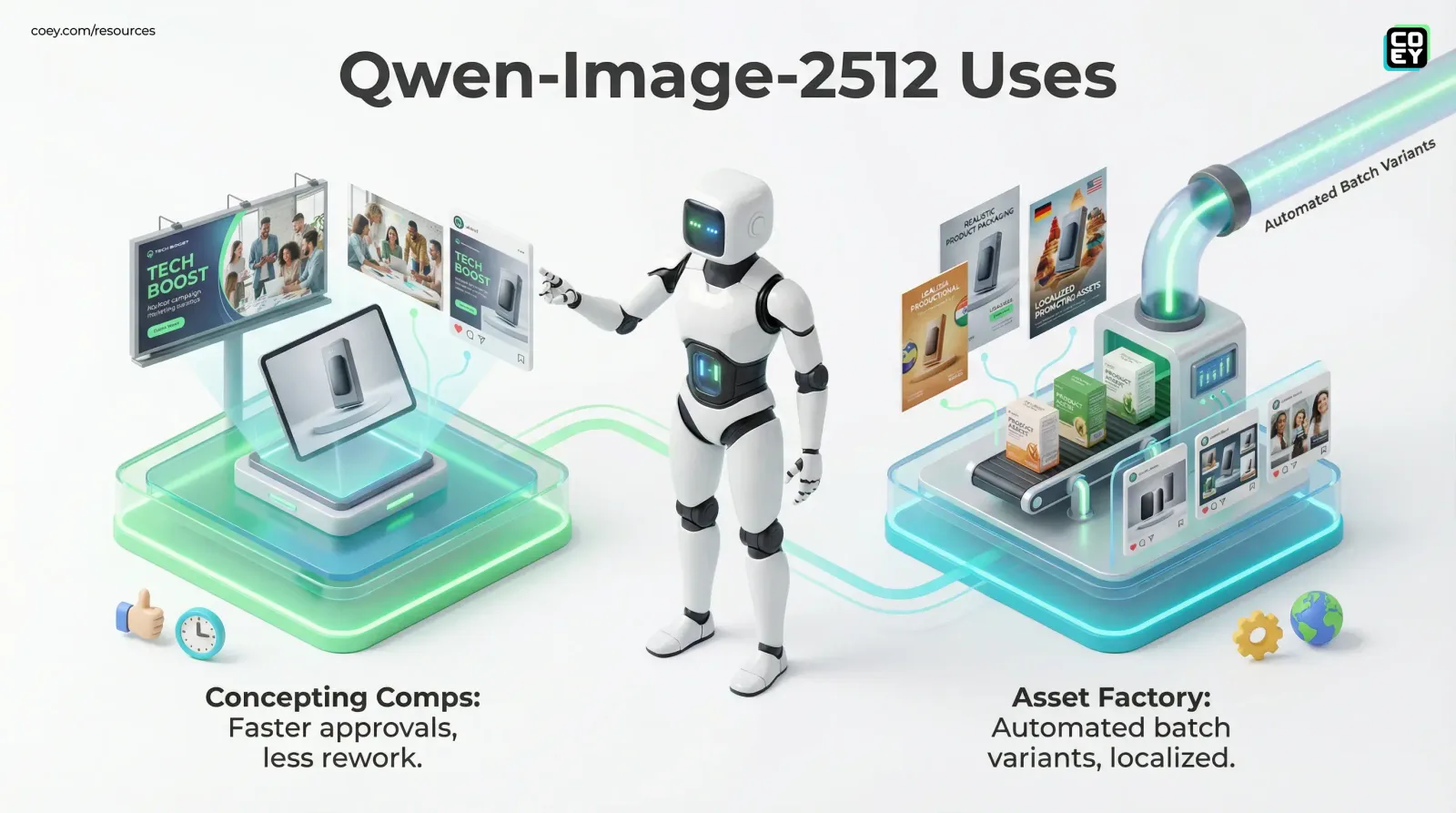
Concepting comps that look closer to final: better realism means fewer “this is just a placeholder” apologies.
Text-forward visuals: end cards, promo tiles, simple posters, menu boards, in-store signage mockups.
eCommerce and product storytelling: materials and textures matter when the output needs to resemble a real product photo.
Localization workflows: improved multilingual text rendering makes it more viable for multi-language creative variants.
Automation potential: can it plug into workflows?
Yes, more than most model drops, because it is open and deployable in multiple ways. But the best path depends on your team’s appetite for engineering.
Integration paths (from easiest to most controllable)
| Path | What you get | Best for |
|---|---|---|
| Hosted API (Replicate) | Fast start, no GPU setup, straightforward HTTP calls | Marketing teams piloting automation and quick batch generation |
| Managed deployment (HF endpoints or vendors) | More control than a playground, still minimal infra | Teams that need reliability plus some governance |
| Self-host open weights | Max control, privacy, customization, you own scaling | Studios and brands building an internal asset factory |
Because it is open weights on Hugging Face, you are not trapped in a single UI. You can run it where your stack lives: cloud GPU instances, dedicated inference servers, or a locked-down VPC for sensitive creative.
What automation looks like in real life
Automation is not “type prompt, get image.” Automation is generate 200 on-brand variants, route the best 10 to human review, and push approved assets into your DAM with metadata.
Triggered generation: new product added in Shopify or PIM, auto-generate lifestyle variants, notify a designer in Slack for selects.
Campaign batching: upload a spreadsheet of offers and headlines, generate matching promo tiles, export with consistent naming.
Localization: same visual template prompt, swap language strings, regenerate end cards across regions.
Reality check: even with better text rendering, your final brand typography will still often need a design tool pass. But moving from “always rebuild text” to “sometimes usable text” is still a big throughput win.
API readiness: open model, but the API is your choice
There are two different API stories here, and they matter for executives:
Immediate API: you can run it via Replicate’s API today: Qwen-Image-2512 on Replicate .
Strategic API: because the model is open, you can deploy it yourself and expose an internal endpoint that matches your security, pricing, latency, and governance needs.
This is the open-source advantage that actually matters: you can standardize an image generation capability inside your company as infrastructure, not as “who has a seat in which tool.”
Licensing and can we use it commercially?
Qwen-Image-2512 is released under Apache 2.0, which is generally permissive for commercial use. Confirm the license file on the official repo and the model card for your compliance process.
Still, permissive license does not magically solve brand risk like likeness, IP style mimicry, and sensitive categories. You will want policy guardrails and review gates for anything public-facing.
Real-world readiness: where it is strong vs. still fragile
Open image models are getting dangerously good, and also still occasionally unhinged. The question is whether Qwen-Image-2512 is production good or demo good. Based on what is shared publicly, it trends toward production usefulness, especially on humans and text.
What feels ready now
High-volume ideation: faster comp cycles, more usable outputs per batch.
Marketing mockups: social tiles, posters, rough key art, product storytelling scenes.
Pipeline experimentation: accessible via API and open weights, so you can prototype quickly.
What still needs human control
Brand typography and logos: exact font and kerning perfection is rarely guaranteed by generation alone.
Consistent characters or models: continuity across a campaign is still tricky without reference-driven workflows or fine-tuning.
Compliance-heavy categories: regulated claims and sensitive visuals need a human gate.
The bigger signal: open models are catching up on boring needs
Closed models had the advantage where it mattered most: reliability, realism, and the annoying details like text. Qwen-Image-2512 is part of a broader shift where open models start competing on the boring stuff that makes automation possible.
And boring is good. Boring means:
Fewer revisions
Faster approvals
More assets shipped per week
Less creative energy wasted on cleanup
Scaling creativity is not about making more images. It is about making it easier for humans to direct, select, and ship the right images, while machines handle the volume.
Bottom line for executives and operators
Qwen-Image-2512 is a meaningful open-source move because it attacks the three things that block AI images from real marketing usage: people, textures, and text. The model is available as open weights on Hugging Face, documented in the official repo on GitHub, and runnable via an API surface on Replicate.
If your organization is serious about machine collaboration, not just dabbling, this is the type of release to pilot: open, automatable, and aimed at real creative production constraints. If you want adjacent context on why editability and production structure matter, see our internal coverage: Qwen Layered Images: Editable RGBA Design Files.
Keep it grounded: test it on your brand’s actual needs, set up review gates, and treat “text rendering is better” as “less rework,” not “no design team required.”