
LiquidAI LFM2.5 Brings Local Real Time Voice Automation
LiquidAI LFM2.5 brings local real time voice automation into reach. What it unlocks for AI voice agents, edge deployments, and marketing voice ops.
13 January 2026Team COEY
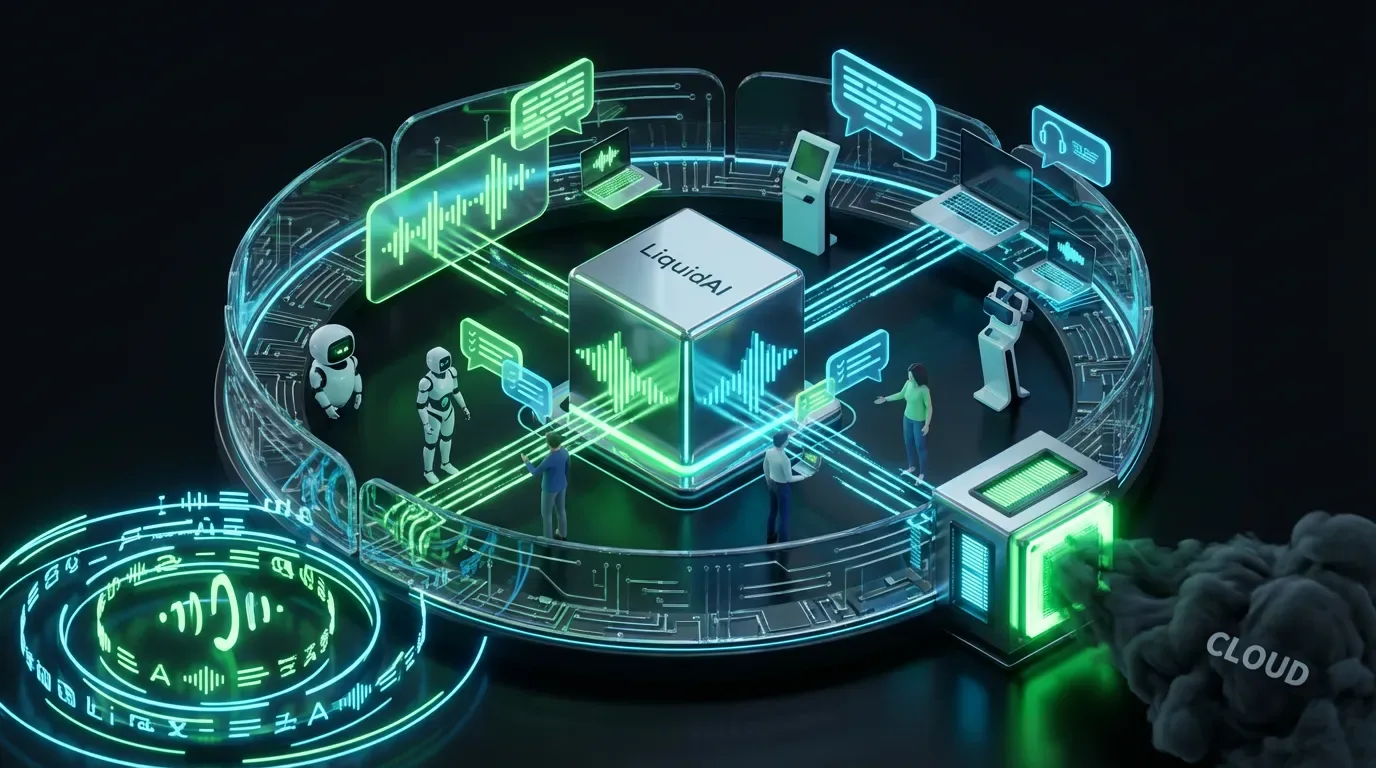
LiquidAI just dropped LFM2.5-Audio-1.5B, an end-to-end audio-language model aimed at real-time speech workflows that can run on local or edge hardware. Translation: this isn’t “voice AI, but make it a dashboard.” It’s a model you can package, serve, and wire into your stack, especially if you care about latency, privacy, or not sending every spoken word through a cloud toll booth.
Voice is having its “API moment,” but the next layer is “voice without the internet moment.” LFM2.5-Audio-1.5B is a signal that on-device speech automation is shifting from lab flex to workflow component.
What actually shipped
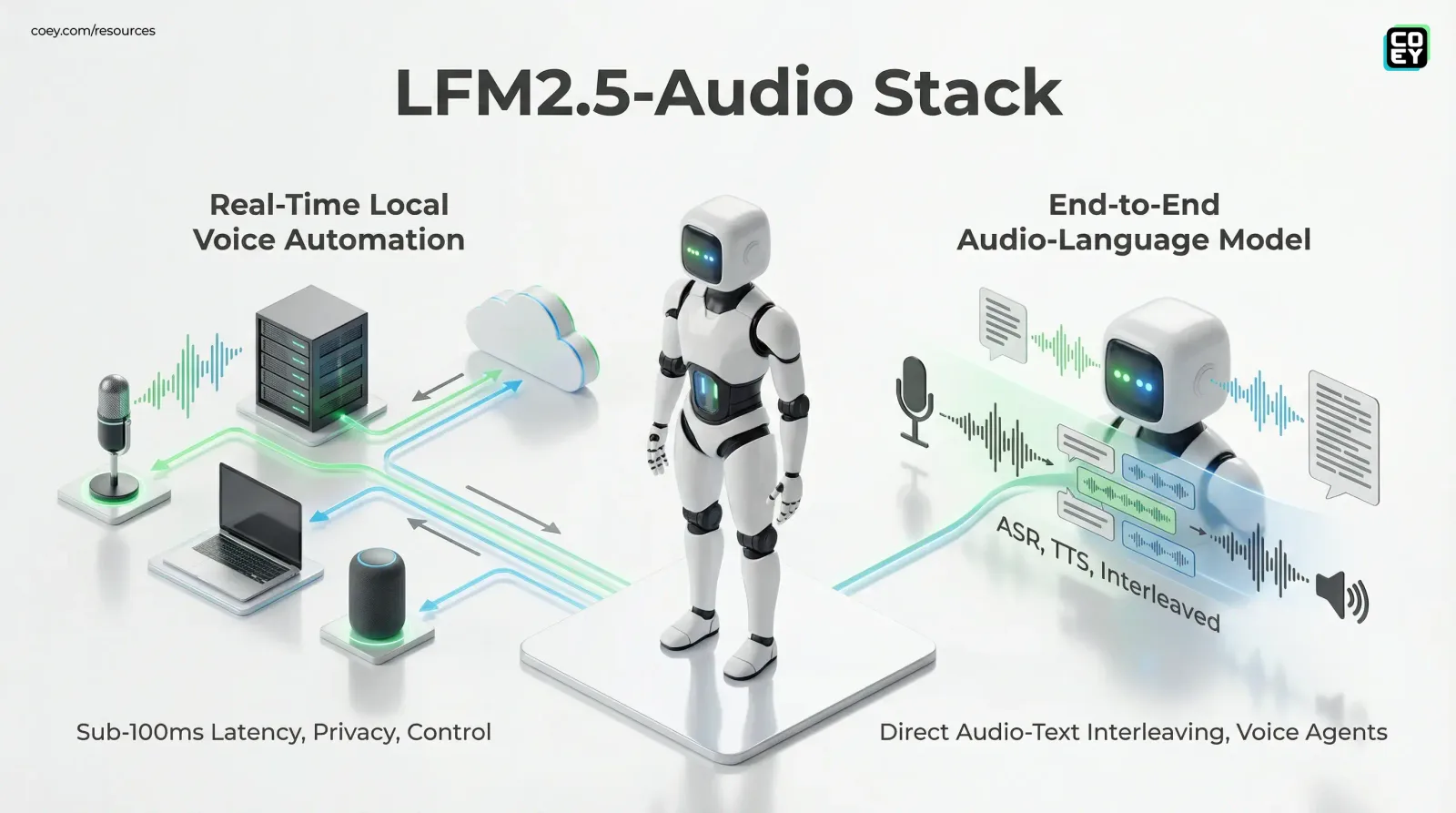
LFM2.5-Audio-1.5B is a roughly 1.5B-parameter audio-language foundation model built to handle speech and text in the same system. Unlike the traditional “three-vendor relay race” (ASR → LLM → TTS), this model is designed for end-to-end audio workflows where audio and text can interleave naturally, useful for conversational experiences, live transcription + response, and voice-driven interfaces.
At a capability level, the model targets three core jobs:
ASR (speech-to-text): transcription, dictation, captions, live notes.
TTS (text-to-speech): generating spoken output from text prompts.
Interleaved audio-text: handling back-and-forth sequences that switch between modalities, which is what “voice agents” actually need in practice.
LiquidAI positions the model for low-latency, local execution, which matters because “voice experience quality” is basically “how fast did it respond” plus “did it sound sane.” Anything else is vibes.
Why local voice is suddenly a big deal
Cloud voice stacks are powerful, but they come with predictable taxes:
Latency: every roundtrip adds lag, and lag is what turns “assistant” into “hold music.”
Cost: speech minutes + tokens + TTS characters can become a recurring invoice nobody wants to own.
Privacy + compliance: some orgs simply can’t ship raw audio off-device (or don’t want the risk profile).
Brittle orchestration: more vendors = more failure points = more “why is it stuck buffering?” incidents.
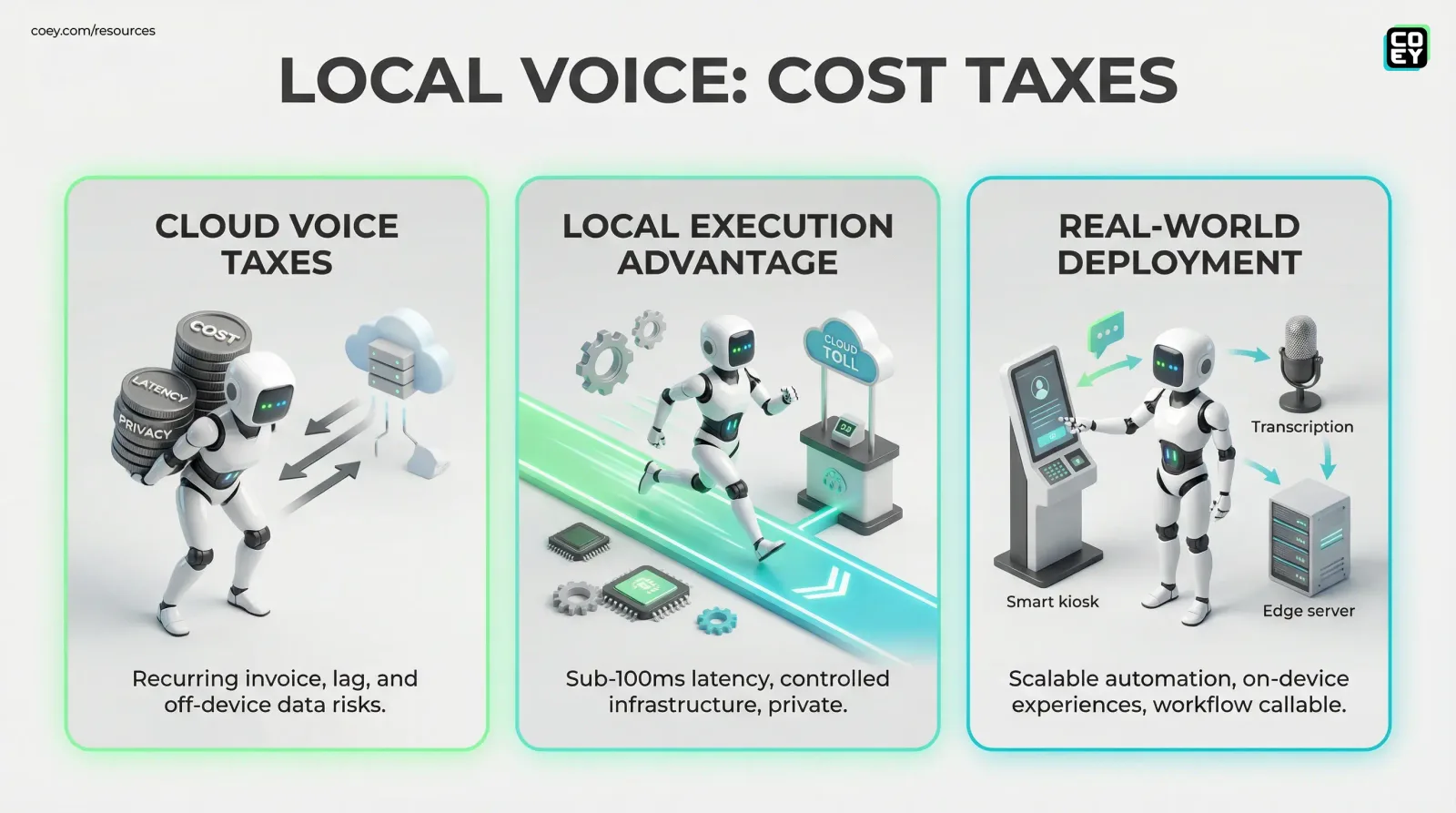
LFM2.5-Audio-1.5B is designed to reduce those taxes by making voice something you can run in your own environment, closer to users or closer to your data. That’s the key operational shift: voice becomes infrastructure you control, not a feature you rent.
Latency claims and the realism check
LiquidAI’s materials and community testing discussions emphasize sub-100ms end-to-end latency as a goal for interactive, real-time scenarios (with results depending on device, quantization, and serving setup). If you’ve ever tried to demo a voice agent and watched it pause like it’s remembering your birthday wrong, you already know why that number matters.
But here’s the grown-up framing: latency isn’t just the model. It’s your whole pipeline: audio capture, buffering, preprocessing, inference, decoding, and whatever you’re doing after (logging, tool calls, database writes, safety checks). So while “sub-100ms” is a strong signal that the model is built for speed, your real-world latency will depend on hardware, serving setup, and concurrency.
The model is not the system. The system is the model plus serving plus monitoring plus fallbacks. If you skip the boring parts, voice automation will humble you publicly.
API availability: callable, but not hosted for you
This is the part that matters for teams trying to automate, not just experiment.
LFM2.5-Audio-1.5B is distributed as open-weight downloads on Hugging Face, which means it’s absolutely automatable, but not automatically SaaS’d. LiquidAI does not present this Hugging Face release as a default, one-line “hosted endpoint” product you just paste into Zapier and call it a day.
Instead, the realistic pattern is:
You run it locally or on your own infrastructure (workstation, on-prem GPU, edge server, private cloud).
You wrap it with an internal API (a lightweight service your apps and automations can call).
You integrate it into workflows via queues, webhooks, and the same orchestration you use for other media jobs.
For developers, LiquidAI also points to companion Python tooling, including liquid-audio on PyPI, which is a practical entry point for scripting and demos around interleaved audio-text interactions.
| Question | Answer | What it means in ops |
|---|---|---|
| Is it available now? | Yes | Download weights, test immediately |
| Is there a turnkey hosted API? | No (by default) | You self-host or use a wrapper platform |
| Can it automate workflows? | Yes | Build an internal endpoint and call it from tools |
Deployment details that actually matter
LiquidAI’s release is built with “run it for real” in mind, especially compared to drops that are basically “here’s a checkpoint, good luck, see you on GitHub Issues.”
Quantization and edge formats
The ecosystem signal here is the availability of alternate weight formats like GGUF via the related repository LFM2.5-Audio-1.5B-GGUF. That matters because it opens deployment paths in popular local inference tooling (for example, llama.cpp-based workflows) and on more constrained machines.
In practical terms, quantized weights are how you get from “cool model” to “actually runs on the machines we already have.” That’s a big deal for creative orgs where compute budgets are real and IT does not enjoy surprise GPU procurement conversations.
Serving patterns that fit modern stacks
Once a model is local-first, the question becomes: how does it behave as a component?
Batch jobs: transcribe a folder of podcasts, auto-caption a campaign’s worth of UGC, generate VO variants overnight.
Streaming / realtime: live captioning, interactive kiosks, voice UI for internal tools.
Human-in-the-loop: auto-transcribe + highlight uncertainties, route to an editor only when confidence drops.
This is where human + machine collaboration gets real: the machine handles volume, the human handles judgment and polish. Nobody is romanticizing the “manually fix captions for 6 hours” era.
Where marketers and creators will feel this first
This model isn’t “replace your entire support org tomorrow.” The near-term winners are workflows that already exist, already produce value, and are currently slowed down by manual audio labor.
High-confidence, high-throughput use cases
Captions and transcripts at scale: faster post-production, searchable content libraries, more accessible media.
Podcast and webinar repurposing: transcript → clips → social captions → newsletter drafts (with your existing automation stack).
Private pre-release content handling: run speech automation without sending unreleased creative to external APIs.
On-device voice experiences: brand kiosks, retail demos, field tools where connectivity is shaky and latency matters.
If you want the broader context on why voice is becoming “callable infrastructure,” COEY has also tracked the hosted side of the trend with OpenAI Realtime Voice API Makes Agents Deployable. LFM2.5-Audio-1.5B is the flip side: the local-first path.
Licensing and readiness: the part people skip
The model is released under the LFM Open License v1.0 (LiquidAI’s custom license, based on Apache 2.0 with modifications). Notably, it includes a commercial-use threshold tied to company revenue (LiquidAI’s published terms specify an additional commercial license is required above $10 million USD annual revenue). If you’re deploying commercially, especially in enterprise environments, this is not the “scroll and click agree” moment. It’s the “someone should actually read this” moment.
Operationally, LFM2.5-Audio-1.5B looks real-world ready for teams that can run models (even modestly): it’s downloadable, it’s scriptable, and it’s designed for latency. The remaining work is predictable work: packaging, serving, monitoring, and building the review gates that keep brand and compliance intact.
Shiny hype is “look, it talks.” Real readiness is “it talks, it’s callable, it’s monitorable, and it doesn’t break when you run 500 jobs.” This release leans toward the second category.
Bottom line
LFM2.5-Audio-1.5B is a meaningful step toward voice automation that’s actually controllable. It’s not a closed UI demo, and it’s not just a cloud endpoint either, it’s a deployable, open-weight model that can live inside your workflows, where speed, privacy, and repeatability matter.
If your team is serious about scaling creativity through human + machine collaboration, this is the kind of release that compounds: faster transcription, faster narration experiments, tighter feedback loops, and voice interfaces that don’t depend on a network prayer. Just keep it grounded: you still need a serving layer, governance, and human review paths. But the core primitive, the model, finally looks like something you can build around.