ElevenLabs Eleven Music Makes Music Workflow-Ready
ElevenLabs Eleven Music makes music workflow ready. What it unlocks for AI marketing automation, brand audio, and generative AI sonic branding ops.
26 January 2026Team COEY
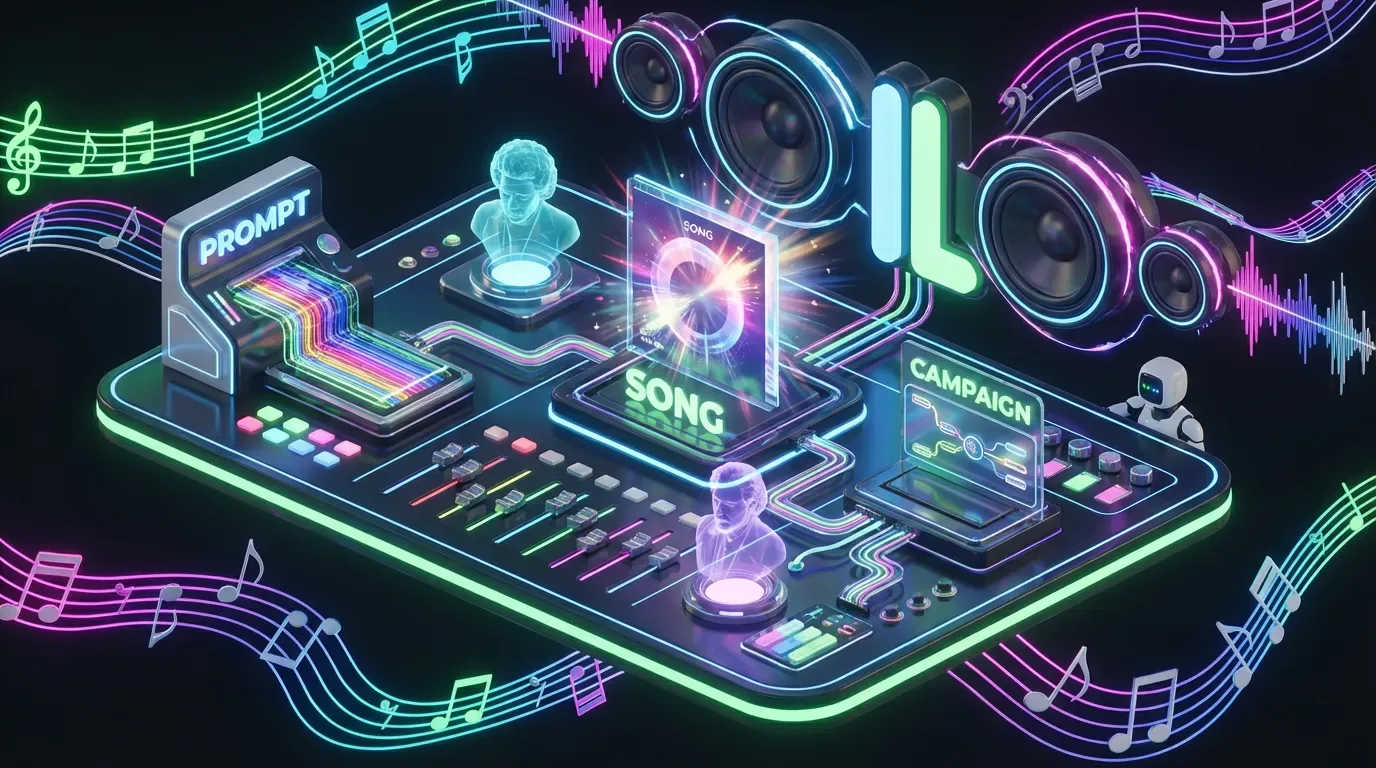
ElevenLabs just stepped into the “make a whole song from a prompt” arena with Eleven Music, a capability that generates complete tracks including instrumentals, vocals, lyrics, and structure from text. If you have known ElevenLabs as the “voice people” for narration, dubbing, and uncanny-good speech, this is them making a not-so-subtle point: audio is a system, not a one-off asset.
The timing makes sense. Marketing teams are pumping out more content than ever, and audio is the bottleneck nobody wants to admit. You can automate scripts, visuals, edits, captions, then you hit the music layer and end up recycling the same royalty-free track like it is 2016 YouTube. Eleven Music is ElevenLabs’ bid to fix that, while also challenging incumbents like Suno and Udio on quality and commercial readiness.
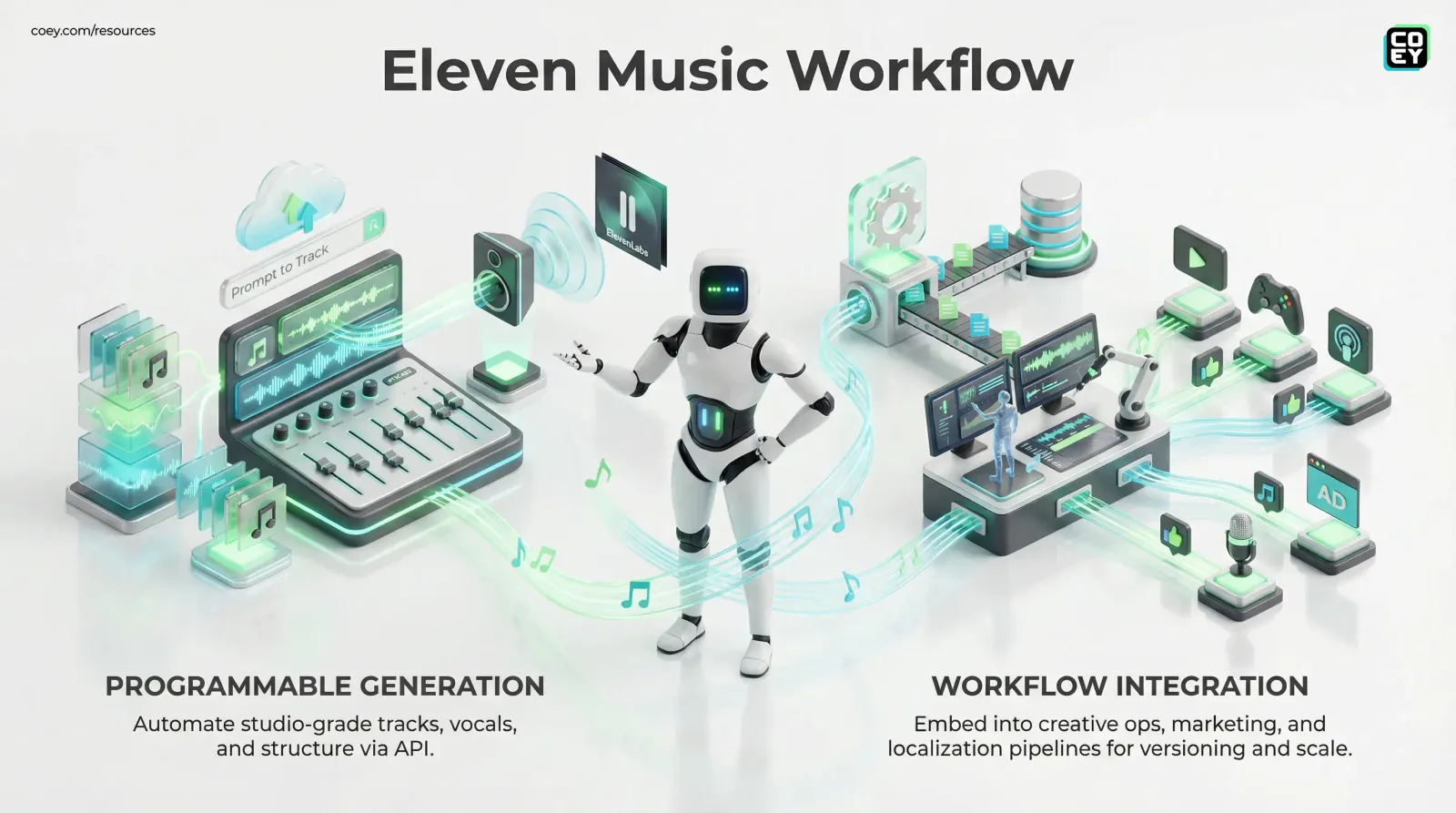
But the real story is not “AI can make songs now.” We have been there. The story is whether this is automation-grade: can it plug into workflows, ship reliably, and stay on the right side of licensing and brand governance?
If you want the broader context of ElevenLabs becoming a true production suite, see our earlier post ElevenLabs Evolves Into Full-Stack AI Studio.
What Eleven Music actually ships
Eleven Music generates multi-minute tracks from natural language prompts. ElevenLabs positions it as studio-grade output intended for real media use: ads, podcasts, social video, games, internal comms.
It also leans into controllability: you can define genre, mood, structure, instrumentation, and whether to force an instrumental. That is the baseline expectation now. What is notable is the positioning: ElevenLabs is implying they can bring their voice realism into music in a way competitors cannot easily match.
The practical shift: music becomes something you generate like copy, iterable, versioned, and tied to campaign data, rather than a static asset you hunt for.
The vocal angle: why ElevenLabs thinks it wins
The AI music market is crowded. What ElevenLabs has that most music-first platforms do not is deep credibility in expressive voice synthesis. Eleven Music supports vocal music generation and ElevenLabs states it can generate songs with lyrics in multiple languages.
That said, vocals are also where risk spikes: brand safety, unintended lyrical content, and the ever-present “who does this sound like?” question. ElevenLabs has historically leaned on safety controls for voice, so there is reason to believe they will take governance seriously here too, but teams should still treat early outputs as draft-grade until proven otherwise.
“The Eleven Album” is a signal, not just a flex
Alongside the launch, ElevenLabs dropped The Eleven Album, a showcase project featuring tracks created with the platform in collaboration with recognizable artists. The official lineup includes names like Liza Minnelli and Art Garfunkel, among others.
This is less about streaming numbers and more about legitimacy: it is ElevenLabs saying, “We are not just shipping a toy. Artists touched this.”
From a market perspective, this album is a tell: ElevenLabs is trying to anchor the narrative around human + machine collaboration, not replacement. That matters because the backlash cycle for AI music is real, and brands do not want to be the next discourse bonfire.
If you are an executive reading this: treat the album as proof that the product can produce listenable work, but not proof that it will match your brand voice out of the box. That is still on your system design.
Automation readiness: web app is nice, API is the point
Eleven Music is available in the ElevenLabs product experience, but the bigger unlock is that it is also supported via developer tooling. ElevenLabs has published capability docs for music at Eleven Music documentation.
For non-technical leaders, here is the translation:
If there is an API, you can automate it.
That means music can be generated on trigger: new campaign brief, new product drop, new locale, new segment, new A/B test variant.
It also means music can be generated in bulk, not one track at a time by a stressed-out editor at 11:48pm.
What “workflow integration” looks like in real life
You do not need to be a developer to benefit, but you do need a workflow mindset. Eleven Music becomes powerful when it is not treated like a novelty generator, but as a component in an automation pipeline:
Creative ops : auto-generate 10 music directions for a pitch deck, route top 3 to human review
Performance marketing : generate variants by audience segment (“Gen Z punchy,” “premium minimalist,” “holiday warmth”) and test against watch time
Localization : keep a consistent motif but generate regionally appropriate instrumentation or vibe per market
Podcast factories : auto-generate intro/outro beds per episode theme, then stamp through a template
If you are thinking bigger than a single feature and more about end-to-end systems, this ties closely to our view in Video Automation Goes Audio Native.
Commercial use and licensing: the grown-up question
ElevenLabs positions Eleven Music as cleared for broad commercial use, and points users to its published terms for details: Eleven Music Terms. ElevenLabs also states the model is trained on licensed data in collaboration with music rightsholders.
Still, “commercially usable” is not the same as “risk-free.” Real-world readiness depends on the fine print: attribution rules, distribution limits, whether outputs can be registered, and how the platform handles claims or disputes. If you are deploying at scale, you want an internal checklist: where the audio goes, how it is archived, and what metadata is stored for provenance.
Here is a simple way to evaluate whether it is ready for your organization:
| Readiness question | What you want to hear | What to do if unclear |
|---|---|---|
| Can we use it in paid ads? | Yes, explicitly allowed in terms | Require terms review before launch |
| Can we automate generation via API? | Yes, documented endpoints | Pilot with a single campaign first |
| Can we version + audit outputs? | You control storage + logs | Save prompts, outputs, approvals in your DAM |
Where this lands vs Suno and Udio
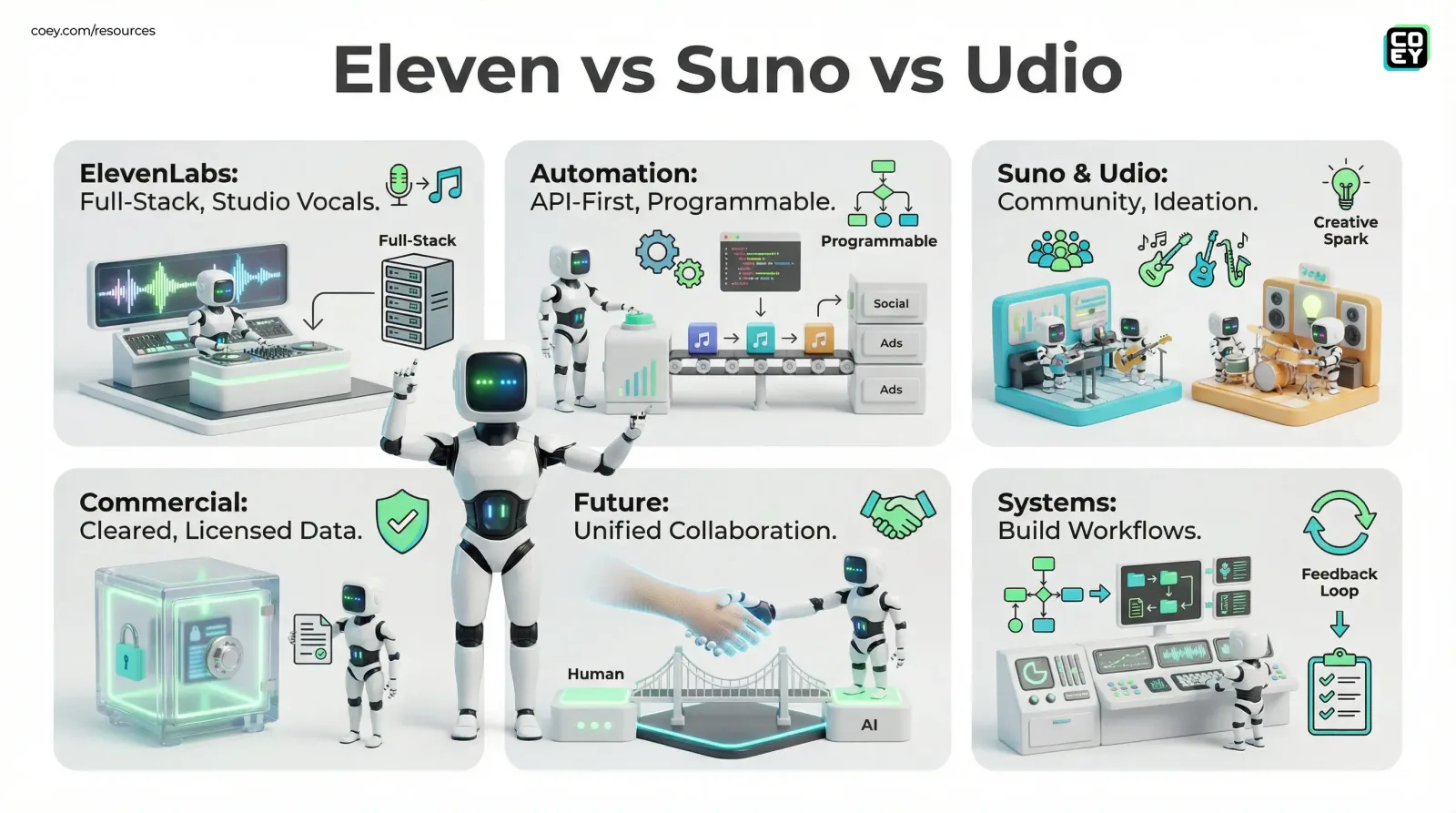
ElevenLabs is entering a space where Suno and Udio already trained users to expect “type prompt, get track.” So differentiation comes down to: quality, control, licensing confidence, and integration maturity.
One key operational difference to keep in mind: commercial use generally requires a paid plan across major generators, and free tiers typically come with restrictions such as non-commercial licensing and or public generations.
ElevenLabs likely has an advantage on vocal expressiveness and enterprise trust since they are already in stacks for dubbing and voice. But incumbents have momentum and community. In practice, many teams will run a multi-model approach: one tool for ideation, one tool for final deliverables, and a human in the loop to keep it on-brand.
If you are betting on Eleven Music, the bet is that ElevenLabs is building an audio platform, not just a music feature. And that aligns with where content operations are going: unified audio generation across voice, music, and localization.
What this changes for marketing teams right now
The most immediate impact is not “your brand is dropping AI albums.” It is that music stops being the blocker in high-throughput content systems.
Faster turnaround for social videos, especially short-form where music is half the vibe
More creative iteration without incremental licensing hunts
Better sonic consistency across campaigns because you can templatize prompts
A path to personalization, music matched to audience segment or context
When music becomes programmable, it becomes testable. And when it becomes testable, it becomes performance creative, not just decoration.
The pragmatic reality: still not fully hands-off
Even if the generation quality is strong, most teams will still need:
human review for taste, brand fit, and any lyrical weirdness
basic audio QC for levels, cutdowns, platform specs
governance around what prompts are allowed and where outputs can ship
Eleven Music looks like a legit move toward automation-grade audio production, but like all generative tools, the winning teams will be the ones who build systems around it: prompt libraries, approval flows, asset management, and feedback loops.
ElevenLabs did not just launch a music toy. They launched another building block for the future where creative teams do not choose between speed and originality, they orchestrate both.
Scale Your Content With AI Agents That Deliver
COEY helps brands and agencies automate content creation, marketing ops, and campaign execution using n8n, Claude Cowork, OpenClaw, and custom integrations. See how our agentic automation works across every marketing channel, or request a proposal.