Meta Debuts Muse Image for Instagram and WhatsApp
Meta Debuts Muse Image for Instagram and WhatsApp
July 7, 2026
Meta has introduced Muse Image, its first in-house AI image generation model from the Muse family, and it is landing where Meta’s creative gravity already lives: Meta AI, Instagram, and WhatsApp. The headline is not "another image model exists." The headline is that Meta is moving generative creative production directly into the social surfaces where a massive volume of prompts, posts, ads, group chats, memes, and brand moments already happen.
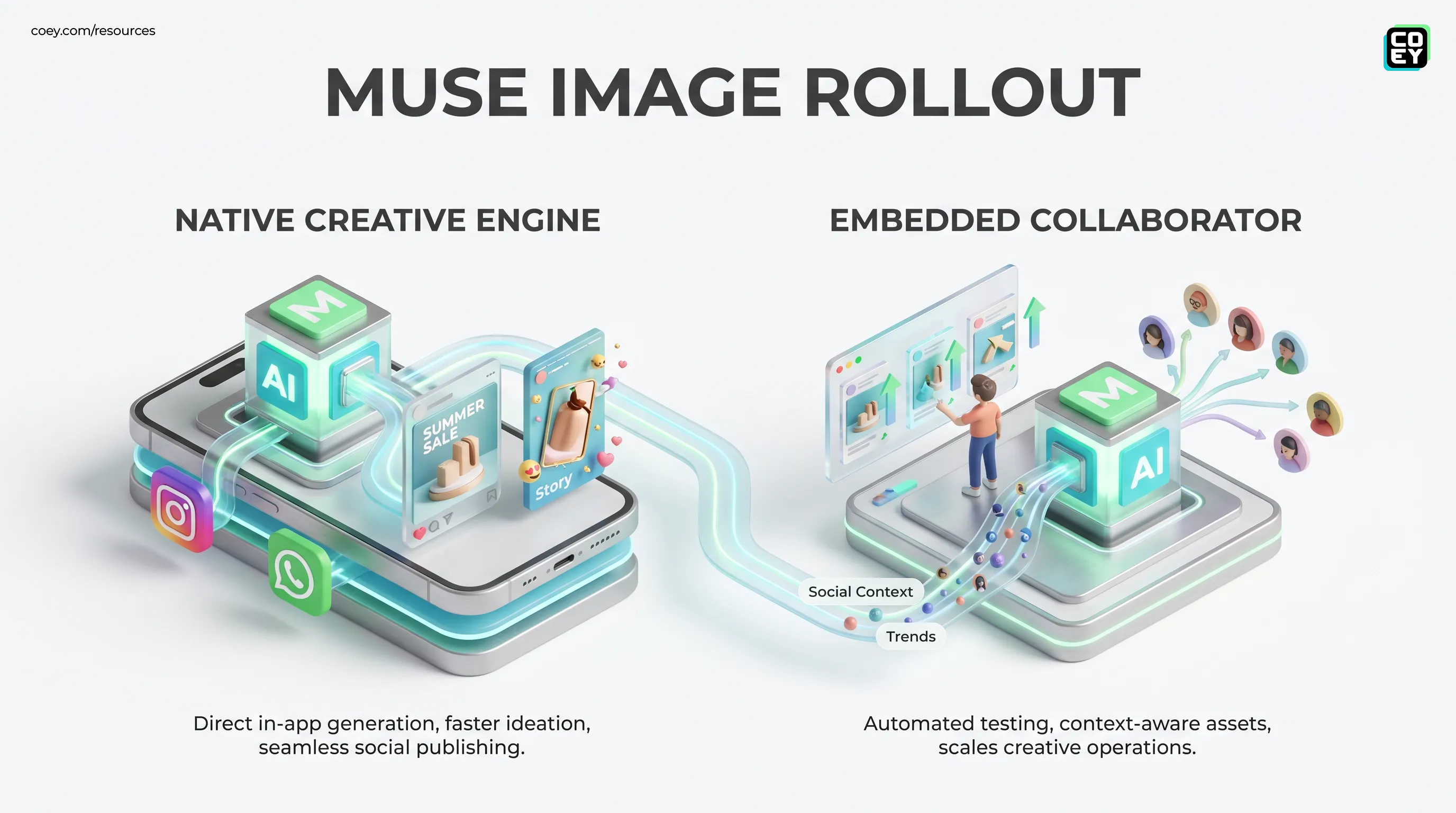
That matters because most AI image tools still require the classic creative ping-pong: generate somewhere else, download, resize, upload, approve, post, repeat until everyone quietly loses the will to live. Muse Image cuts into that loop by making generation native to Meta’s apps. For creators, that means faster visual ideation inside the same places they publish. For marketers, it signals a bigger shift: Meta wants creative automation to become part of the platform, not a side quest in another tab.
Meta Builds Its Own Image Engine
Muse Image comes from Meta Superintelligence Labs and marks a meaningful change in Meta’s AI strategy. Instead of relying primarily on external or partner models for consumer-facing generation, Meta is pushing its own foundation model into its own products. In plain English: the company that owns the feeds, ad auctions, social graphs, performance data, and publishing surfaces now owns more of the creative machine too.
The model supports text-to-image generation, prompt-based editing, multi-photo blending, image refinement, sketch and annotation-based edits, and stronger instruction following for complex visual prompts. Meta is also positioning Muse Image as better at composition and practical social output, including images that need cleaner layout and more usable text than older image models often delivered. Any marketer who has watched an image model turn "SUMMER SALE" into "SUMNER SALE" knows the pain. If Muse Image can consistently render usable text in real campaign assets, it becomes more practical for social graphics, promotional mockups, thumbnails, Stories, and meme-native campaign content.
The strategic move is bigger than image generation. Meta is compressing the distance between idea, asset, placement, and performance feedback.
This lands in the same broader shift COEY has been tracking as image generation becomes more operational and workflow-aware, including recent coverage of SeFi-Image and efficient image models. The market is moving beyond pretty outputs toward systems that can generate, revise, govern, and route creative assets at scale.
Muse Image also builds on Meta’s broader multimodal work, including the earlier Muse Spark model reported by TechCrunch. Meta describes Muse Spark as the reasoning and context layer behind parts of the Muse system, while Muse Image handles visual generation and editing. The direction is clear: Meta does not just want AI that chats. It wants AI that understands social context, visual language, creator behavior, and ad performance signals all at once. That is either very powerful or very Black Mirror but with better CPMs, depending on your mood and governance framework.
Where Muse Image Shows Up
The initial rollout puts Muse Image into the Meta AI app and website, Instagram Stories, and WhatsApp chats, with availability starting in select markets rather than everywhere at once. In Instagram, users get more than 30 new AI-powered effects and generation options inside creative surfaces like Stories. In WhatsApp, Meta AI can generate images directly inside conversations, turning chat into a lightweight creative studio. Meta also says the product is expected to expand across more Meta surfaces, including Facebook and Messenger.
This is important because the use case is not limited to polished campaign production. In fact, the most immediate value may sit in the messy middle of creative work: moodboarding, fast mockups, reactive social posts, product-in-context concepts, internal approvals, and "can we make this less corporate and more internet?" requests from a Slack thread that should have been an email.
| Surface | What changes | Workflow impact |
|---|---|---|
| AI effects, Stories tools, image generation | Faster Stories, Reels concepts, campaign visuals | |
| Image generation inside Meta AI chats | Quick ideation, collaboration, client previews | |
| Meta AI | Prompt-based visual creation and editing | Central assistant for drafts and edits |
| Ads tools | Coming integration with Advantage+ Creative | More automated testing and variation |
Why Marketers Should Care
For marketing teams, the Muse Image launch points toward a future where creative production becomes more responsive to platform behavior. Meta already knows which formats, placements, and audiences perform. If image generation increasingly connects to those signals, the next leap is not just "make me a picture." It is "make me ten viable visual directions for this audience segment, in placements that match campaign objectives, with guardrails my brand team will not immediately set on fire."
That is where AI collaboration becomes genuinely useful. Humans still define the intent: the story, the offer, the audience, the cultural angle, the emotional punch. The machine accelerates the variations, swaps contexts, fills in the production gaps, and helps teams test more ideas without adding more midnight design requests. Creativity scales when the system removes the grind, not when it replaces the taste.
Meta’s existing Advantage+ Creative products already use AI to adapt ad creative with enhancements such as format adjustments, image expansion, background generation, visual variations, text overlays, and image-to-video style creative treatments. Meta says Muse Image is coming to Advantage+ Creative, which could deepen that stack by supplying stronger native generation rather than just enhancement. But there is a difference between "possible" and "production-ready," and marketers should keep their hype goggles at half tint.
Automation Is Not Fully Open
The most important operational detail: Muse Image does not currently appear to have a public standalone API for developers, agencies, or automation teams. Meta has not published public Muse Image developer documentation, API pricing, rate limits, or a separate usage-based rate card. That means you should not assume you can plug Muse Image directly into n8n, Zapier, Make, Airtable, a DAM, or your custom campaign pipeline tomorrow morning and start batch-generating 4,000 localized product visuals while sipping cold brew like an automation goblin.
For now, Muse Image is best understood as an in-product creative layer. It can reduce friction for humans working inside Meta’s apps, but it is not yet an open creative infrastructure layer. That distinction matters for executives evaluating real-world readiness. Native generation is useful. Programmatic generation is transformational. Meta is closer to the first than the second with this release.
| Capability | Status | Practical meaning |
|---|---|---|
| In-app generation | Rolling out in select Meta surfaces and markets | Useful for creators and social teams with access |
| Direct Muse API | Not public | No full workflow automation yet |
| Ad creative automation | Partly available via Meta tools, with Muse Image integration coming | Good for platform-native testing |
| External stack integration | Limited | Manual review and transfer remain |
Meta’s broader ad ecosystem does support automation through campaign and creative tooling, and Advantage+ features can already be part of performance workflows. But Muse Image itself should be treated as a closed-platform capability until Meta publishes developer access, API documentation, usage limits, pricing, rights terms, and governance controls. Translation for non-technical teams: it may save time inside Meta, but it is not yet a button you can wire into your whole marketing machine.
The Social Context Question
One of the most culturally spicy pieces of the rollout is Muse Image’s ability to use Instagram context. Meta’s rollout materials describe the ability to reference public Instagram accounts as part of a prompt, with controls for people who do not want their accounts used this way.
For brands, this could be powerful for style references, influencer concepts, and social-native creative. It also introduces risk. If public images can inform generated outputs, teams need clearer rules around consent, likeness, creator partnerships, and what counts as inspiration versus appropriation. The internet is already allergic to "we trained on your vibe and called it innovation," so governance cannot be an afterthought.
Meta has also been expanding AI transparency across advertising products, including labeling and disclosure policies for generative content in ads, as described in its AI ads transparency update. That is necessary, but marketers should not treat labels as a complete trust strategy. Responsible use still requires internal review, documented rights, brand safety checks, and human approval before AI-generated assets go live.
Readiness For Real Teams
Muse Image is production-adjacent, not fully enterprise-operational. For individual creators and social teams with access, it looks immediately useful: faster ideation, fewer app hops, better remixing, and more playful creative exploration inside the platforms that matter. For performance marketers, the value becomes stronger when connected to ad workflows, especially as Muse Image moves into Advantage+ Creative generation and testing.
For larger organizations, the readiness score is more mixed. Legal teams will want clarity on training data, commercial usage, likeness, account references, and retention. Brand teams will want controls over fonts, logos, claims, regulated language, and visual consistency. Marketing operations teams will want APIs, permissions, audit logs, batch generation, approval states, and integration with asset management systems. In other words: fun demo, but the grown-up workflow still needs grown-up plumbing.
This is where creative automation needs QA, not just generation. COEY’s guide on building an AI ad QA workflow is the operating mindset teams should bring to tools like Muse Image: rules first, AI second, humans in control for risky public work.
The good news is that Meta has every incentive to build that plumbing. Creative fatigue is one of the biggest bottlenecks in paid social. Brands need more variants, faster testing, better localization, and sharper iteration without ballooning production costs. If Meta can make Muse Image reliable, governable, and eventually programmable, it could become a serious creative operations layer for social advertising.
What This Signals
Muse Image is not just Meta joining the image-generation party three years after everyone already wore the Midjourney hoodie. It is Meta embedding generative creation into the places where culture gets posted, forwarded, remixed, advertised, and judged by strangers in comments. That is a bigger distribution advantage than raw benchmark bragging.
The pragmatic read: Muse Image is useful now for fast human-in-the-loop creation inside Meta apps where it is available. It is promising for marketers because it sits close to publishing and performance data. It is not yet a fully open automation platform because the public API story is still missing. The opportunity is real, but so are the controls, rights, and workflow questions.
For teams trying to scale creativity, this is the pattern to watch: AI moving from separate tool to embedded collaborator. The winners will not be the brands that generate the most images. They will be the ones that combine human taste, clear strategy, responsible governance, and machine-speed iteration into creative systems that actually ship.