Zhipu AI’s GLM-5 Is Open-Weights and Built for Agentic Work
Zhipu AI's GLM-5 is open weights and built for agentic work. What it unlocks for AI marketing automation and on-prem content pipelines.
13 February 2026Team COEY
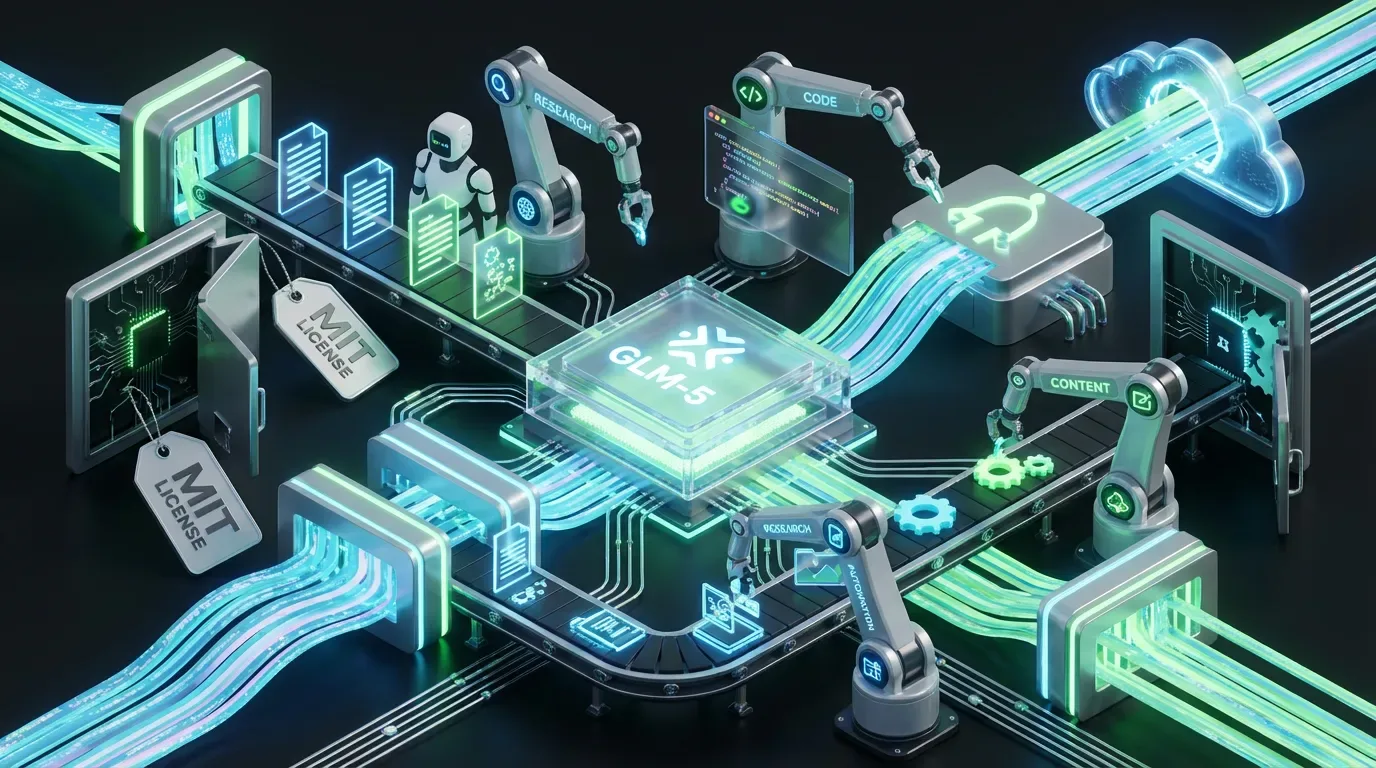
Zhipu AI has released GLM-5, a frontier-scale open-weights language model that’s explicitly framed for agent workflows and long-context automation. The official hub is chat.z.ai, with broader coverage summarizing architecture and benchmarks now circulating in the wild.
On paper, GLM-5 is the kind of release that makes every ops-minded creative team do the same thing: pause, squint, and ask, “Okay, can I actually run this, or is this another ‘look at our chart’ moment?” The interesting part is that GLM-5 is positioned as both: a competitive model for reasoning and coding and a deployable component because the weights are open under a permissive license. As of current reporting around the launch, GLM-5 is released as open weights under the MIT license, including commercial use.
Open weights don’t automatically mean “easy.” But they do mean “ownable,” and that’s the difference between a model you demo and a model you wire into a workflow with budgets, compliance, and real deliverables.
What Zhipu actually shipped
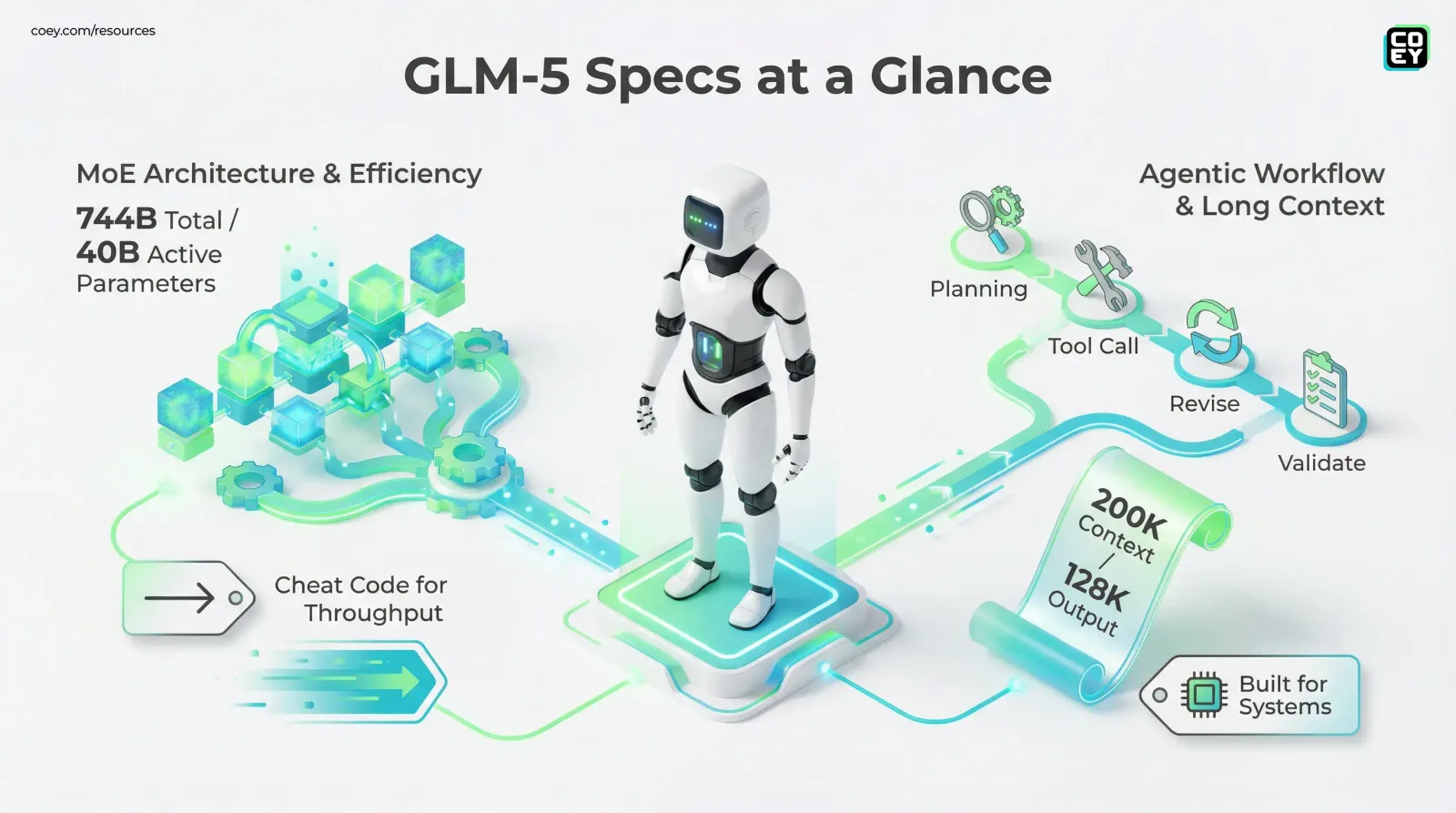
GLM-5 is described as a Mixture-of-Experts (MoE) model with 744B total parameters and roughly 40B active per token during inference. That “active” number is the point: MoE is basically the industry’s favorite cheat code for frontier vibes without dense-model burn rates.
Several third-party summaries also cite:
Training scale: approximately 28.5T tokens
Long context: up to 200K context , with a reported maximum output length up to 128K tokens
Agentic posture: positioned for tool use, multi-step work, and browse-style tasks
For a consolidated overview of these specs and benchmark claims, see Maxime Labonne’s rundown: GLM-5: China’s First Public AI Company Ships a Frontier Model. For mainstream business framing, SCMP also covered the launch: China’s Zhipu AI launches new major model GLM-5 in challenge to its rivals.
MoE matters because agents are expensive
Creators and marketers don’t buy “parameters.” They buy outcomes: faster research, more content iterations, fewer manual steps, and fewer “we’ll get to it next sprint” bottlenecks. The reason MoE architecture is showing up everywhere is simple:
Agents loop. Planning, tool call, revise, retry, format, validate. That’s not one inference. It’s a dozen.
Loops multiply costs. If every step is priced like a flagship dense model, your automation dream turns into a line item your CFO will personally delete.
MoE is built for throughput. You keep a huge pool of capability, but you don’t pay to activate all of it on every token.
So when GLM-5 shows up with MoE plus long context plus agent framing, it’s not just competing with closed models on “smart.” It’s competing on a far more practical axis: Can this run continuously as part of a system?
Benchmarks: useful signal, not a verdict
Early reporting places GLM-5 as strong on coding and reasoning benchmarks, with frequently repeated figures like 77.8% on SWE-bench Verified and 86.0% on GPQA Diamond in multiple roundups. WinBuzzer’s recap pulls several of these points together: Zhipu AI Releases GLM-5: 744B Model Rivals Claude Opus.
But let’s keep this adult and workflow-oriented:
Benchmarks measure potential. Automation readiness is: tool reliability, structured outputs, retries, permissioning, logging, and whether your team can operate the thing without turning it into a fragile science project.
GLM-5’s real benchmark is whether it reduces the “human glue” required to get from intent to shipped work. That’s where long context plus agent posture can matter more than another point on a leaderboard.
API availability: can you actually automate it?
There are two different automation stories here, and they’re not interchangeable:
1) Open-weights automation (you host it)
If you can deploy GLM-5 yourself, you can wrap it behind an internal endpoint and call it from:
workflow engines (n8n, Make, Zapier via webhook patterns)
job orchestrators (Airflow and Prefect-style batch pipelines)
your internal tools (Slack bots, dashboards, CMS integrations)
This is the “real leverage” lane: version pinning, private data, predictable governance, and the ability to build repeatable creative systems instead of ad hoc prompting.
2) Hosted access (someone else hosts it)
GLM-5 is also being referenced as available through various hosted surfaces and aggregators. One example of an OpenAI-style proxy documentation page listing GLM-5 is here: AI/ML API docs for zhipu/glm-5.
Pragmatic translation for execs: hosted APIs are fastest to integrate, but you’ll still want to confirm SLA posture, rate limits, and whether you can keep sensitive data out of third-party systems.
Automation potential: where GLM-5 fits
GLM-5’s spec stack (MoE plus long context plus agent framing) maps cleanly onto a few high-leverage automation categories for marketing and creative ops:
Research that stops being a one-off
Long context changes research from “summarize this doc” to “absorb the whole messy corpus” strategy decks, call transcripts, competitor pages, internal notes and produce outputs that can be reused downstream (briefs, messaging, objection handling, content outlines).
Content ops that behaves like a pipeline
The real win isn’t “generate blog posts.” It’s consistent batch work:
content audits at scale
multi-version adaptation (channel and audience variants)
structured outputs (JSON for CMS fields, campaign assets, metadata)
Code plus glue work that unlocks everything else
If GLM-5 holds up for coding tasks, that matters because the bottleneck in creative automation is often integration: connecting tools, cleaning data, writing small scripts, and maintaining brittle pipelines. The model doesn’t need to replace engineers. It needs to reduce the backlog of “small but annoying” work that blocks creative throughput.
Real-world readiness: what’s solid vs shiny
GLM-5 looks like a serious release, but “serious model” and “production system” are different products. Here’s the grounded view:
Likely ready now
Internal research automation (low external risk, high time savings)
Draft generation plus structured formatting with human approvals
Repo-aware coding assistance in constrained environments (PR drafting, test generation, refactors, review required)
Still needs guardrails
Autonomous tool execution (anything that can publish, email, delete, spend money)
High-stakes compliance content without a validation layer
Fully automated browsing agents without source capture, citation, and fallback behaviors
The model is not the workflow. If you don’t have retries, validation, escalation, and logging, you don’t have automation, you have faster chaos.
Why GLM-5 is a strategic signal
Zoom out: GLM-5 reinforces the ongoing shift from “AI as a destination” (a chat UI you visit) to AI as infrastructure (a component you deploy, version, and orchestrate). That shift matters for COEY’s world because it’s how you scale creativity responsibly:
Humans provide intent (taste, goals, constraints, brand judgment)
Machines execute the grind (batching, synthesis, formatting, iteration, first-draft assembly)
Zhipu shipping a frontier-ish open-weights MoE model with long context is basically them saying: “Don’t just chat with it. Build with it.” And in 2026, that’s the only kind of AI that really compounds.
Bottom line
GLM-5 is one of the more consequential open-weights releases because it’s optimized for the stuff that makes automation real: throughput economics (MoE), long-context work packets, and agent-ready positioning. If you’ve been waiting for an alternative to closed-model dependence that can still play in the serious-capabilities tier, GLM-5 is worth watching and testing in a bounded workflow where success is measurable.
Not magic. Not autopilot. But a very real piece of the “human plus machine” stack that can scale creative output when you wrap it with the boring (essential) parts: guardrails, validation, and approvals.
Turn AI News Into Marketing Advantage
COEY turns the latest AI developments into real marketing firepower. We deploy n8n workflows, Claude Cowork agents, and OpenClaw pipelines that keep your channels running and your team focused on strategy. See our automation approach or request a proposal.
For senior marketing leaders evaluating the broader shift, our Executive AI Accelerator is a confidential top-to-top engagement. For a structured blueprint, read How to Build an AI Content System.