
ByteDance’s Seed 2.0 Is Betting on “Workflow AI,” Not Just Chat
ByteDance's Seed 2.0 is betting on workflow AI, not just chat. What it unlocks for AI marketing automation and end to end generative ad pipelines.
18 February 2026Team COEY
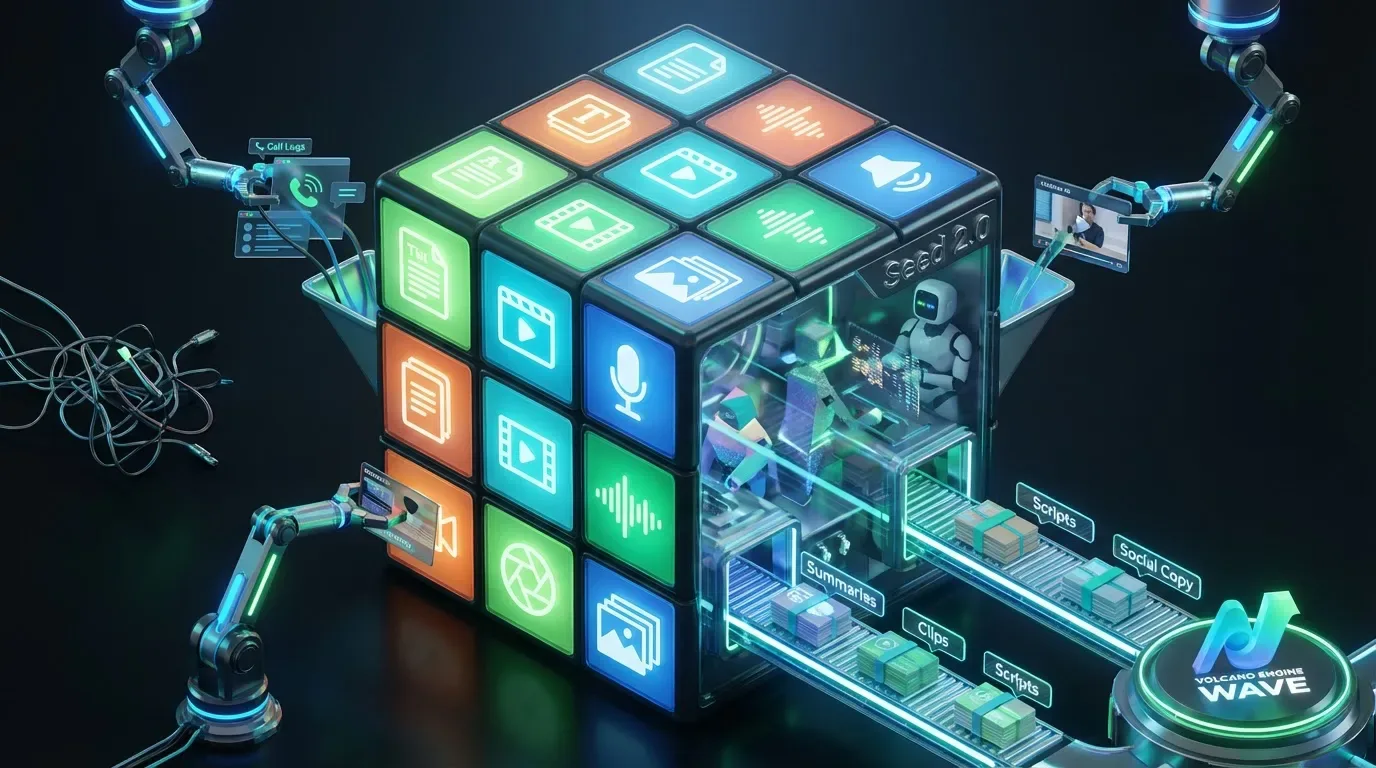
ByteDance is expanding its Seed family into more agentic, multimodal territory, aiming at the kind of end-to-end creative automation that actually reduces headcount hours, not just makes prettier demos. The rollout ties into ByteDance’s broader AI stack via Doubao and Volcano Engine, and it’s being positioned as cheap enough to run in always-on production pipelines. For the practical-minded: yes, this is the direction everyone’s going. The question is whether you can plug it into your workflow today, or if it’s another “trust us, coming soon” moment.
At minimum, Seed 2.0 is a clear signal: ByteDance doesn’t just want to ship a model. It wants to ship a factory for content operations, one that can ingest messy real-world media (calls, webinars, podcasts, product footage) and output structured assets (clips, summaries, scripts, thumbnails, social copy) with less human glue work in between.
Volcano Engine is the most likely home for serious deployment, while consumer-facing experiences show up inside Doubao and other ByteDance creation surfaces.
What “quad-modal” really means
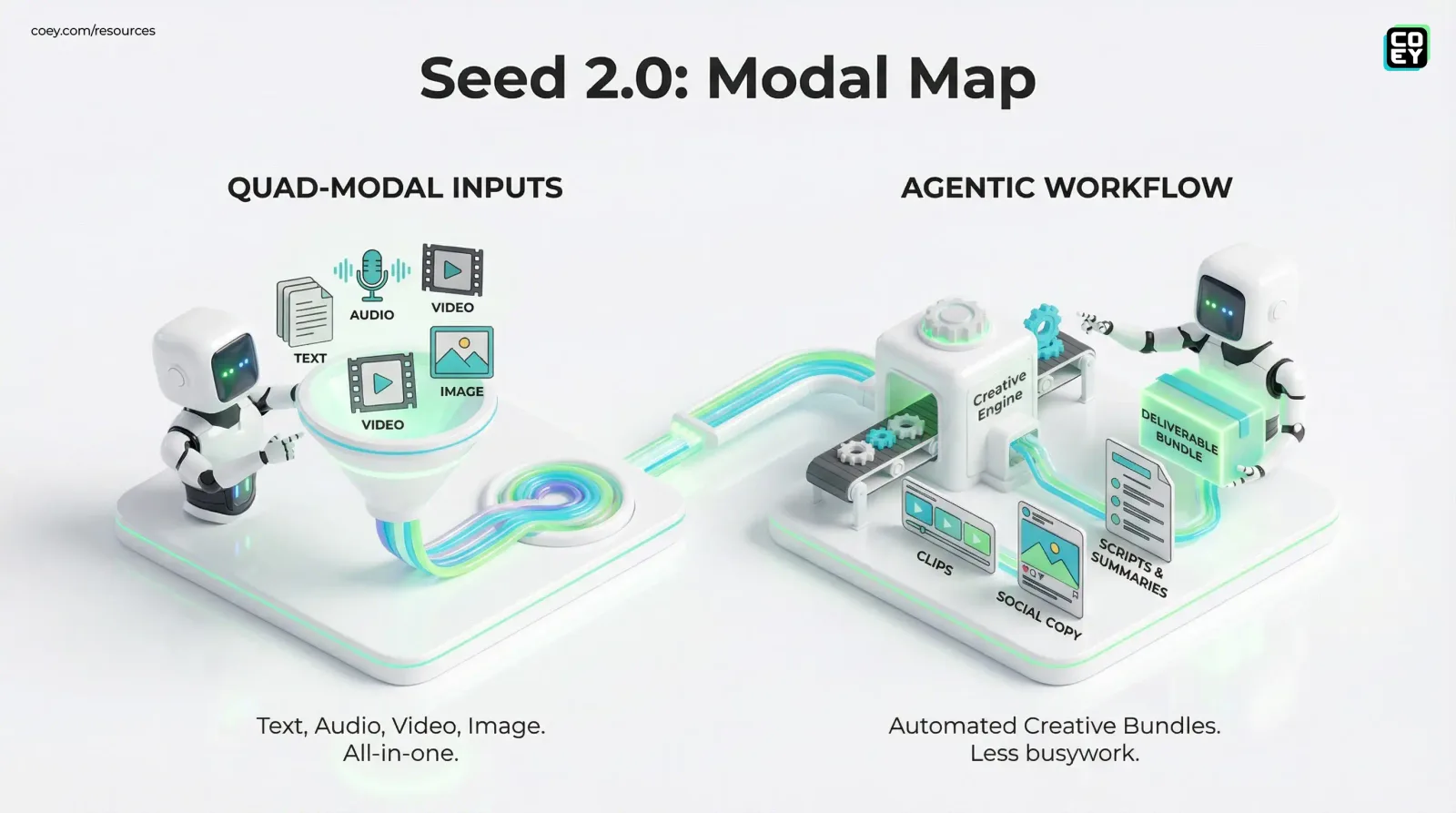
“Multimodal” has been abused so hard it basically means “can look at an image sometimes.” Seed 2.0’s positioning is more ambitious: text, images, audio, and video as first-class inputs and outputs, combined inside a single system that can keep context across a longer chain of steps.
In real workflows, that matters because creative work is rarely single-format. Your best-performing TikTok came from a webinar. The webinar came from a deck. The deck came from a product brief. The product brief came from a Slack thread that shouldn’t exist in the first place.
Quad-modal isn’t a flex feature, it’s a workflow feature. It reduces the “format tax”: the manual exporting, transcribing, converting, re-uploading, and re-briefing that slows teams down.
Agentic is the point, not the garnish
Seed 2.0 is being framed less like “ask it a question” and more like “hand it a job.” The core promise is long-chain execution: the model can plan multiple steps, coordinate tool use, and return structured outputs rather than a single blob of text.
This is the shift executives should care about: models becoming operators, not just assistants. In a content org, that looks like:
Input: a 45-minute video + brand voice rules + campaign goal
Process: detect chapters → identify moments → draft hooks → generate captions → propose cut list → package assets
Output: a deliverable bundle your team edits, approves, and ships
That last line is key. The real win isn’t “AI made a thing.” It’s “AI made the bundle”, the set of artifacts your team already produces, but faster and more consistently.
Availability: where it likely lands
ByteDance’s ecosystem matters here because it dictates how real this is for automation teams.
Volcano Engine: ByteDance’s enterprise cloud platform, where API access and production workloads typically live. Start here if you’re thinking integration, governance, and scale. ( Volcano Engine )
Doubao surfaces: consumer and prosumer apps are where capability often gets productized first, but not always where automation is easiest. Still valuable for testing outputs and creative behaviors before engineering commits.
ByteDance has also been pushing video-generation aggressively in parallel, including Seedance 2.0 being integrated into Doubao-facing products (different line, same strategy: own the creator stack). (Longbridge coverage)
API reality check: can you automate it?
The good news: Seed 2.0 is already showing up via developer-facing distribution (including APIs offered through ByteDance-adjacent platforms), which strongly suggests that API availability is real for at least some tiers and regions. The less-good news: “agentic” doesn’t automatically mean “clean orchestration primitives.” Some platforms market agent behavior while still forcing you into brittle prompt chains on your side.
What to look for in a real deployment (aka: what separates workflow-ready from demo-ready):
| Requirement | Why it matters | Workflow impact |
|---|---|---|
| Structured outputs | JSON, schemas, tool calls | Can push results into CMS/DAM/PM tools |
| Job control | Async runs, retries, checkpoints | Reliable batch processing (not one-off prompts) |
| Media handling | Video/audio upload, timecodes | Enables clip lists, chapters, quote extraction |
| Observability | Logs, traces, eval hooks | Makes QA possible without babysitting |
| Policy controls | Safety, brand rules, redlines | Prevents “helpful” brand damage at scale |
If Seed 2.0 exposes those capabilities through Volcano Engine APIs, it becomes a legitimate building block for automation platforms (custom Python services, internal tools, and orchestration layers like Make or n8n). If it doesn’t, you’ll still get good outputs, but the “end-to-end pipeline” story becomes more manual than marketed.
Pricing: the pipeline economics angle
ByteDance has been signaling aggressive economics for inference. One widely reported figure for Seed 2.0 Pro is $0.47 per million input tokens, alongside reports of $2.37 per million output tokens (provider, tier, and region can change the exact numbers). (The Decoder) The exact SKU details matter (input vs. output pricing, context tiers, modality add-ons, and enterprise commitments), but the strategic intent is obvious: make it cheap enough to run constantly.
That’s not just a pricing war. It’s a workflow unlock. When compute is expensive, teams use AI like a special effect: sparingly, for “hero” moments. When compute gets cheap, AI becomes infrastructure: daily briefs, daily repurposing, continuous creative testing, always-on analysis.
Cheap input tokens change behavior. They make it rational to feed entire libraries of calls, webinars, and footage into an automated content engine instead of cherry-picking.
What this changes for marketing orgs
Seed 2.0’s biggest implication isn’t “more content.” It’s more throughput with fewer coordination costs. Most teams aren’t blocked by ideas, they’re blocked by production friction: handoffs, rewrites, asset wrangling, format conversion, and the eternal “can someone pull three clips from this?” Slack loop.
In an org that already has a content pipeline, a quad-modal agent shifts the work distribution:
Humans: decide what matters, set the creative direction, approve, publish, and refine taste
Machines: transcribe, segment, draft variants, package assets, and keep everything consistent
That’s the collaboration model that scales without turning your brand into AI slop: humans on intent and taste; machines on repetition and packaging.
Benchmarks vs. business readiness
ByteDance has been pushing “competitive with frontier models” messaging around multimodal comprehension and long-context reasoning. Publicly discussed benchmark results around the Seed 2.0 family highlight strong performance in areas like math, vision, and agent-style tasks, alongside some reported gaps in other categories depending on the eval. Benchmarks are useful, especially for sanity-checking if a model can follow instructions or handle long inputs, but they’re not the buying criteria for executives.
The buying criteria are operational:
Can we integrate it with what we already use? (CMS, DAM, ad platforms, project management, analytics)
Can we control brand risk? (guardrails, redlines, approvals)
Can we measure quality? (evals, sampling, human review loops)
Can it run unattended? (retries, job queues, monitoring)
If Seed 2.0 lands with strong Volcano Engine primitives, it’s not just a model announcement, it’s an automation platform play aimed straight at creative operations. If it lands mostly as a UI experience inside Doubao, it’s still valuable, but you’ll be exporting files like it’s 2019 and calling it “agentic.”
The bigger signal: ByteDance wants the factory
ByteDance already understands creators better than most companies on Earth, because its products are literally built around creator feedback loops. Seed 2.0 reads like the next step: turning those loops into programmable systems that can run across modalities, not just recommend content.
For teams scaling output in 2026, this is the north star: not “AI that makes content,” but AI that runs content operations, with humans directing the machine, and the machine doing the busywork at a price point that makes constant collaboration feasible.
If you want the closest adjacent ByteDance creator-stack context on COEY, see Seedance 2.0 Lands Inside CapCut, and That’s the Real Flex.
Modernize Your Marketing With AI Agents
COEY deploys coordinated AI agent teams using n8n, Claude Cowork, and OpenClaw that compress marketing timelines from weeks to hours. See how our agentic automation works across every marketing channel, or request a proposal.