
Campaign QA an agent can run
A practical guide to building an AI campaign QA workflow that catches brand, compliance, and factual errors before your marketing automation ships.
19 March 2026Team COEY
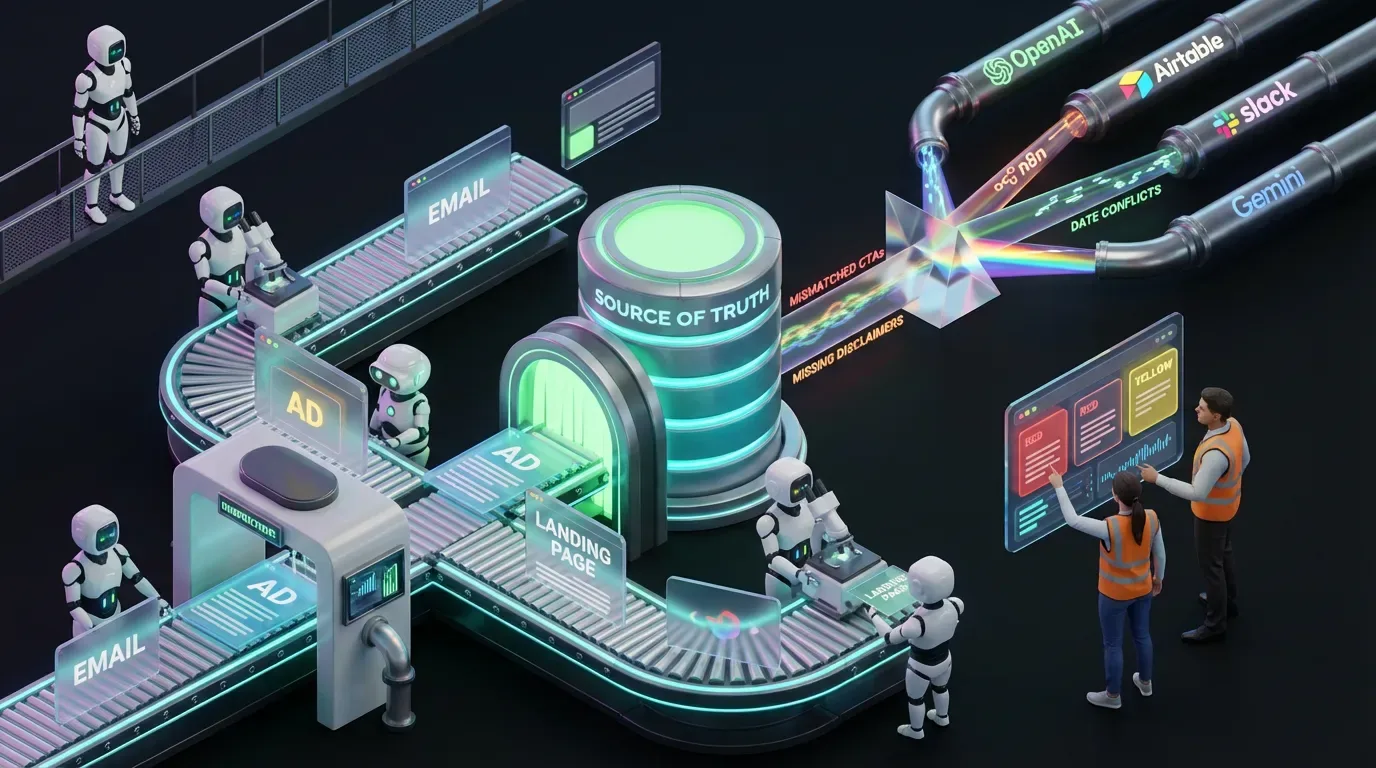
Most teams use AI to make more stuff. Fewer teams use AI to catch mistakes before that stuff goes live. That is weird, because campaign QA is exactly where automation earns its keep. If you are building this now, start with tools and models that are actually current, like OpenAI’s Responses API, not legacy patterns you will rip out six months later.
Not glamorous. Not sexy. Extremely useful.
If your team ships email, ads, landing pages, paid social variants, and sales collateral across multiple tools, you already know the failure modes:
the CTA says one thing in the ad and another on the landing page
the product name changed three weeks ago, but one asset missed the memo
legal language is missing in one channel
the offer expires on Tuesday in email and Thursday on paid social, which is a fun way to annoy everyone
someone pasted in an old headline because tabs are a form of psychological warfare
This is where an AI QA workflow makes sense. Not as a replacement for human review. As a force multiplier for it.
Humans should still own strategy, claims, brand judgment, and final approval. AI should do the boring comparison work at machine speed.
This matters even more now because marketing systems are getting more agentic. More platforms can draft, optimize, and act, which increases output volume and the odds of weird little inconsistencies multiplying across channels. More machine throughput means you need better review layers, not fewer.
What problem this workflow solves
An AI campaign QA workflow helps you answer one simple question before launch:
Does every asset match the brief, the offer, the brand rules, and the risk constraints?
Instead of relying on one tired marketer to manually compare six tools and seventeen tabs, you create a system that:
collects campaign assets automatically
extracts the key facts from each asset
compares them against a source of truth
flags mismatches, missing disclaimers, and suspicious claims
routes only the risky items to a human reviewer
This is a classic human-in-the-loop design. AI narrows the review surface. Humans make the call.
The mental model
Think of this workflow as a three-layer system.
| Layer | What it does | Who owns it |
|---|---|---|
| Source of truth | Stores offer details, brand rules, approved claims, and required disclaimers | Humans |
| AI review layer | Extracts, compares, scores risk, and summarizes issues | AI plus automation |
| Approval layer | Reviews exceptions and approves or rejects launch | Humans |
If you skip the source of truth, the whole thing gets dumb fast. The model cannot compare assets against vibes and hope.
Tools you need
You do not need a moon base. You need a clean stack.
n8n for orchestration
A current LLM API for extraction and comparison, such as OpenAI via Responses API, or other current workflow-ready models like GPT-5.4 Mini, GPT-5.4 Nano, and Gemini depending on the task
Airtable, Notion, Google Sheets, or your PM tool for campaign truth data
Your content systems such as CMS, ad platforms, email platform, DAM, or docs
Slack or email for alerts and approvals
An audit log in a database or sheet so every decision has receipts
You can make this fancier later. Do not start fancy. Start reliable.
What goes in the source of truth
Your source of truth should be structured, not poetic.
For each campaign, store:
campaign name
offer name
approved product names
approved CTA list
required disclaimers
banned phrases or risky claims
launch dates and expiry rules
target audience
brand voice notes
landing page URL
owner and approver
This is the adult part. If your team cannot agree on what is approved, AI is not your problem. Operations is.
How the workflow works
Step 1. Trigger the QA run
The trigger can be:
a campaign status changing to Ready for QA
a scheduled pre-launch check
a webhook from your CMS or PM system
a manual Slack command for high-stakes launches
In n8n, this is your starting node. Simple. If you are using n8n in production, build on the current 2.x line, not an old setup, because the platform has shifted toward more mature publish controls and safer execution patterns.
Step 2. Pull all campaign assets
Grab draft or near-final assets from the systems your team actually uses:
email subject lines and body copy
landing page text
ad copy variants
social captions
creative metadata
PDF or doc based collateral if relevant
Normalize them into a standard format so each asset has:
asset type
channel
version
text content
link destination
campaign ID
If you are dealing with screenshots or PDFs, use OCR or document extraction first, then feed the clean text into the model. If you want multimodal checks later, current models like Google’s Gemini API can help with screenshot and visual QA workflows, but start with text if you want fewer moving parts.
Step 3. Ask AI to extract key facts
Do not ask the model, “Is this good?” That is lazy and expensive.
Ask it to return structured fields like:
offer mentioned
product names used
CTA used
date references
discount references
claim statements
required disclaimer present yes or no
tone rating against brand notes
Require JSON output. Always.
{
  "asset_type": "email",
  "offer_mentioned": "Free trial",
  "product_names": ["Platform X"],
  "cta": "Start your free trial",
  "claims": ["Boost productivity by 40%"],
  "disclaimer_present": false,
  "date_mentions": ["Ends Friday"],
  "risk_flags": []
}
This turns the model into an extractor, not a creative writing gremlin.
Step 4. Compare extracted facts against the source of truth
Now run deterministic checks first.
Is the CTA in the approved CTA list?
Is the product name valid?
Does the landing page URL match the campaign record?
Is a disclaimer required but missing?
Do dates conflict with the campaign calendar?
This part should be rules-based wherever possible. AI is useful, but string comparisons do not need a philosopher.
Step 5. Use AI for fuzzy comparison and risk scoring
After deterministic checks, use the model for things rules struggle with:
does the ad overstate the offer compared to the landing page?
does the tone drift away from brand guidance?
does a claim sound performance-guaranteed when it should not?
does this asset imply an audience segment it should not target?
Ask the model to classify issues by severity:
High : legal, compliance, or factual mismatch
Medium : brand inconsistency or likely confusion
Low : stylistic drift or formatting issue
Then summarize findings in plain English for a reviewer who has a job and does not want to decode model output.
| Check type | Best method | Why |
|---|---|---|
| CTA, URL, dates, product names | Rules-based validation | Fast, cheap, deterministic |
| Claim tone, overstatement, audience implication | LLM review | Handles ambiguity better |
| Final launch decision | Human approval | Because consequences are real |
Step 6. Route exceptions to a human
This is the whole point.
If no issues are found, the workflow can mark the asset set as QA passed. If issues exist, route them to Slack, email, or your PM system with:
campaign name
asset name
risk level
flag summary
source snippets
approve, reject, or revise options
The best human-in-the-loop systems do not ask people to review everything. They ask people to review what matters.
Step 7. Log every result
Store:
what was checked
which rules fired
what the model flagged
who approved or rejected
final resolution
This matters for governance, future training, and the inevitable “who approved this?” moment that appears right after something weird goes live.
Guardrails that keep this sane
Here is where teams either build a real system or create a haunted automation.
1. Never let the model be the sole approver
AI can recommend. Humans approve high-risk launches.
2. Separate extraction from judgment
One prompt extracts facts. Another compares. A third summarizes. This reduces drift and makes debugging easier.
3. Use rules before reasoning
If a field can be validated deterministically, do that first. Save the model for ambiguity.
4. Keep a locked claims library
Approved claims, disclaimers, and banned phrases should be controlled by humans, not generated on the fly.
5. Add confidence thresholds
If model confidence is low, route automatically to review. Do not let uncertain outputs quietly pass.
6. Review prompts like code
Version them. Test them. Do not let random prompt edits become production logic because someone had a coffee and a dream.
Where teams usually mess this up
they try to automate final approval instead of exception handling
they have no source of truth, only scattered docs and vibes
they use one giant prompt for everything
they skip logging, then cannot explain decisions later
they expect the model to know legal nuance without approved policy inputs
Again, automation is not a tool problem. It is a systems problem.
A practical rollout plan
| Phase | What to automate | Goal |
|---|---|---|
| Pilot | Email plus landing page checks | Catch factual mismatches |
| Expansion | Add paid social and ad copy variants | Extend cross-channel consistency |
| Maturity | Add brand tone checks and approval routing | Reduce manual review load |
Start with one campaign type and one high-cost failure mode. Usually that means offer mismatch, missing disclaimer, or outdated product naming. Get a win. Then widen the surface area.
What success looks like
You know this workflow is working when:
reviewers spend less time hunting and more time deciding
launch errors drop
high-risk issues get caught earlier
campaign teams trust the process because it produces receipts
your marketers stop doing detective work across five platforms like unpaid QA engineers
Small models are great for high-volume extraction. Bigger models are for messier judgment. Route by risk, not by hype.
Bottom line
If your team is using AI to generate more campaigns, you should also use AI to check them. Not because AI is magically trustworthy. Because it is very good at repetitive comparison work when constrained by human rules, structured inputs, and real approval gates.
The smart pattern is simple: humans define the truth, AI checks for drift, humans decide what ships. If you want a current COEY take on using cheaper worker models for this kind of always-on validation, our recent post on GPT-5.4 Mini and Nano is worth a look.
That is the future of useful automation. Not set it and forget it. More like set it, inspect it, and sleep a little better.
Let COEY Wire Your AI Marketing Stack
We help brands and agencies connect n8n, Claude Cowork, OpenClaw, and other AI tools into marketing systems that produce real output. From content automation to full campaign orchestration across every channel. See how it works or request a proposal.