Microsoft’s MAI-Image-2 Looks Like a Real Upgrade, but the API Story Still Decides the Winner
Microsoft's MAI Image 2 looks like a real upgrade, but the API story still decides the winner for AI marketing automation and creative pipelines.
21 March 2026Team COEY
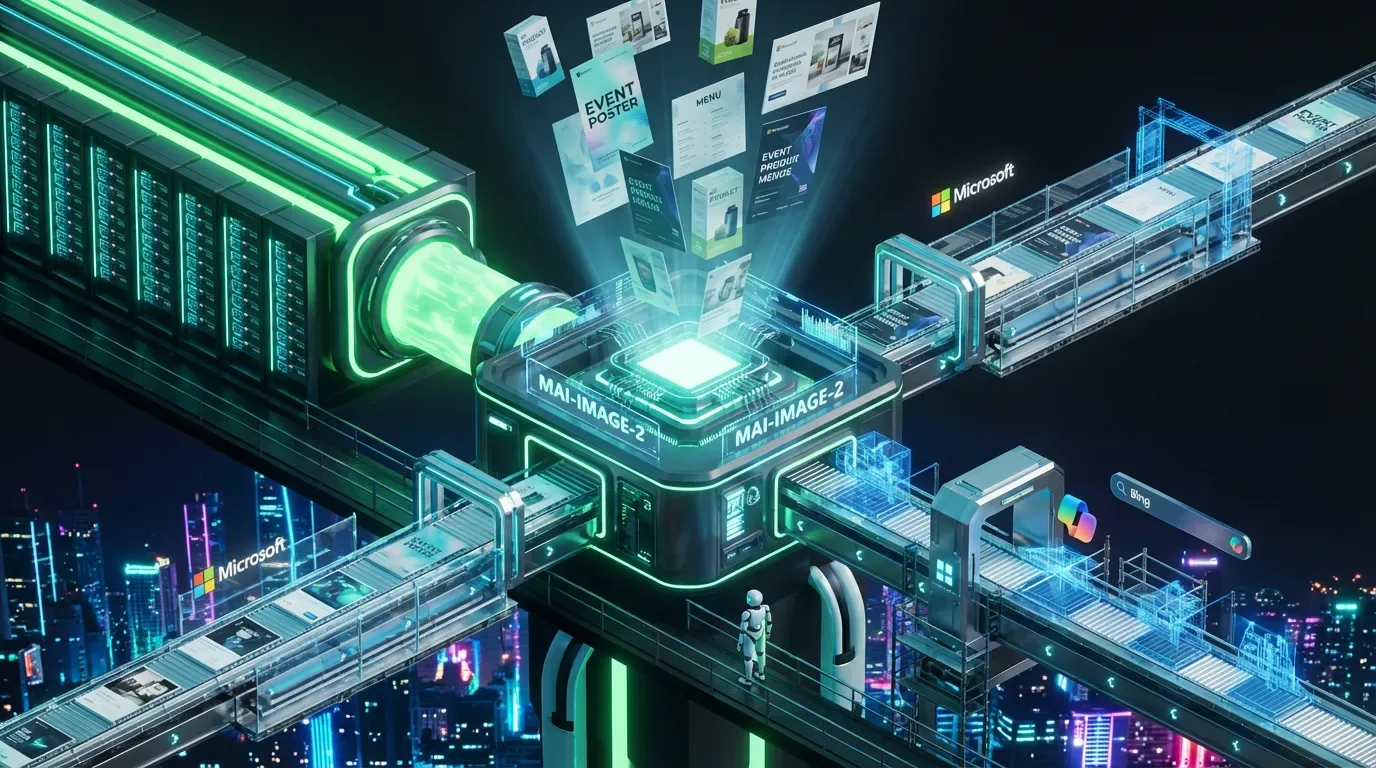
Microsoft has introduced MAI-Image-2, a new in-house image generation model aimed at higher-fidelity visuals, stronger prompt adherence, and notably better text inside images. That last part matters more than it sounds. Pretty pictures are easy to celebrate on social. Readable packaging, signage, menus, posters, and campaign graphics are what actually move a model from “nice demo” to “maybe this belongs in production.” Microsoft has also said MAI-Image-2 is rolling out to Copilot and Bing Image Creator, while broader developer access through Microsoft Foundry is still in phased rollout. That means this launch is not just about image quality. It is about whether Microsoft can turn image generation into an automation-friendly layer inside its broader AI stack.
The timing makes sense. Image generation is maturing fast, and the competitive gap is no longer only about raw visual wow factor. It is increasingly about first-pass usability. Can a team generate assets that need less cleanup, fit more briefs correctly, and plug into workflows without a full-time human acting as translator between prompt chaos and campaign reality? That is where MAI-Image-2 gets interesting.
What Microsoft is actually shipping
Microsoft is positioning MAI-Image-2 as a major step forward from its earlier in-house image efforts. Based on Microsoft’s announcement and early outside coverage, the model focuses on three practical improvements: photorealism, prompt fidelity, and text rendering. It is also being framed as a proprietary alternative that gives Microsoft more control over its visual AI stack rather than relying entirely on outside model providers.
That matters because image generation has had a recurring problem: a lot of models are great at “cinematic astronaut with vibes,” and much less great at “clean retail sign with correct product name and believable hands.” Marketing teams do not get paid in vibes. They get paid in assets that can survive review.
The shift here is subtle but important: MAI-Image-2 is trying to reduce the reroll tax. And reroll tax is one of the main reasons AI image workflows still feel slower than they should.
Microsoft also has an external signal worth noting. Community chatter around the launch points to MAI-Image-2 debuting strongly in the Arena text-to-image leaderboard, with reports placing it around the top five at launch and as high as number three shortly after. Leaderboards are not destiny, and they move fast, but they do suggest the release is more than a cosmetic refresh.
Why text rendering changes the game
If Microsoft’s claims hold up in wider use, better in-image text is the most commercially relevant part of this release. It is also the least glamorous, which is exactly why it matters.
Most image generators still get weird when you ask for:
product packaging with exact label copy
event posters with readable headlines
menu boards, signage, or infographic-style layouts
social graphics with embedded calls to action
When text breaks, the workflow breaks. A designer still has to rebuild or patch the image. A marketer still has to request revisions. An ops team still has to manually QA every asset. So while “improved realism” gets the applause, clearer text rendering is what lowers friction across actual creative production.
| Capability | Why it matters | Workflow effect |
|---|---|---|
| Better photorealism | More believable campaign visuals | Less post-editing for concept and ad assets |
| Stronger text rendering | More usable signage and branded graphics | Higher first-pass asset quality |
| Improved prompt adherence | Fewer off-brief outputs | Shorter iteration loops |
That does not mean designers are out of a job. Calm down, LinkedIn prophets. It means AI gets better at producing draft inventory that humans can refine, approve, and deploy faster.
Playground now, infrastructure later
Right now, MAI-Image-2 is available through Microsoft’s MAI Playground, and Microsoft says it is rolling out in Copilot and Bing Image Creator. Developer access is more limited today: outside reporting and Microsoft-adjacent coverage indicate API access has started for select customers, with broader availability through Microsoft Foundry expected later rather than fully open right now.
For non-technical readers, here is the real distinction:
Playground access means your team can test it manually
API or Foundry access means your systems can call it automatically
That difference is everything. A playground is where you discover what a model can do. An API is where you turn it into throughput.
Microsoft’s Foundry documentation shows the company is building a broader image-generation stack that supports playbooks like experimentation, agent workflows, and multimodal orchestration inside Azure AI Foundry and related services. That is the infrastructure layer enterprise teams actually care about, because it determines whether MAI-Image-2 can be routed into approval chains, DAM systems, campaign builders, or no-code orchestration tools. The relevant Foundry overview is here: Microsoft Foundry Playgrounds.
Can you automate it yet?
Not broadly in the cleanest sense, not yet. That is the pragmatic answer.
Microsoft has signaled that developer access is coming through Foundry-related surfaces, and coverage of the launch indicates API availability is currently selective rather than generally open. So for most teams evaluating this launch today, MAI-Image-2 is still more workflow-promising than fully workflow-proven.
That means the readiness picture currently looks like this:
| Question | Best answer now | What it means |
|---|---|---|
| Can teams test it today? | Yes, via MAI Playground, with rollout in Copilot and Bing Image Creator | Good for prompt exploration and quality checks |
| Can developers automate it broadly? | Not broadly yet; access appears selective and still rolling out | Plan pilots, not full dependency |
| Is it enterprise-stack friendly? | Potentially, via Microsoft Foundry | Stronger long-term than immediate plug-and-play |
If your team lives in Microsoft already, that roadmap matters. It suggests MAI-Image-2 could become more valuable over time than some flashier competitors simply because it may end up closer to where work actually happens: Copilot, Bing, Azure, internal apps, and business workflows.
Translation: if Microsoft turns this into a stable callable service inside the stack companies already pay for, MAI-Image-2 becomes much more than a cool model. It becomes a default visual co-worker.
Where it looks useful right now
MAI-Image-2 appears best suited to teams that need high volumes of on-brand visual drafts with human review still in the loop. That includes:
Marketing teams creating ad concepts, social graphics, event visuals, and infographics
E-commerce teams producing lifestyle scenes, promo art, and product storytelling assets
Creative ops teams trying to reduce designer bottlenecks for repetitive production work
Enterprise builders planning future automation once API access stabilizes
This is especially relevant for organizations trying to scale content output without just throwing more humans at the problem. That is where human plus machine collaboration gets real: humans set the brief, constraints, and taste; the model generates breadth; operators select what deserves to move forward.
If you want a parallel example of how COEY has been judging image-model releases through the lens of workflow readiness, our recent post on Midjourney V8 Alpha made a similar point from the opposite direction: better outputs help, but API access and system fit still decide who wins at scale.
What to watch next
The next phase matters more than the announcement itself. MAI-Image-2 will be much easier to evaluate once three things become clearer:
Broader API access
If Microsoft exposes stable endpoints through Foundry or Azure services beyond the current selective rollout, then this becomes automatable in the ways business users actually need: triggered generation, batch jobs, asset routing, approvals, and storage.
Reliability under production prompts
Launch demos are one thing. Messy real-world prompts with brand rules, product specifics, and localization requirements are another. That is where models either become useful teammates or expensive slot machines.
Integration into Microsoft products
Because Microsoft says MAI-Image-2 is rolling into Copilot and Bing Image Creator, the next real test is how consistently it shows up there and whether the user experience holds up at scale. If that product plumbing works, Microsoft could create a powerful ladder: casual use for broad adoption, then deeper deployment for enterprise workflows. That kind of product plumbing often beats raw benchmark flexing.
Bottom line: MAI-Image-2 looks like a meaningful image-generation upgrade, especially for photorealism and in-image text, two things that directly affect whether outputs are usable in marketing workflows. The hype-resistant read is simple: the model looks promising, the product direction is smart, and the real unlock will come when Microsoft fully exposes it as an automation-friendly service inside Foundry and the broader Azure ecosystem. Until then, it is more than shiny, but not yet a fully wired creative infrastructure layer. Close, though. And in this market, “close, with enterprise plumbing” is not a bad place to be.