
Lightricks' LTX 2.3 Pushes Open Video Closer to Real Creative Infrastructure
Lightricks LTX 2.3 pushes open video closer to real creative infrastructure. What it unlocks for AI marketing automation and video ops teams.
22 March 2026Team COEY
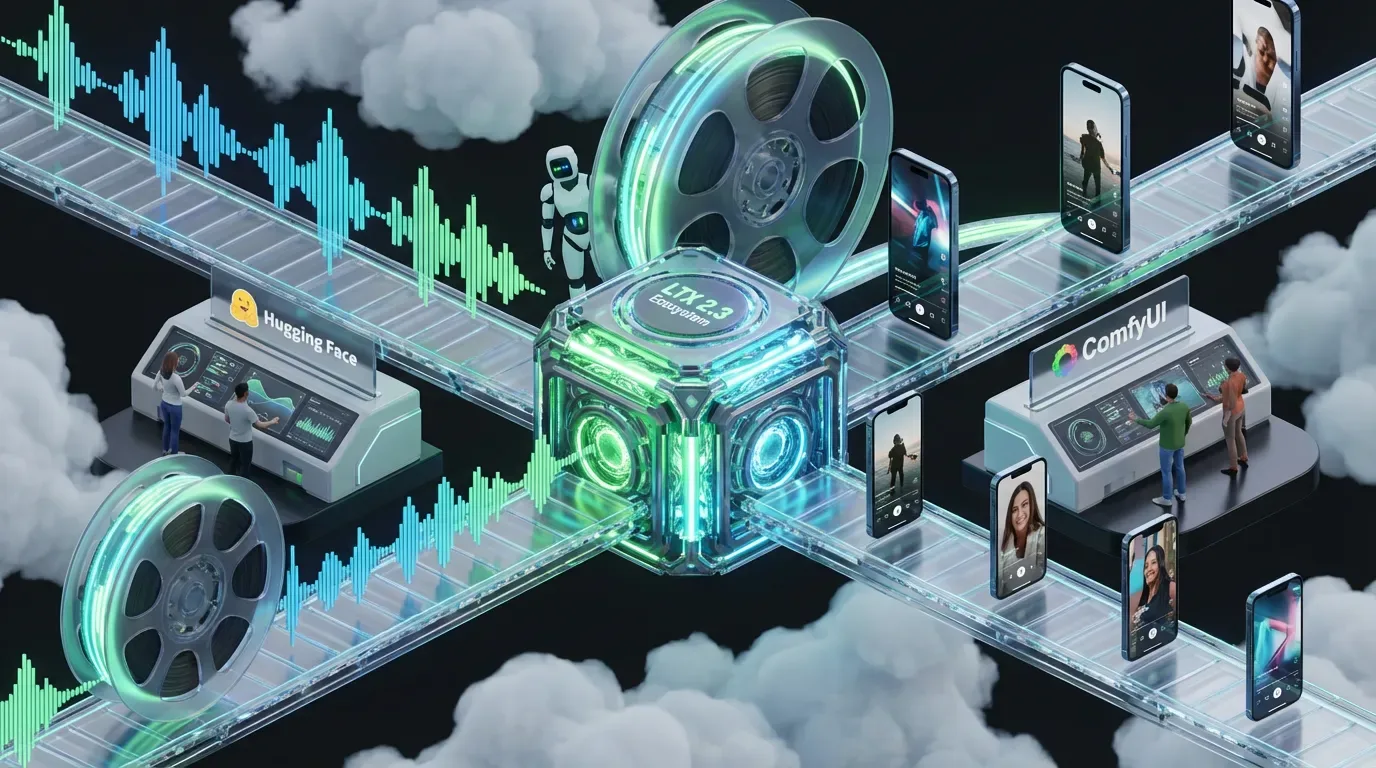
Lightricks has released LTX 2.3 on Hugging Face, and this one matters for a reason bigger than spec-chasing: it makes open AI video look a lot less like a research flex and a lot more like something teams can actually build workflows around. The headline features are easy bait for the timeline: native 4K output, support for portrait formats, synchronized audio, multiple input modes, and public weights under Lightricks' community license. But the more interesting question for marketers, operators, and creative leads is the one that always separates shiny from useful: can this plug into a real content system, or is it still just a cool toy with cinematic screenshots?
The answer is surprisingly solid, with caveats. LTX 2.3 is one of the clearest signs yet that open video generation is maturing into callable creative infrastructure. Not perfect. Not magically "replace your studio" ready. But much closer to workflow-ready than the usual AI video circus.
Translation: this is less "look what AI can make" and more "look what your team might automate next."
What actually shipped
LTX 2.3 is Lightricks' latest open video model, published with code and weights through the company's public model surfaces, including the official ComfyUI-LTXVideo GitHub repository and the Hugging Face model page. Public materials describe it as a joint audio-video generation model that supports text-to-video, image-to-video, audio-conditioned generation, video extension, and retake-style workflows, with distribution also available through hosted inference platforms like fal.ai's LTX 2.3 page.
That matters because open in AI video is often more theoretical than practical. Sometimes "open" means a model card, a waitlist, and some vibes. Here, the release is much more operational: downloadable weights, documented usage paths, and ecosystem integrations that point toward real deployment rather than academic admiration.
The most attention-grabbing claims include:
Native 4K output at up to 2160p, with workflows that also support higher frame rate options
Portrait and vertical composition with native 9:16 support rather than awkward post-crop energy
Native synchronized audio in the generation pipeline
Public weights under a community license that is much friendlier to experimentation and integration than closed model black boxes
That combo is what makes the release newsworthy. Resolution alone is not strategy. Audio alone is not workflow. But when quality, aspect-ratio flexibility, and deployment freedom land together, teams start paying attention.
Why open matters here
The open-model angle is not just philosophical branding for developer Twitter. It changes the automation story.
With closed video tools, your workflow is limited by whatever the vendor decides to expose. If there is no API, no batch control, no predictable export behavior, and no self-hosting option, then your "AI workflow" is really just a human doing repetitive clicks in a browser tab. That is not scale. That is cosplay operations.
LTX 2.3 is more interesting because it can be deployed, wrapped, and integrated. For non-technical readers, that means a team can potentially put this inside a repeatable system:
new product enters a campaign database
prompt template and brand rules get applied
video variants render automatically
outputs route to review
winners move downstream into editing, localization, or publishing
That is the difference between "AI helps a creator make one clip" and "AI helps a team run a content pipeline."
Automation readiness is the real story
LTX 2.3 appears to be unusually well positioned for workflow use because it already sits inside a builder-friendly ecosystem. Lightricks hosts the model publicly, and community plus partner tooling is making it accessible through things like ComfyUI and hosted inference layers. For teams that need a cleaner developer path, the earlier LTX-2 release offers useful context for how Lightricks has been pushing open video toward practical deployment, while the official Hugging Face model page remains the best front door for understanding what is available.
| Question | Best answer now | Why it matters |
|---|---|---|
| Can teams use it today? | Yes , if they are comfortable with open-model workflows | Useful now for labs, agencies, and internal creative ops |
| Can it be automated? | Yes , because it can be served locally or accessed through developer-friendly platforms | Makes batch generation and orchestration realistic |
| Is it turnkey for non-technical teams? | Not really | You still need tooling, hosting, or a wrapper layer |
This is where the pragmatic read matters. LTX 2.3 is API-possible and workflow-friendly, but that does not mean every marketing team should go full self-hosted video stack tomorrow morning like it is a personality trait.
Audio plus vertical is not trivial
A lot of AI video coverage treats specs like Pokemon cards. This one has 4K. That one has 50 fps options. Another one can maybe do a crab walking through a boardroom. Cool. But from an operations standpoint, two of LTX 2.3's most meaningful features are actually more boring and more valuable: native audio and portrait-native output.
Why? Because those are the features that reduce downstream friction.
For marketing teams, the real-world win is not just prettier clips. It is fewer handoffs:
Vertical-ready outputs mean less reframing work for TikTok, Reels, and Shorts
Synchronized audio means less patching together video and sound in separate tools
Multiple input modes make it easier to build around existing assets, not just prompts
That is especially relevant for high-volume use cases like paid social variants, UGC-style b-roll, product explainers, concept boards, and localized campaign spins. In those workflows, reducing edit tax is often more valuable than squeezing out a tiny boost in visual fidelity.
The hidden KPI in AI video is not "best clip." It is "usable-output rate."
Where it looks strongest first
LTX 2.3 looks best suited for teams that already think in systems: in-house creative ops teams, AI-native agencies, production labs, and builder-heavy marketing orgs.
Near-term high-value use cases include:
Ad variant factories: generate multiple hooks, scenes, or offer framings from one campaign brief
Social-ready vertical assets: produce portrait-first clips without retrofitting landscape renders
Storyboard and pre-viz work: move faster from concept to stakeholder review
B-roll and filler generation: create coverage footage to support real-shot content
Localized creative systems: keep the same concept while swapping language, pacing, or region-specific cues
This is where open models start to shine. Closed products are often better at convenience. Open models are often better at becoming part of your stack.
What still limits it
Now for the adult supervision section.
LTX 2.3 may be one of the more operational open video releases we have seen, but it is still open video. That means some very normal constraints still apply:
Hardware demands are real: the full model is not aimed at weak machines or casual laptops
Serving complexity exists: open weights do not automatically equal a polished enterprise service
Quality still depends on prompting and workflow design: open models are not immune to garbage in, garbage out
Human review still matters: especially for brand accuracy, product fidelity, and legal-sensitive content
There is also a broader reality in AI video that no launch post can meme its way around: determinism is still hard. If you need exact packaging, exact logos, exact UI, or exact claims presented the same way across hundreds of outputs, you still need review loops and likely a hybrid pipeline.
What this means for creative teams
LTX 2.3 is important not because it "wins" AI video, but because it moves open video another step toward production logic. It is not only about generation quality. It is about whether a machine can participate in the messy middle of content creation without creating more mess than it removes.
That is the mission-aligned part. Humans still bring the brief, the taste, the strategy, the yes-or-no judgment. Machines bring speed, range, and the ability to generate breadth on demand. When that loop works, creativity scales without scaling grind.
Bottom line: LTX 2.3 is one of the most workflow-relevant open video releases in the market right now because it combines public access to weights, native 4K output, audio support, and real integration potential. It is not fully plug-and-play for every org, and it is definitely not "fire the studio" software. But for teams that want an automatable, ownable foundation for AI video, this is the kind of release that moves the conversation from hype to infrastructure.
GroundSlate did not stop on 2.3. LTX 2.5 is the video pack it installs, and the clip is a library row, not a download from a Comfy queue. The open-weights path this piece describes is the one that ended up on the Mac.