Microsoft’s MAI-Image-2 Wants to Be More Than Pretty
Microsoft's MAI Image 2 wants to be more than pretty. What it means for AI marketing automation, ad creative pipelines, and brand image ops.
23 March 2026Team COEY
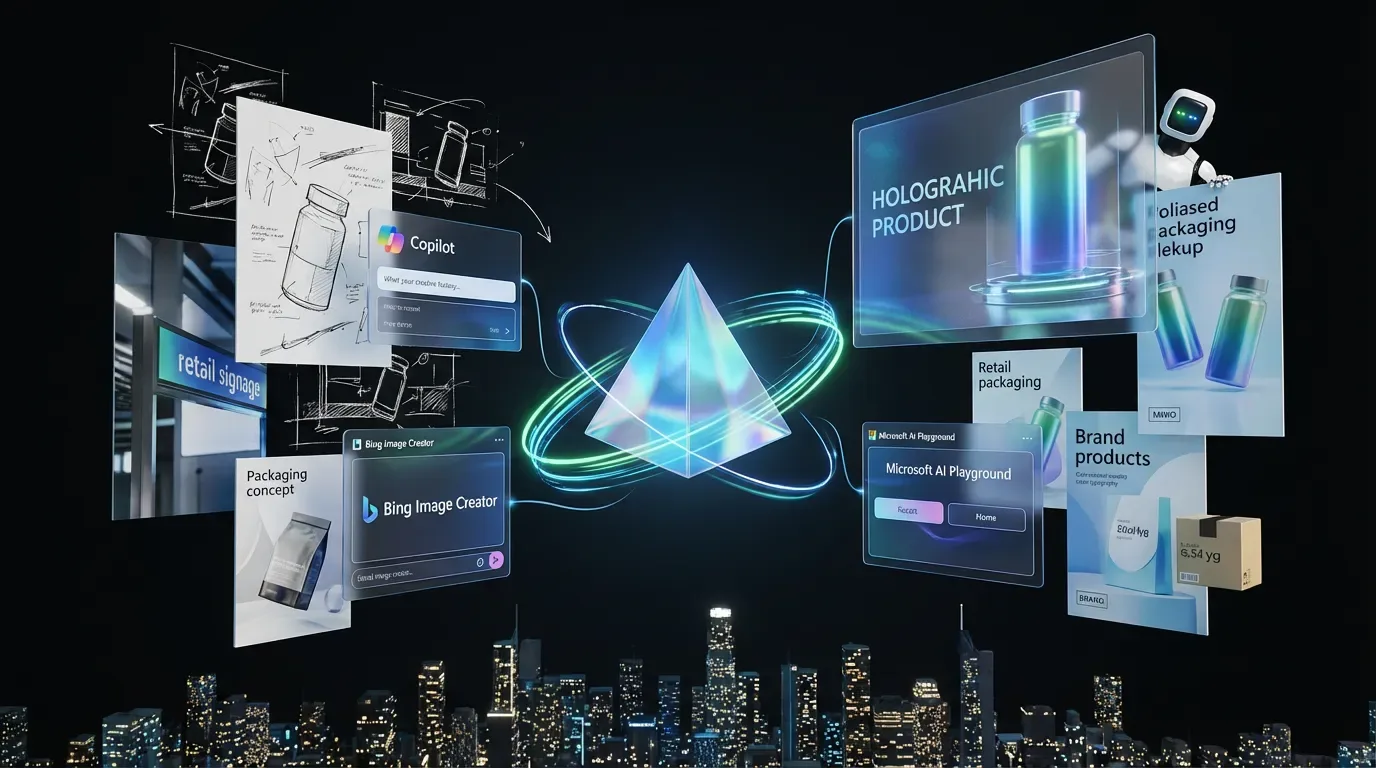
Microsoft has introduced MAI-Image-2, a new in-house image generation model aimed at the part of AI visuals that actually matters in business: outputs you can use without immediately opening Photoshop in emotional support mode. Microsoft is positioning the model around stronger photorealism, better prompt adherence, and better text rendered inside images. The company also says MAI-Image-2 is rolling out across Copilot, Bing Image Creator, and Microsoft AI Playground, while developer access appears to be phased rather than broadly open on day one.
That framing matters. The image-model race has moved beyond “who can make the coolest cyberpunk frog riding a Vespa.” The new bar is first-pass usability. Can a marketing team get campaign-worthy concepts faster? Can a retailer generate believable product scenes without endless cleanup? Can a creative ops team automate part of the visual pipeline instead of just adding one more tab to babysit?
MAI-Image-2 looks like a serious attempt to answer yes. But as always, quality is only half the story. The other half is whether Microsoft turns this into a callable, dependable layer inside real workflows rather than a nice feature trapped in a friendly UI.
The big shift: Microsoft is not only chasing prettier generations. It is chasing lower reroll tax, lower cleanup tax, and eventually lower operations tax.
What Microsoft is actually shipping
Microsoft positions MAI-Image-2 as an upgrade to its earlier in-house image work, with improvements centered on three commercially relevant areas: visual realism, prompt fidelity, and text rendering. That combination is a lot more important than it sounds.
Photorealism helps, obviously. Better lighting, more natural faces, stronger environmental detail: all good. But most business users do not lose time because an AI image is slightly less cinematic. They lose time because the image is almost right. The product label is nonsense. The poster headline looks cursed. The sign in the background says something that appears to have been invented by a haunted keyboard.
That is where MAI-Image-2 gets interesting. Microsoft’s launch materials and early reporting around the release point to improved in-image text, which is one of the hardest and most commercially valuable things for an image model to get right. Packaging mockups, promo graphics, infographics, event posters, menu boards, retail signage: these are not edge cases. They are actual marketing work.
| Capability | Why it matters | Workflow effect |
|---|---|---|
| Better realism | More believable campaign visuals | Less retouching on concepts and ad assets |
| Stronger text rendering | More usable branded graphics and signage | Higher first-pass hit rate |
| Improved prompt adherence | Fewer off-brief generations | Shorter iteration loops |
That does not mean the design team can go feral and disappear into the woods. It means the model may now be more useful at generating draft inventory that humans can select, refine, and deploy faster.
Why text accuracy is the real headline
Let’s be honest: “better text in images” is not sexy launch-copy material. It does not trend like “cinematic detail” or “hyperreal visual fidelity.” But it is one of the most workflow-relevant parts of this release.
Most image generators still struggle the moment you ask for anything involving exact language. They can make a moody beverage ad with lens flare all day. Ask for a clean retail display with readable offer copy, and suddenly the machine starts free-styling in another dimension.
That weakness breaks automation. Once text fails, someone has to fix it manually. Once someone has to fix it manually, the asset is no longer moving through the pipeline cleanly. The model stops being infrastructure and goes back to being a sketch assistant.
So if MAI-Image-2 really does improve text accuracy in a meaningful way, the impact is bigger than the feature list suggests:
Campaign graphics become more usable on first generation
Packaging and product mockups need less compositing work
Localized variations become more realistic to produce at scale
Creative testing gets faster because outputs survive review more often
The hidden KPI in image generation is not “wow.” It is “usable without drama.”
Copilot now, infrastructure later
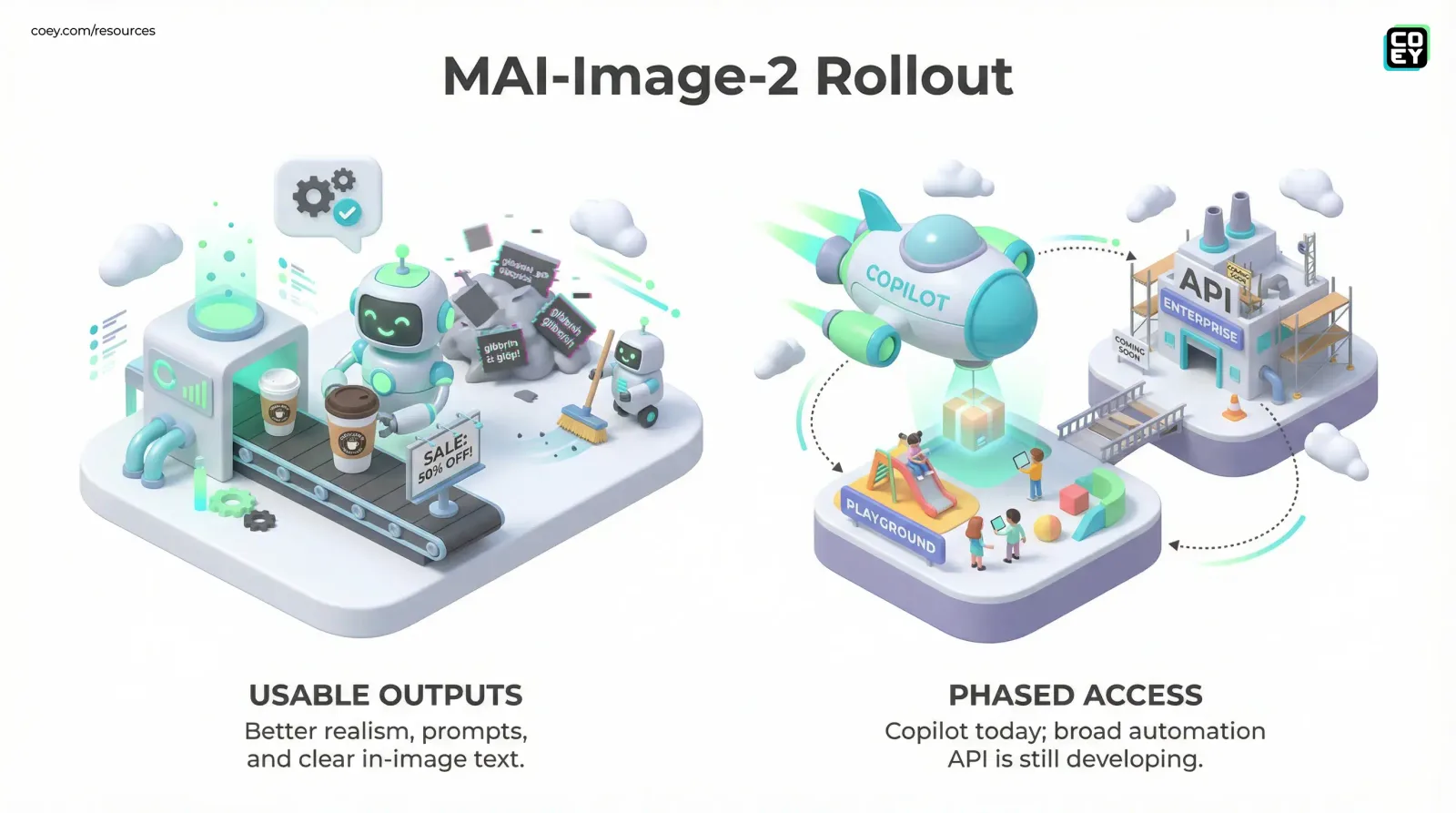
Microsoft says MAI-Image-2 is rolling into consumer-facing and business-facing surfaces like Copilot, Bing Image Creator, and Microsoft AI Playground, which gives the model immediate reach. That is good for adoption. Teams can try it without setting up some glorious Rube Goldberg contraption on day one.
But there is a crucial distinction non-technical readers should care about:
Product access means a human can use it in an interface
API access means your systems can use it automatically
Those are not the same thing. One is convenient. The other is transformative.
Right now, the public story still looks phased. Based on Microsoft’s launch positioning and current reporting, MAI-Image-2 is available through Microsoft-owned interfaces first, while broader developer availability appears limited or still expanding rather than universally open as a standard image API from day one. Reports on X also point to early access for select enterprise customers and partners, but Microsoft has not clearly published a broad public API rollout with pricing.
For operators, the takeaway is simple: this is workflow-promising now, but not yet universally workflow-proven.
Can you automate it yet?
The pragmatic answer: partly, depending on where you sit in Microsoft’s rollout curve.
If your team is using Copilot, Bing Image Creator, or Microsoft AI Playground, you can start testing creative quality right away. That is useful for prompt development, brand fit checks, and early internal evaluation. But if your goal is to trigger image generation from forms, campaign systems, product feeds, or no-code orchestrators, then broader API-style access still matters more than the launch demo.
| Question | Best answer now | What it means |
|---|---|---|
| Can teams try it today? | Yes , through Microsoft surfaces like Copilot, Bing, and Microsoft AI Playground | Good for testing quality and fit |
| Can most teams automate it broadly? | Not broadly yet | Pilot it, do not hardwire the whole stack |
| Does it have a credible enterprise path? | Yes , through Microsoft’s broader platform direction | Potentially strong long-term workflow value |
This is where Microsoft has an advantage if it executes. Plenty of image tools are impressive. Fewer can become default layers inside software businesses already use every day. If MAI-Image-2 gets proper developer surfaces through Microsoft’s stack, the model could matter less as a standalone art engine and more as a quiet background collaborator inside enterprise workflows.
For a useful comparison on how COEY has been evaluating image releases through this exact lens, see our earlier coverage of Midjourney V8 Alpha, where the output quality improved but the API story still lagged behind the infrastructure dream.
Where MAI-Image-2 looks strongest
This model appears best suited for teams that need lots of visual options with human review still in the loop. In other words: most sane organizations.
Near-term high-value use cases likely include:
Marketing teams producing social concepts, promo graphics, and event visuals
Ecommerce teams generating product lifestyle scenes and merchandising imagery
Agencies creating pitch visuals, campaign mockups, and localized variants
Creative ops teams reducing repetitive production load before final human polish
The sweet spot is not “push one button and publish forever.” It is humans define the brief, constraints, and taste; the model generates breadth; the team selects what is worth carrying forward. That is the actual scale play. Not replacing creative judgment, but removing some of the grind around getting to viable options.
What still needs adult supervision
Even if MAI-Image-2 is a real quality jump, some limits do not magically disappear just because the launch graphics are shiny.
Brand precision still matters: exact product details, exact logos, and legal-sensitive claims still need review
Automation depends on access: broad API availability has not been clearly established yet
Leaderboards are not production: early discussion around the release cites a high arena ranking, but your weird real-world prompts are the actual test
That last point is worth underlining. The history of AI launches is basically a museum of “looked incredible in demos, got weird in normal work.” The teams that win with MAI-Image-2 will be the ones that test it against actual business use cases: campaign variants, retail graphics, packaging concepts, localized creative, approval-heavy assets.
Bottom line: MAI-Image-2 looks like a meaningful upgrade because it targets the part of image generation that matters most in production: first-pass usability, especially for text-heavy and brand-sensitive visuals. The model quality story is promising. The bigger story is whether Microsoft turns that quality into a stable, callable service that plugs into the workflows companies already run. If it does, MAI-Image-2 stops being just another good image model and becomes something much more valuable: a practical visual layer for human-plus-machine creative systems.
Turn AI News Into Marketing Advantage
COEY turns the latest AI developments into real marketing firepower. We deploy n8n workflows, Claude Cowork agents, and OpenClaw pipelines that keep your channels running and your team focused on strategy. See our automation approach or request a proposal.