DeepSeek V4 Brings 1M-Context Open Weights Into the Automation Race
DeepSeek V4 Brings 1M-Context Open Weights Into the Automation Race
April 25, 2026
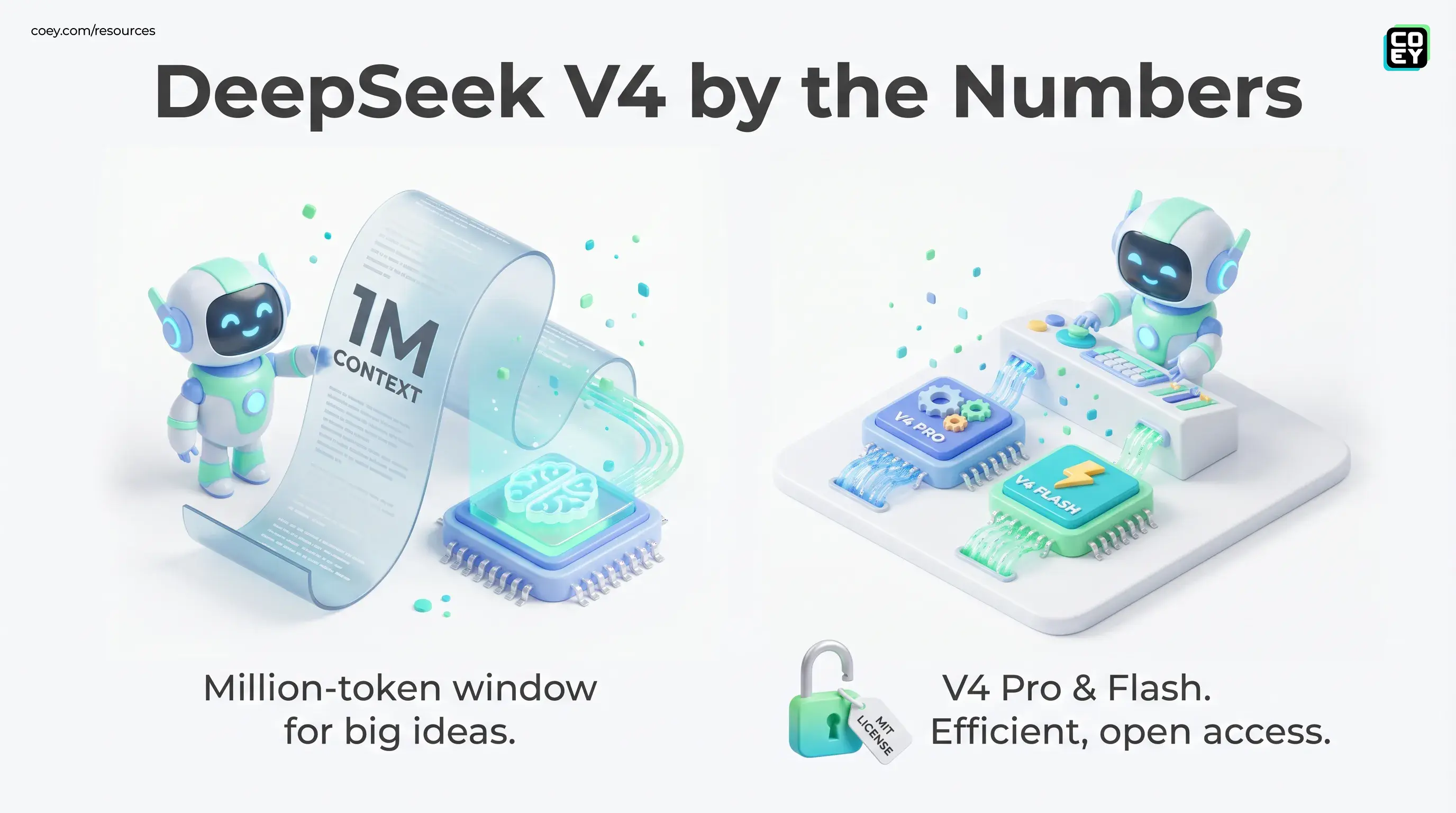
DeepSeek has entered the long-context arms race with new V4 open-weight releases that pair a 1,000,000-token context window with Mixture-of-Experts efficiency and commercially usable MIT-licensed weights. The headline sounds like classic AI launch theater until you look at what actually matters for operators: can it run through an API, can it be self-hosted, and does it reduce workflow pain instead of just making benchmark bros post harder. On those fronts, DeepSeek-V4-Pro and DeepSeek-V4-Flash look less like hype bait and more like serious infrastructure for teams building automations, agents, and long-document workflows.
The split is straightforward. V4-Pro is the heavier reasoning model, using about 49B active parameters from a 1.6T-parameter MoE system. V4-Flash is the cheaper, faster sibling, activating about 13B parameters from a roughly 284B-parameter MoE model while still offering the same 1,000,000-token context window. If those numbers hold up in production, DeepSeek is making a very direct play: give teams closed-model-scale context without closed-model lock-in.
What actually shipped
At a high level, DeepSeek’s V4 family is designed around a familiar but increasingly important tradeoff: very large total model size, much smaller active compute per token. That is the whole MoE pitch. You get a large-capability model without paying the full cost of lighting up every parameter on every request.
That matters because long context is only exciting when it is usable. A million-token window sounds cool on stage. In practice, it only becomes relevant when teams can afford to run it inside actual products and workflows.
| Model | Positioning | Best fit |
|---|---|---|
| DeepSeek-V4-Pro | Higher-end reasoning and coding | Complex agent workflows, repo analysis, technical tasks |
| DeepSeek-V4-Flash | Lower-cost, faster inference | High-volume API calls, assistants, bulk automation |
Community chatter on X has focused hard on price, especially around Flash, because that is where the disruption story lives. As of launch pricing, Flash is listed at $0.14 per 1M input tokens and $0.28 per 1M output tokens, while Pro is listed at $1.74 per 1M input tokens and $3.48 per 1M output tokens, with lower cached-input pricing also documented. If Flash can keep quality respectable while staying dramatically cheaper than premium closed APIs, it becomes interesting not as a toy chatbot but as a background worker for content pipelines, classification jobs, internal assistants, and long-input summarization.
Why 1M context matters
Let’s be honest: most teams do not need one million tokens for everyday prompt-and-pray copy tasks. You do not need a cargo ship to deliver a sandwich. But long context becomes very real when work involves entire repositories, campaign histories, support logs, legal packets, research archives, or big internal knowledge bases.
That changes the shape of automation in a few important ways.
Less chunking, less glue code
One of the least glamorous problems in AI workflows is also one of the most expensive: splitting source material into chunks, managing retrieval, reassembling outputs, then fixing the weird coherence issues that show up when the model loses the plot halfway through. A larger native context does not solve every retrieval problem, but it can remove a lot of orchestration overhead.
The real win is not “the model can read a novel.” The win is fewer brittle steps between input and output.
For marketing and creative operations, that means teams can potentially pass in full strategy docs, performance reports, brand voice references, approval notes, and content drafts in one working memory. That is much closer to how humans actually review campaigns.
More coherent agent runs
Agent workflows often break because context gets fragmented across steps. The planner forgets what the researcher found, the writer misses the constraints, and the reviewer loses the original brief. A larger context window gives orchestrated workflows more room to keep task state together.
That does not magically make autonomous agents reliable. But it does make multi-step systems easier to build and less annoying to maintain.
Open weights change the business case
The bigger story here may not be context at all. It is access. DeepSeek is positioning V4 as open-weight and commercially usable under the MIT license, which gives companies a choice that many closed models do not: run via hosted API for speed, or self-host for control.
That choice matters a lot for enterprises and agencies managing client-sensitive information. If the model is only available through a sealed product, then your automation potential is limited by the vendor’s UI, pricing, policies, and roadmap. If it is available as weights plus API access, you have options.
- API route: quickest path for testing and deployment
- Self-hosting route: stronger control over privacy, logs, and compliance
- Hybrid route: use hosted inference for low-risk work, private deployment for sensitive tasks
That is the difference between nice demo and could actually go into the stack.
Can you automate it today?
Mostly, yes. The key question for non-technical readers is simple: does this plug into the systems teams already use? By current documentation and launch reporting, the answer looks favorable. DeepSeek is offering API access and the V4 family is exposed through OpenAI-compatible chat-completions style endpoints. Reporting also indicates compatibility with Anthropic-style APIs, which means existing workflows may be able to swap it in with limited surgery.
| Question | Answer | Why it matters |
|---|---|---|
| API available? | Yes, via hosted endpoints | Useful for fast testing and workflow rollout |
| Self-hostable? | Yes, with open weights | Important for privacy, governance, and cost control |
| Automation-ready? | Largely yes | Can fit into orchestrators and custom apps |
In plain English: if your team uses n8n, Make, Zapier, internal scripts, or a custom application layer, DeepSeek V4 looks much closer to a drop-in model provider than a waitlist science project. For broader context on how COEY has already framed the model’s operational angle, see this earlier DeepSeek V4 breakdown.
Where it looks strongest
Technical content and product marketing
Teams explaining software, platforms, APIs, or large documentation sets are obvious beneficiaries. A long-context model can ingest more reference material at once, which improves consistency across product pages, technical explainers, enablement docs, and knowledge-base generation.
Internal research and analysis
Long PDFs, policy sets, earnings documents, transcripts, and customer feedback archives are classic too big for one pass, too annoying to manually stitch material. That is where 1M context starts to feel less like a flex and more like a practical upgrade.
Agent back ends
V4-Pro in particular looks aimed at builders who want a reasoning-capable model behind research agents, coding assistants, and multi-step workflow systems. If the current pricing and early performance reports hold, Flash could become the cheap workhorse while Pro handles the heavier lifts. Very brains plus interns, which is honestly the healthiest architecture pattern right now.
Where the hype needs a leash
This is still a model launch, so a little skepticism is healthy. Massive context windows do not automatically produce massive accuracy. In many workflows, retrieval quality, prompt design, validation, and human review will matter more than raw context ceiling.
There is also a practical infrastructure question: self-hosting giant MoE systems is not free just because the weights are open. Open-weight does not mean lightweight. Teams still need capable hardware, monitoring, routing, and governance if they want production-grade deployment.
And of course, supports 1M tokens does not mean every task should use 1M tokens. Sometimes the smartest automation move is still to send less context, not more. Bigger windows are a capability, not a personality trait.
What this means for creative ops
DeepSeek V4 matters because it pushes the market toward a more useful version of AI competition: not just who has the flashiest frontier demo, but who offers real deployment options, real automation surfaces, and real cost viability.
For executives, the takeaway is simple: this is a sign that long-context AI is moving from premium closed platforms into more flexible infrastructure territory.
For marketing teams, it means bigger source packs, richer campaign memory, and fewer duct-taped handoffs between analysis, drafting, and revision.
For builders, it means another serious model option that can live behind products, workflows, and internal tools without asking everyone to marry a single vendor forever.
That is the part worth paying attention to. Not the big number by itself. The fact that the big number comes with open deployment paths and automation potential. In AI, that is usually where the meme ends and the real work begins.