
SeFi-Image Pushes Efficient Image Models Into the Open
SeFi-Image Pushes Efficient Image Models Into the Open
July 4, 2026
SeFi-Image has arrived as a new publicly released text-to-image foundation model family built around a simple but important promise: make high-quality image generation less computationally ridiculous. For creative teams, marketers, agencies, and automation builders, that matters. The AI image boom has been fun, chaotic, and occasionally why does this hand have 14 knuckles? energy, but the next phase is not just prettier pictures. It is whether image generation can run predictably inside real workflows without blowing up budgets, compliance rules, or production timelines.
SeFi-Image, short for Semantic-First Image, is not another glossy consumer app trying to become the next Midjourney Discord cult. It is a research-driven model family with public Hugging Face repositories, with access to the weights subject to the posted non-commercial terms, including variants such as SeFi-Image-5B-RL and SeFi-Image-2B-turbo. The release gives technical teams more control over how image generation is deployed, tested, and potentially embedded into creative systems.
The headline is not another AI image model exists. The headline is that efficient, self-controlled visual generation is becoming more accessible to teams that want automation without total platform dependency.
What SeFi-Image Changes
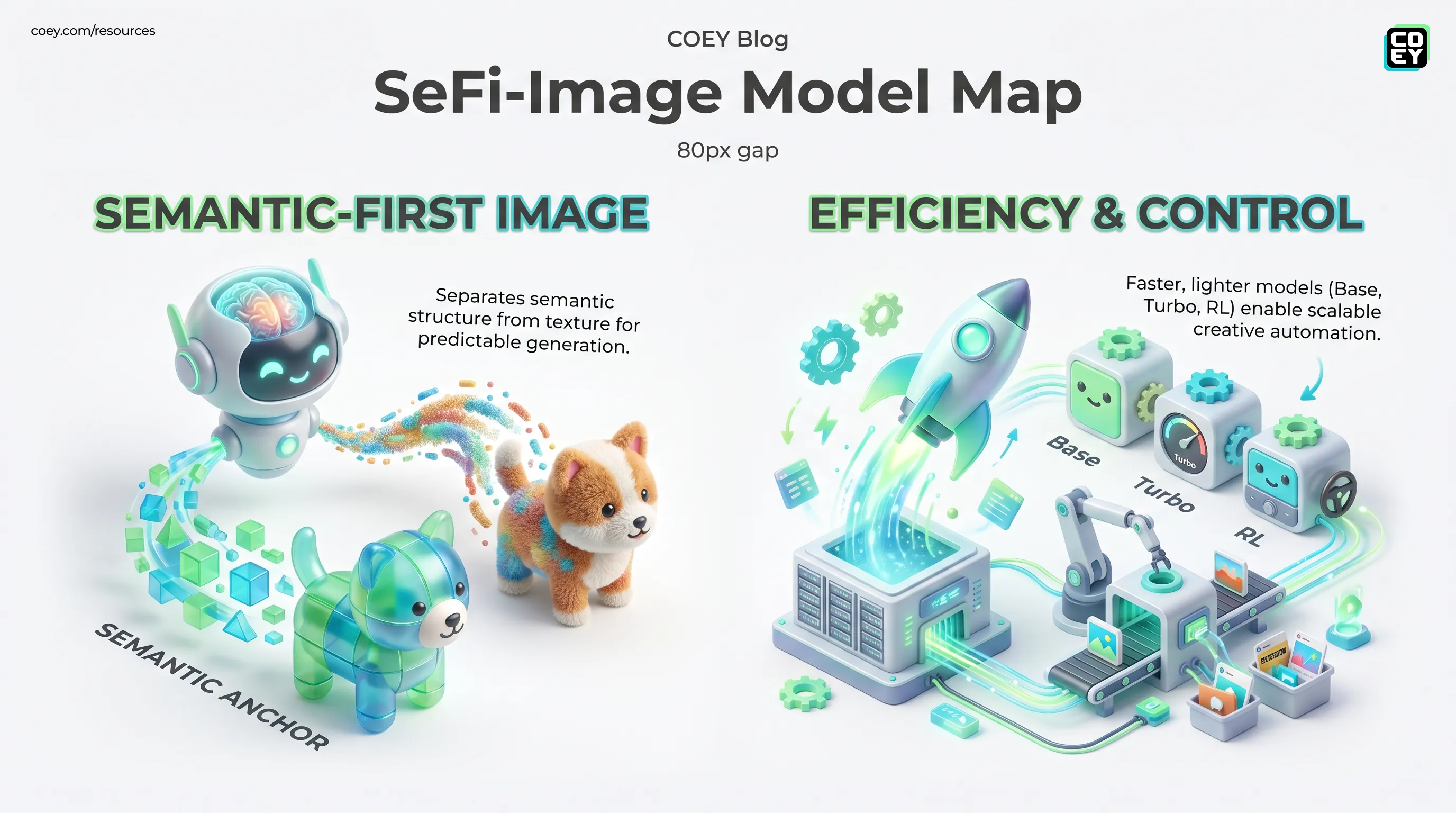
Most image models work by gradually denoising a latent representation until an image appears. SeFi-Image introduces what its authors call Semantic-First Diffusion. In plain English: the model separates semantic structure from texture, then denoises the semantic component slightly ahead of the texture component so the image has a cleaner structural anchor before surface detail gets refined.
That distinction matters. A lot of image-generation failures happen because the model gets vibes right but structure wrong. The lighting is gorgeous, the cinematic grain is chef’s kiss, and the product has quietly transformed into a cursed geometry puzzle. SeFi-Image’s approach is designed to resolve objects, composition, and spatial relationships earlier, then refine details later.
The model family comes in multiple scales, roughly 1B, 2B, and 5B parameter versions, which gives teams more flexibility depending on hardware, speed needs, and quality expectations. There are Base and Turbo checkpoints across the family, while the public RL checkpoint highlighted in the release is the 5B-RL variant. The Turbo checkpoints are DMD2-distilled versions built for faster generation with fewer inference steps, reported around 4 steps compared with the Base models’ roughly 50-step setup, while the RL variant focuses more on prompt following, visual quality, and text rendering alignment.
| Variant | Primary Use | Workflow Fit |
|---|---|---|
| Base | General generation and tuning | Research, experimentation, internal testing |
| Turbo | Faster image output with fewer steps | Batch previews, rapid creative iteration |
| RL | Better prompt adherence and alignment | Higher-control campaign concepts and text-heavy prompts |
Efficiency Is The Real Story
SeFi-Image’s most interesting claim is not just quality. It is training efficiency. The research reports that the largest 5B model was trained with about 125,000 NVIDIA A800 GPU hours, which the authors frame as roughly 10% to 20% of the compute used by the comparable Z-Image model while remaining competitive on several reported text-to-image benchmarks, including GenEval, DPG-Bench, LongTextBench, OneIG, and CVTG-2K.
For executives and marketing leaders, that may sound like an infrastructure footnote. It is not. Compute efficiency is one of the biggest barriers between cool demo and repeatable creative engine. If a model is cheaper to train, lighter to run, or easier to distill into faster variants, then it becomes more realistic to deploy inside high-volume creative systems.
Think campaign localization, product-feed-driven ad variants, seasonal landing-page visuals, retail banners, creator thumbnails, CRM personalization, and internal concepting. These use cases do not need one magical image. They need hundreds or thousands of good-enough-to-review outputs, consistently, on schedule, with cost controls.
That is where efficient models start to matter. Not because they win X benchmark fights, although yes, the benchmark screenshots will continue until morale improves, but because they reduce the friction of turning image generation into an operational capability.
Automation Potential
SeFi-Image is much more relevant to automation teams than to casual prompt tourists. Because the model weights are available for non-commercial access through Hugging Face, teams can run inference in their own environment, connect it to internal tools, and build repeatable generation pipelines around it for evaluation, research, and prototyping.
That could look like a creative operations system that takes a product catalog, generates image prompts from structured metadata, produces variant concepts, sends outputs to a human reviewer, and pushes approved assets into a DAM or CMS. It could also support an agency workflow where strategists define campaign directions, AI generates moodboard directions overnight, and designers spend their morning curating and refining instead of staring into the blank canvas void.
This is the human-plus-machine pattern COEY cares about: humans set intent, taste, constraints, and judgment; machines accelerate the production surface area. Nobody needs AI to replace the creative director. Everyone needs fewer hours lost resizing, versioning, and producing 37 near-identical campaign visuals because the media plan got slightly updated.
| Workflow | Automation Value | Human Role |
|---|---|---|
| Ad variant generation | Scale concepts quickly | Approve, edit, enforce brand taste |
| E-commerce visuals | Create seasonal or contextual assets | Validate accuracy and merchandising fit |
| Editorial imagery | Produce drafts for articles and social | Curate, fact-check, avoid visual cliches |
API Reality Check
This is where we separate workflow gold from shiny object confetti. SeFi-Image is not, based on the public release, a polished commercial API product like a plug-and-play SaaS image platform. It is a model release. That means automation is possible, but it is not necessarily one-click simple.
For technical teams, that is actually good news. The model can be integrated through local inference scripts, Python workflows, containers, job queues, or a custom internal API layer. A developer could wrap it in FastAPI, expose it to n8n or Make through webhooks, connect it to a DAM, or orchestrate it with product and campaign data. That is real automation potential.
For nontechnical teams, the translation is this: SeFi-Image is not something your social media manager casually plugs into HubSpot before lunch unless your team has already packaged it into a usable internal tool. It is infrastructure, not a finished marketing app.
The Hugging Face availability also helps with experimentation. Teams can evaluate checkpoints, test prompts, compare output quality, and prototype deployment patterns. But production readiness depends on your environment: GPU availability, queue management, storage, review tooling, content moderation, and brand-safety checks.
The Licensing Catch
Here is the part that matters before anyone starts planning a fully automated campaign machine: the public Hugging Face model cards list the weights under CC BY-NC 4.0, a non-commercial license. Access to the checkpoint files also requires users to accept the posted non-commercial terms. That is a major constraint for brands, agencies, and media companies.
In practical terms, non-commercial licensing means companies should not assume they can use the model outputs or weights in revenue-generating workflows without legal review or separate permission. The code may be easier to reuse depending on its license, but the model weights are the business-critical asset.
This does not make the release less important. It just changes the adoption path. SeFi-Image is immediately useful for research, benchmarking, internal evaluation, academic work, workflow prototyping, and proof-of-concept automation. For commercial production, teams need to check licensing carefully and avoid the classic AI move of we put it in prod and legal found out later. That movie always ends badly.
Readiness For Real Teams
SeFi-Image looks promising, especially for teams that already understand model deployment. But it is not a turnkey replacement for commercial creative platforms and image tools such as Adobe Firefly, Midjourney, Ideogram, or OpenAI’s GPT Image tools. Those platforms still win on interface polish, support, commercial licensing clarity, managed infrastructure, and nontechnical usability.
Where SeFi-Image stands out is control. If your organization wants to evaluate self-hosted image generation, study efficient architectures, benchmark prompt adherence, or build internal creative automation without depending entirely on closed APIs, it is worth attention.
The likely early adopters are AI labs, creative technology teams, advanced agencies, internal innovation groups, and marketing engineering teams. These are the people who can turn model weights into workflow tools. Everyone else should watch closely but resist the urge to mistake available weights for production-ready creative department in a box.
Where It Fits In The Image Model Shift
SeFi-Image lands at the same moment image generation is becoming more operational, more structured, and more workflow-aware. COEY recently covered Qwen-Image-Agent, which attacks a different part of the same problem: prompts rarely contain enough context, so image systems need planning, memory, search, and feedback to create better outputs. SeFi-Image approaches the problem from the model architecture and efficiency side instead.
That contrast is useful. The future of AI image workflows will not be solved by one trick. Teams need better models, better prompt context, better review loops, better deployment options, and clearer licensing. COEY also covered Microsoft’s MAI-Image-2 rollout, where the key story was API access and enterprise workflow readiness. SeFi-Image is less turnkey than Microsoft’s managed path, but more interesting for teams that want to study, host, and shape the model layer themselves.
Why It Matters Now
The broader signal is bigger than SeFi-Image itself. Image generation is moving from novelty into infrastructure. The winners will not simply be the models that make the prettiest cyberpunk fox astronaut. The winners will be the systems that let teams generate, review, govern, remix, localize, and deploy creative assets at scale.
That future requires more than model quality. It requires automation hooks, transparent licensing, predictable cost, strong review loops, and human creative control. SeFi-Image contributes to that shift by showing how efficient open model families can support more flexible experimentation.
For marketers and brand builders, the near-term move is clear: evaluate the model, understand the licensing, test output quality against your brand needs, and map where visual generation could remove production drag. The opportunity is not replacing designers. It is giving creative teams more shots on goal, more room to explore, and less time trapped in repetitive asset churn.
SeFi-Image is not the final boss of AI imagery. But it is a useful marker of where the field is going: faster models, more open experimentation, and a growing focus on creative systems that humans can actually steer. That is the good stuff. Not magic buttons. Better collaboration between intent, automation, and taste.